More appreciation of the late Rosa Naipo Kambuou and her work on the diversity of the Pacific’s crops, especially banana.
Another use for taro leaves
This is a new one on me. Hanging out on Instagram, I came across this photo by Bea Misa Crisostomo, self-confessed “plant bore.”
Had never heard of fermented taro leaves made into a patty like this. Apparently “anishi” is a Nagaland delicacy, and can be made from yam leaves too. Incidentally, “gabi” seems to be the word for taro in the Philippines, rather than India, where the word “aravi” is more commonly used. But there doesn’t seem to be any doubt that anishi is an Indian dish.
Outstanding Papers in Plant Genetic Resources 2014
…early this month the Crop Science Society of America (CSSA) has selected the paper ‘Improving Hierarchical Clustering of Genotypic Data via Principal Component Analysis’ for the 2014 award for ‘Outstanding Papers in Plant Genetic Resources’.
The paper is the result of a collaboration between Biometris and the Centre for Genetic Resources, the Netherlands (CGN): “The result of these two worlds meeting is influential science and efficiently managed germplasm.” Congratulations to Thomas Odong and his co-authors.
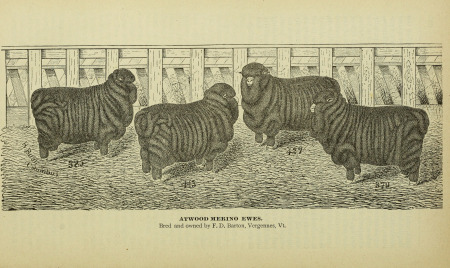
Lots of old book illustrations now online
A Yahoo research fellow at Georgetown University, Kalev Leetaru, extracted over 14 million images from 2 million Internet Archive public domain eBooks that span over 500 years of content. Because we have OCR’d the books, we have now been able to attach about 500 words before and after each image. This means you can now see, click and read about each image in the collection. Think full-text search of images!
Very cool. Interested in sheep breeds, say? Go crazy.
IPK responds on Eurisco
I think it’s only fair to reproduce in full IPK’s response to our plea for clarification on some of the search functionalities of the new Eurisco.
The observation that the current EURISCO has limited functionality is fully correct. Let me explain why we’ll have to cope with this for a little while, for the transition period.
While transferring EURISCO to its new host at IPK, due to technical issues, large parts of the EURISCO infrastructure needed to be revised; this regards both to the EURISCO application (search interface and database structure behind) and to the backend (module for uploading national data sets by the National Focal Points). Thus, it was necessary to find a balance between developments which are visible (search interface) and those which completely take place in the background. For this reason, the search interface currently available is limited in functionality, but this will be improved soon.
Actually we hope to make EURISCO into a sandbox, a playground, where it concerns PGR documentation and interfaces with it. We hope to start experimenting with new and flexible ways of including C&E data and linking to genomic data next year. But first, obviously, we’ll bring the interface for the passport data to an appropriate level. All feedback regarding necessary modifications but also wild ideas regarding possible extensions are most welcome.
We encourage all our readers to take advantage of this request for input. Play around with Eurisco, subscribe to the newsletter, and let your views be known.