- The characterization of goat genetic diversity: Towards a genomic approach. A single Neolithic origin.
- Genome-wide patterns of adaptation to climate-mediated selective pressures in sheep. Adaptation to local climates has been important.
- Characterisation of camel breeding practices in the Ansongo Region, Mali. Diversity of practices, diversity of breeds.
- Gynomimicry in the Dwarf Gwembe breed from Zambia. The males mimic the secondary sexual characters of females, presumably because they’ve been selected to do so.
- Evaluation of a diverse, worldwide collection of wild, cultivated and landrace peppers (Capsicum annuum) for resistance to Phytophthora fruit rot, genetic diversity and population structure. No completely resistant lines out of 177, 2 pretty good ones, the better ones confined to 2 of 4 genetic clusters.
- Evaluation of strawberry (Fragaria L.) genetic resources on resistance to Botrytis cinerea. Out of 107 accessions in the German national genebank, 5 were pretty good, 4 of them F. vesca.
- Redesigning the exploitation of wheat genetic resources. Allele mining is out, genome-wide selection is in.
- Making biodiversity-friendly cocoa pay: combining yield, certification and REDD for shade management. Even if you increase yields by 50%, that may not be enough to stop farmers converting from traditional agroforestry. Enter ecolabelling and REDD.
- Measuring nutritional diversity of national food supplies. Production diversity is a good predictor of dietary diversity, but only for low income countries; otherwise income and trade are better. Dietary diversity associated with key health outcomes.
Genetic Resources for Climate Change: room for optimism?
Dr Hannah Jaenicke, one of the organizers of last week’s 4th International Symposium on Plant Genetic Resources: Genetic Resources for Climate Change last week, kindly sent in this summary of the proceedings from Brisbane. Many thanks to her and all our moles at IHC2014 who have also contributed over the past week.
The symposium was held during the 29th International Horticultural Congress in Brisbane, Australia 18-22 August 2014. There were 18 posters and 32 oral presentations given across the three themes “Utilization of plant genetic resources”, “Germplasm conservation strategies and technologies” and “Harnessing the diversity of crop wild relatives”. Each theme was introduced by a cross-cutting keynote presentation. In addition, there were two workshops during which participants had the opportunity to discuss additional issues: a workshop on “Global conservation strategies for horticultural crops” was held on Monday 18th August with panelists from the Global Crop Diversity Trust, USDA and ACIAR and a workshop on “Strengthening informal seed systems: integrating plant genetic resources conservation within a larger development” was held on Thursday 20 August with panelists representing the private seed/nursery industry and community seed banks. This workshop was held together with the scheduled workshop on “Quality planting material” (convener: Sisir Mitra).
The quality of the posters and presentations throughout the symposium was very high and discussion with the participants was lively, despite the time and logistics constraints posed by the tight schedule of the Congress, with up to 20 parallel sessions. Despite this competition, the symposium and workshops attracted a good attendance of 30-60 participants in each session, estimated at around 200 individuals overall who participated in the symposium.
The presented activities ranged across the world, with a particular focus on the Pacific, Asia and Africa where the effects of climate change are likely to be most severe. Useful examples were provided, from successful rehabilitation activities after a typhoon, to suggestions for more climate-ready genetic resources, to technologies able to provide vital information to genebank managers and breeders to support future plant improvement. Efforts are being made to increase the genetic diversity of particularly vulnerable resources like root and tuber crops in the Pacific and to establish novel markets to increase interest in more diverse production systems. Important tools are regional and international genebanks, such as that of CePaCT, run by SPC, serving the Pacific Island countries with a particular focus on providing virus-free planting material of important vegetatively propagated root and tuber crops, and that of AVRDC, with a global mandate for vegetables, where research is underway for example on heat-tolerant tomato varieties. For commercially important genetic resources, such as Citrus, increased global networking was suggested. In addition to the important role of public and private genebanks, the increasingly recognized role of farmers as custodians of genetic resources and repositories for future genetic improvement was discussed in several papers.
Whilst the challenges that climate change will pose are huge, especially for vulnerable communities and ecosystems, the presentations during this symposium showed that already significant efforts are being taken to address the issue at the level of plant genetic resources. However, more coordinated and collective efforts are needed for more sustainable and focused impact.
Brainfood: Ethiopian wild veggies, Cold tolerant rice, Chickpea genomics, Improved tilapia, Wild cassava oil, Chinese horses, Chinese melon, Seed sampling, Tomato spp sequencing
- Wild and semi-wild leafy vegetables used by the Maale and Ari ethnic communities in southern Ethiopia. 30 of them.
- Collection and Conservation of Cold Adapted Indigenous Rice Landraces from Western Ghats, South India. 56 of them.
- Exploring Germplasm Diversity to Understand the Domestication Process in Cicer spp. Using SNP and DArT Markers. 3 populations among domesticated types; more diversity in the wilds.
- Genetically-Improved Tilapia Strains in Africa: Potential Benefits and Negative Impacts. Mean present value of introducing an improved strain to Ghana is 1% of GDP, but you could get same with better management. Both would of course be best.
- Diversity in oil content and fatty acid profile in seeds of wild cassava germplasm. Some species could be oil crops.
- The Study of Genetic Diversity and Phylogenetic Evolution in Indigenous Horses (Equus caballus) of Gansu. If I understand the abstract correctly, this suggests, among other things, that some local horse breeds can be traced back to Przewalski’s Horse, maybe.
- Microsatellite Diversity, Population Structure, and Core Collection Formation in Melon Germplasm. In China. Frankly not nearly as interesting as the horse story.
- Optimal sampling of seeds from plant populations for ex-situ conservation of genetic biodiversity, considering realistic population structure. 25–30 individuals per population from few but widely-spaced populations.
- Exploring genetic variation in the tomato (Solanum section Lycopersicon) clade by whole-genome sequencing. 20x more diversity in the wilds than the cultivated, correlated with habitat.
- Understanding Sustainable Diets: A Descriptive Analysis of the Determinants and Processes That Influence Diets and Their Impact on Health, Food Security, and Environmental Sustainability. The determinants of sustainability are agricultural, health, sociocultural, environmental and socioeconomic, and fiddling with one to improve it may screw up another.
- Anchoring durum wheat diversity in the reality of traditional agricultural systems: varieties, seed management, and farmers’ perception in two Moroccan regions. Farmers grow both improved varieties and landraces, the latter mainly for their quality characteristics.
- Unraveling the nexus between water and food security in Latin America and the Caribbean: regional and global implications. Production has increased, but at the cost of the natural capital of the region, and nutritional problems persist.
Conserving horticultural species, one at the time
Another report from one of our correspondents at the International Horticultural Congress in Brisbane, this on the symposium on Utilization of Plant Genetic Resources:
The full day symposium keynote by Dr Ehsan Dulloo of Bioversity International covered the broad topic of developing strategies for conserving plant genetic diversity. Individual presentations covered a wide range of topics and crops, including: roots/tubers (sweet potatoes, yams, cassava), aroids and breadfruit in the Pacific Islands; use of native species to restore costal landscapes impacted by cyclones in Fiji; conservation of wild temperate small fruit species such as Vaccinium in Canada (blueberries and cranberries); use of the underutilized tea tree (Melaleuca alternifolia) in Australia; conservation of mango landraces on-farm in India; characterizing the morphological and genetic diversity of baobab (Adansonia digitata) in Kenya; and the cryopreservation of clonal genetic material of apple, peach and nut trees (Juglans spp), among others. The common thread that ran though most of these presentations is that a lot of work still needs to be done to understand the genetic diversity that we have and the best way to conserve it (in situ & ex situ), such that it leads to optimal use of these important genetic resources.
There’s one more of these updates from IHC2014 in the pipeline, which we’ll probably put up tomorrow.
Baobab, frankincense and croton: private sector brings gifts
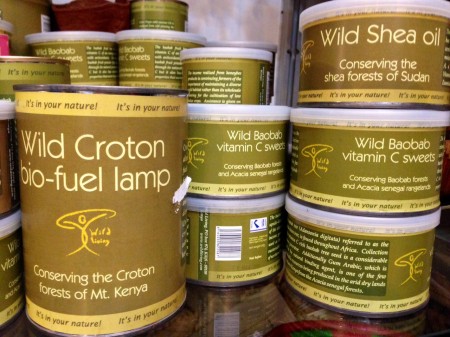
Found these in an up-market curio shop in Nairobi’s Yaya Centre shopping centre. I’ve never come across Wild Living before, but they sound like an interesting outfit, doing some serious value addition to local products by the look of it:
From Baobab and Shea to Leleshwa and Acacia frankinsense forest oils, East Africa, the cradle of mankind, hosts a remarkable diversity of unique natural resources that have provided succour and health during the majority of our evolution.
Whilst traditionally used, the natural benefits of these products, have until now, been unavailable to the global market. Furthermore, Africa’s potential to produce conservation and livelihoods products for its own development has remained unclaimed.
Wild Living realizes this potential by providing a market for over twenty community based projects located throughout East Africa who are being assisted by partner organizations such as WWF and OXFAM to sustainably and ethically produce natural products.
Wild Living publicises the conservation and livelihoods benefits of each of these producers products and through increased sales revenue assists them to continue conserving their unique natural resources whilst building their own lives in a dignified and self-sufficient manner.
Revenues realized by Wild Living through the sale of its brand are used to assist partners in the ethical and sustainable production of goods whilst providing access into an increasingly conscientious consumer market.
Anyone know anything more about them? Are they on the level? In any case, something else to add to those baobab fact sheets.