Featured: Crossing CWR

Tom Payne of CIMMYT has a question:

I was wondering if you had ever come across pre-breeding within a crop wild relative species? Not the intercrossing of CWRs with cultivated species, but (for this example) the intercrossing of T. timopheevi accessions to reveal enhanced levels of additive genetic variability, perhaps selecting materials for specific cytoplasmically controlled traits? Thus, from a very limited pool of X number of accessions, Y more accessions could be derived increasing the amounts of materials available to users.

Any takers?

‘Dead Souls’ in genebanks?

We have received this contribution from Theo van Hintum and Liesbeth de Groot of the Centre for Genetic Resources, The Netherlands (CGN). We very much welcome such submissions. Many thanks to Theo and Liesbeth.

CGN strives to promote the use of its plant genebank collections by collaborating with private breeding companies in the search for useful traits. It usually selects material, preferably from its own collection, and organises evaluation trials in consultation with, and funded by, these companies. In this context, CGN recently searched for additional material of a wild leek (Allium ampeloprasum), the most important member of the primary genepool of leek, in order to identify resistance against two fungal diseases, as well as insect tolerance. CGN only has nine accessions of this species, and for the evaluation we aimed at about twenty.

The search in EURISCO for A. ampeloprasum germplasm resulted in a list of 52 accessions from 7 genebanks, and GRIN showed an additional 12 accessions from the USDA network. Most of the accessions of the USDA network came up as unavailable in GRIN; only 2 out of the 12 were available for distribution. In Europe, availability was even worse. The five collections holding more than two accessions were approached. Apart from the nine accessions from CGN itself, the other four collections, holding 40 accessions in total, could effectively provide CGN with only one accession. One collection did not respond to the email request despite repeated attempts, the others informed us that, due to the difficulty in regeneration of this species, no seed was available for distribution, one accession excepted.

The bottom line is that, apart from its own collection, from 52 reported and requested accessions in EURISCO and GRIN, only three were available for distribution. What does this mean for the overall availability of plant genetic resources from national collections. Are we maintaining a database of ‘Dead Souls’?

An agroforestry database to rule them all

During my recent visit to Nairobi, the reason for my lack of blogging during the past couple of weeks, I briefly ran into Dr Roeland Kindt, one of the people behind the various ICRAF databases I have occasionally written about here. And guess what? He warned me there’d be another ICRAF database coming out imminently. Of course, by now the Agroforestry Species Switchboard 1.0 has been announced all over the place and my scoop has evaporated. Anyway, no matter, better late than never. I haven’t had a chance to go into the Switchboard in detail, but hope to very soon, and will blog about it when I do. It certainly sounds useful. Here’s what Roeland had to say about it in the ICRAF press release:

Before the Switchboard, you had to search for a particular species one database at a time. But now, multiple databases that list information on a particular species can be accessed in one go. Because listings of species in databases only partially overlap, it is common to find little or no information on a particular species in one database, but plenty of it in a second or third database. So it makes sense to query multiple trusted sources of data on one web interface.

It sure does. Maybe this will spell the end of factsheets?

photo (2)

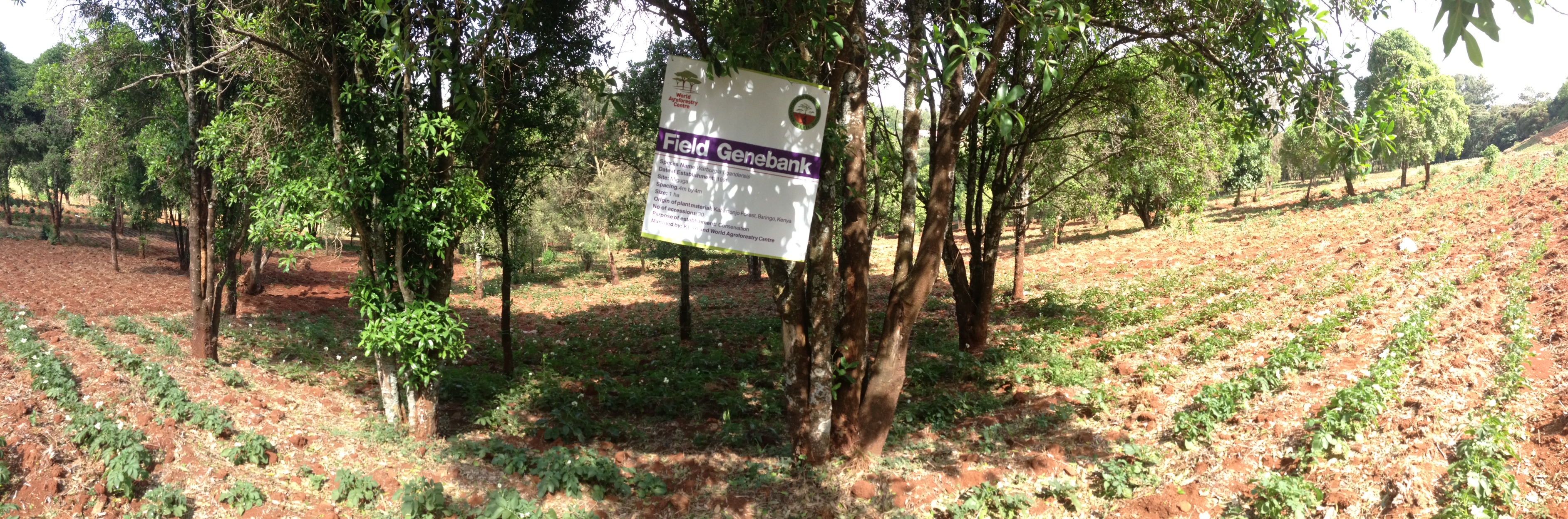
Oh, and that’s a totally gratuitous panorama shot of ICRAF’s Warburgia field genebank at Muguga, Kenya. Well, not so gratuitous maybe. Because it allows me to say that if the Switchboard had permalinks to search results, such as for things like Warburgia, I would have been able to link to them, which would have been cool(er).

Brainfood: Pollinator communities, Supply chains and deforestation, Restoration in cities and connected landscapes, Forages in China, Forages in Australia, Indian eggplant minerals, Mediterranean eggplant, Carpathian agrotourism, Nordic apples, Hungarian grape, Saline SP

Cemeteries reveal the secrets of pre-agricultural prairie soil

soil-fertility

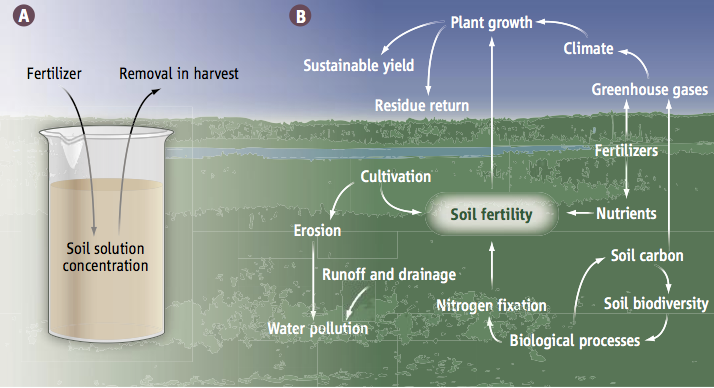
If a picture were worth a thousand words I would stop right now. But it isn’t, so I can’t. An explanation:

Exhibit A, on the left, caricatures, but only a bit, the worldview of many of those responsible for funding and carrying out research into agricultural productivity. Exhibit B, on the right, a slightly more nuanced view, lifted from an article by Mary C. Scholes and Robert J. Scholes in this week’s Science. 1 Scholes and Scholes are commenting on a paper by Noah Fierer and his colleagues in the same issue, which specifically addresses the little label in the lower right: “Soil biodiversity”.

Fierer’s paper 2 asks what the effect of agriculture might have been on the microbial diversity of soils in the tallgrass prairie of North America. There’s not that much left now, but they managed to sample 31 sites, “found primarily in cemeteries or nature preserves”. And they subjected DNA from the samples to some high-throughput DNA sequencing and analysis. The bottom line conclusion is that tallgrass prairie soils are very complex and that this complexity would be expected to affect all sorts of soil cycles, especially nitrogen and carbon.

Scholes and Scholes put those results into context, pointing out that

We have forgotten the lesson of the Dust Bowl: Even in advanced economies, human well-being depends on looking after the soil. An intact, self-restoring soil ecosystem is essential, especially in times of climate stress.

The diversity that Fierer and his team uncovered is strongly linked to functional diversity, independently measured. Prairie soils are particularly rich in Verrucomicrobia, “bacteria specialized for low-nutrient conditions, [which] are lost from the cultivated soils, making the soils less able to supply nutrients other than those provided as fertilizer”. And that’s the key to the bigger picture. Scholes and Scholes point out that:

[I]mproved technology—including the unsustainably high use of fertilizers, irrigation, and plowing—provides a false sense of security.

We need to stop thinking simplistically about the role of inorganic fertilisers and start to consider the soil in which our food grows.

An agricultural soil ecosystem that more closely approximates the close and efficient cycling in natural ecosystems, and that also benefits from the yield increases made possible by biotechnology and inorganic fertilizers, is needed to increase agricultural production to the levels that will be required while minimizing its adverse effects. Integration of the insights, innovation, and best practice from agronomy, ecology, soil biology, chemistry, physics, plant breeding, and natural resource governance is the only viable route to both feeding the world and keeping it habitable.

In other words, we have to do it, but it isn’t going to be simple. Knowing a bit more about what makes prairie soils both productive and self-sustaining may help the process of restoring degrading lands and preventing future degradation.