Massive congratulations to David Lobell for being awarded a MacArthur Foundation Fellowship.
Agricultural transformation in Ethiopia
A very interesting short film about efforts to help smallholder farmers in Ethiopia to become more productive. Maybe a bit long on talking heads in suits and short on specifics, but fascinating insights into how very simple technologies — plant in rows, reduce seeding rate — can transform harvests.
Have they, though, taken account of Land constraints and agricultural intensification in Ethiopia? One hopes so, because, as any fule kno:
Highland Ethiopia is one of the most densely populated regions of Africa and has long been associated with both Malthusian disasters and Boserupian agricultural intensification.
You may need this link to Ester Boserup.
Brainfood: Adaptation priorities, Sorghum genomics, Rice seed storage, Barley DNA, Nutrition breeding, Variety adoption, Croatian wine, Chinese eggplants, Finger millet breeding, Fruit & veg
- Global Climate Change Adaptation Priorities for Biodiversity and Food Security. Changes in crop suitability + changes in suitability for restricted-range birds = 10 priority areas.
- Whole-genome sequencing reveals untapped genetic potential in Africa’s indigenous cereal crop sorghum. Two domestication events. At least.
- Association analysis of seed longevity in rice under conventional and high-temperature germination conditions. 10 markers on 5 chromosomes explain 10% of the variation in seed longevity. Fascinating, but one wonders if the game is worth the candle.
- Analysis of DNA polymorphism in ancient barley herbarium material: Validation of the KASP SNP genotyping platform. It’s a brave new world we live in.
- DNA evidence for multiple introductions of barley into Europe following dispersed domestications in Western Asia. European Neolithic barley falls into 3 distinct groups which originated in different places in the Near East and entered Europe via different routes at different times. And they didn’t even look at herbarium material.
- Plant breeding for nutrition-sensitive agriculture: an appraisal of developments in plant breeding. Pick your target, bring in complementary expertise, and don’t rely on the commercial sector.
- Impact of Improved Seeds on Small Farmers Productivity, Income and Livelihood in Umruwaba Locality of North Kordofan, Sudan. Dismal scientists tell farmers to adopt improved peanuts based on bunch of clever maths. What could possibly go wrong?
- Classification of Croatian wine varieties using multivariate analysis of data obtained by high resolution ICP-MS analysis. 75 of them!
- Analysis of genetic diversity and structure of eggplant populations (Solanum melongena L.) in China using simple sequence repeat markers. 92 accessions, 7 geographic ares, 4 clades. As ever, “(t)he results will be useful for eggplant germplasm management and will lead to more efficient use of germplasm in eggplant breeding.” Riiiiiight.
- Heritability, variance components and genetic advance of some yield and yield related traits in Ethiopian collections of finger millet (Eleusine coracana (L.) Gaertn.) genotypes. Some simple selection could improve yields.
- Feasibility of Using a Community-Supported Agriculture Program to Improve Fruit and Vegetable Inventories and Consumption in an Underresourced Urban Community. In smallish randomized controlled trial, 5 educational sessions and a box of fresh produce for 16 weeks results in more diverse foods in the house, and maybe even more fruit and veg consumption, compared to households which got nothing. Which is good, but the comparison doesn’t seem fair, somehow.
Botanic gardens conserve crop diversity too, two.
Speaking of social media, Royal Botanic Gardens Edinburgh just published an interesting post entitled Botanic gardens conserve crop diversity too. 1 The crux of the matter is that RBGE tweeted about having collected some wild relatives of cabbages and other veg. A picture of one cabbage caught Luigi’s eye, as pictures of wild relatives often will, and he in turn discovered that the population from which it came is not represented in the UK’s leading collection at the Genetic Resources Unit in Warwick. Horrors! As he said at the time:
[T]he material mentioned in the Edinburgh tweet, which comes from Fife in Scotland, is likely to add significant diversity to the “national” collection at Warwick. Scope for some closer collaboration between these two institutes? Well, maybe it’s already there and I haven’t caught it. Do let me know if I’m being unfair.
@RBGE_Science shot back a tweet.
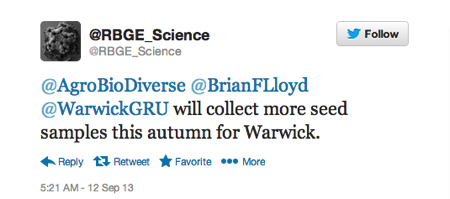
Fast forward less than a week, and RBGE now has this to say:
Seed samples from wild collections … will be passed to the Genetic Resources Unit at Warwick to enhance their CWR collection. An example of the value of this collaboration is provided by the fact that Warwick currently has no Scottish origin wild cabbage. … [T]his in turn will provide further ex-situ conservation for what is quite a rare plant in Scotland.
Was Luigi being unfair? Or should he take full credit for furthering cross-border collaboration in the important matter of cabbage wild relatives?
Genebank managers manage to have a good time
Luigi has been tweeting up a storm from the genebank managers meeting in Ames Iowa. If that’s the kind of thing that interests you, look for his hashtag, #ames13. Even if it isn’t, you might take a look for an object lesson in how to use social media.

This morning they’re off on a field trip. Will that slow him down? I doubt it.