- Evidence for recent evolution of cold tolerance in grasses suggests current distribution is not limited by (low) temperature. Geography a better predictor of cold tolerance than phylogeny.
- May we eat biodiversity? How to solve the impasse of conservation and exploitation of biodiversity and fishery resources. We may, if we all agree.
- Genetic diversity of cassava (Manihot esculenta Crantz) landraces and cultivars from southern, eastern and central Africa. There isn’t any.
- Evidence of sustainable intensification among British farms. Amazingly, there is some, and aiming to increase profitability can get you there.
- Key areas for conserving United States’ biodiversity likely threatened by future land use change. To the tune of 5-8% area loss, and not counting climate change. Would be interesting to know what that will do to crop wild relatives.
- Dilemma in participatory selection of varieties. If it’s a one-time deal, as it often is, it ain’t gonna work.
- Green Revolution research saved an estimated 18 to 27 million hectares from being brought into agricultural production. And saved 2 million ha of forest. But less than Borlaug thought. More on “Agricultural innovation to save the environment” from PNAS.
Conserving forages for 30 years
That’s what the genebank at ILRI has been doing. Under the stewardship first of Jean Hanson and then Alexandra Jorge, both of whom you can see in the photo reproduced below from ILRI’s Flickr stream. Jean is the one on the right. Happy birthday, and keep up the good work!
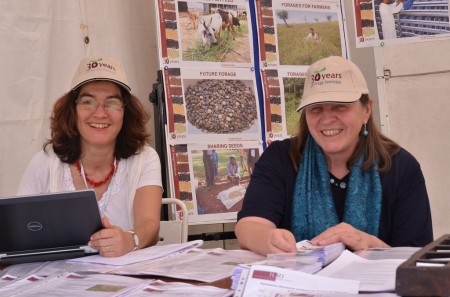
(photo credit: ILRI\Zerihun Sewunet)
Featured: Seed Law
Patrick gets it: beyond fitness for purpose, freedom of choice is all people want from seed laws.
Everything else can more effectively be dealt with through the free market. If farm-saved seed, local adaptation and the value of diversity don’t translate into farm profits and productivity, then they will cease to exist. If people want to buy DUS and VCU, and these are more productive, so be it. If one seed company produces seeds deamed in some way to be better than their competitors, then farmers can choose those seeds.
So I guess he’d agree with Dave’s point:
As to Holly point: “There’s nothing wrong with growing whatever you want.” I agree – but tell that to the people who are blocking Mexican farmers growing GM maize. The activist-imposed `regulation’ tries to stop farmers in ill-defined Centres of Crop Origins growing GM crops (brinjal in India, maize in Mexico).
You are what you eat: junk food edition
An article in last weekend’s New York Times Sunday Review has been getting a lot of traction. Breeding the Nutrition Out of Our Food by one Jo Robinson complains that nutrition has been going downhill ever since farming began. Not, she says, merely with the advent of modern varieties.
Wow! I mean, that’s quite a claim. So I took a serious look.
I guess my main beef with the piece is that it still presents a thoroughly medical view of nutrition and diet. I guess the de rigeur hat-tip to Hippocrates should have tipped me off. “Let food be thy medicine” is not in fact a prescription for specific active ingredients to combat specific ailments. And to switch, as Robinson does, between active ingredients and some vague notion of phytonutrients, confuses me at least. There’s also the vaguely disquieting idea that if a phytonutrient is good, more is better. It ain’t necessarily so. 1
Actually, there’s a lot more in the piece that made my blood boil. Most trivially, having said that our nutritional downfall is the result of preferring more sugar and less bitter, how can this be good advice:
Make a stack of blue cornmeal pancakes for Sunday breakfast and top with maple syrup.
Because blue corn contains anthocyanins, obviously.
More worrying is Ms Robinson’s deep misunderstanding of the nature of selection, at least as she describes the domestication of teosinte. To imagine that “nature had been the primary change agent in remaking corn” from the first cultivation of maize until the 19th century, when “farmers began to play a more active role” is nothing short of scandalous. Not unlike people who think Columbus discovered America.
Better yet, in hammering on about modern maize and how sweet it is, we are treated to a description of the discovery and commercialisation of supersweet corn. The first release of a commercial supersweet corn took place in 1961, of which Robinson says:
This appears to be the first genetically modified food to enter the United States food supply, an event that has received scant attention.
If you think supersweet corn is genetically modified, I’d love to know what you think of the changes that turned teosinte into maize.
I was also intrigued by a little “correction” the NYT yesterday slipped in at the bottom of the piece.
An earlier version of this article incorrectly referred to the origins of supersweet corn. The corn was the result of a natural, spontaneous mutation, not one artificially induced through radiation.
I’m sure the whole thing was equally well researched. Because …
Jo Robinson is a bestselling, investigative journalist who has spent the past 15 years scouring research journals for information on how we can restore vital nutrients to our fruits, vegetables, meat, eggs, and dairy products.
The book will probably be a runaway success.
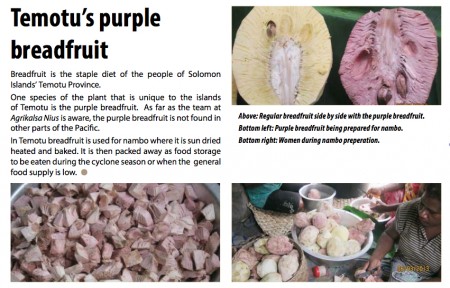
The purple breadfruit of Tamotu
I really hope the Ministry of Agriculture and Livestock of the Solomon Islands won’t mind me reproducing this snippet on a cool breadfruit variety from the province of Temotu, courtesy of the April issue of their monthly electronic newsletter, Agrikalsa Nius. 2