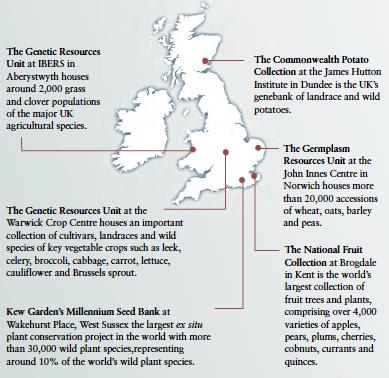
 The latest issue of Plant Breeding Matters, the organ of the British Society of Plant Breeders, focuses on genebanks around the UK. In particular, the ones at the John Innes Centre and Kew, but the accompanying map hints at further treasures. We have mentioned a couple of these other genebanks before (Brogdale, Warwick), more often than not, alas, to report on their precarious state. But maybe things are changing.
Brainfood: Viruses, Allium genomic size, Acacia adaptation, Local carp, Chinese onions, Bull genetic info, Ecosystem services, Sahelian ag
- New threats to endangered Cook’s scurvy grass (Lepidium oleraceum; Brassicaceae): introduced crop viruses and the extent of their spread. Introduced crop virus threatens endemic.
- Role of adaptive and non-adaptive mechanisms forming complex patterns of genome size variation in six cytotypes of polyploid Allium oleraceum (Amaryllidaceae) on a continental scale. It’s not the environment.
- Evolution and ecology meet molecular genetics: adaptive phenotypic plasticity in two isolated Negev desert populations of Acacia raddiana at either end of a rainfall gradient. It’s the environment.
- Using biodiversity to valorise local food products: the case of fish ponds in a cultural landscape, their biodiversity, and carp production. It could work, if only people liked to eat carp and knew what biodiversity was.
- Phenotype and genetic diversity in potato onion cultivars from three provinces of northeast China. In other news, there’s something called a potato onion. Otherwise, this is actually a deeply boring paper.
- The value of genetic information to livestock buyers: a combined revealed, stated preference approach. Low to none, for now.
- Ecosystem Services. Latest issue includes a bunch of interesting reviews, and an editorial summarizing each in like a paragraph. Great service, great value. See what I did there?
- Scientific documentation of crop land changes in the Sahel: A half empty box of knowledge to support policy? There is no data, not really.
Genebank standards no longer draft
The 14th Session of the FAO Commission on Genetic Resources for Food and Agriculture, taking place in Rome all week, has just adopted a new version of the Genebank Standards, two years in the making. Which we hope will be of more than merely theoretical interest to the Greek delegation.
New beer from old hops
Dept. of shameless self-promotion: A little while ago, Luigi nibbled a heart-warming tale of beer and genebanks; to whit, a hop variety that British brewers rejected as too tasty in 1960, and that found new favour as in-your-face American craft brews changed some beer drinkers’ ideas of what their tipple should taste like. And the reason hop OZ97a was still around for brewers to re-evaluate was that it had been maintained in a field genebank for more than 60 years. Meat and drink for the latest Eat This Podcast, where I interviewed Mark Dredge, the beer writer who broke the story.
Who knows what other flavours lurk uncharacterised among the diverse hops?
FAO Commission meets again
The Commission on Genetic Resources for Food and Agriculture is meeting in Rome this week for the 14th time, on its 30th anniversary. Nutrition is on the agenda, bigtime. But also little things like genebank standards and the process for developing the first State of the World’s Biodiversity for Food and Agriculture. You can sort of follow the goings on at IISD, and on Twitter.