- Using biodiversity to link agricultural productivity with environmental quality: Results from three field experiments in Iowa. Diversify any way you can. Even in Iowa.
- Improving conservation planning for semi-natural grasslands: Integrating connectivity into agri-environment schemes. Connect any way you can. Even in Europe.
- Early millet use in northern China. Very early. Starch grains push broomcorn millet use in China back 1,000 years, and foxtail millet 2,000.
- Paleolithic human exploitation of plant foods during the last glacial maximum in North China. And ten thousand years before millets, there were wild grasses, roots, tubers and gourds.
- Draft genome of the wheat A-genome progenitor Triticum urartu. Can be used to find agronomically important genes. But settle down, it’s only one of the 3 wheat genomes, after all.
- Aegilops tauschii draft genome sequence reveals a gene repertoire for wheat adaptation. Not so fast, here comes the D genome too…
- Side-effects of plant domestication: ecosystem impacts of changes in litter quality. Domestication led to higher quality, more easily decomposed litter.
- Crop wild relatives from the Arabian Peninsula. 400 of them.
- Compositional Characterization of Native Peruvian Chili Peppers (Capsicum spp.). There’s much variation, but not that much.
- Feeding the world: genetically modified crops versus agricultural biodiversity. Guess which one is drinking the other’s milkshake. And a similar blast from the past.
Healthier maize available for development
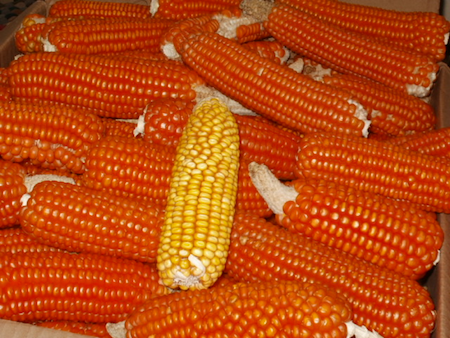
The real subject of this picture is not the yellow ear front and centre, but the orange ones in the background. They represent a high-carotene variety that could add to the arsenal of foods targeted at vitamin A deficiency. This orange maize was bred by a backyard breeder who is looking to share the variety with people who could help to take it further. The variety is “particularly suited to 30-36 degrees of latitude,” so any researchers in South Africa, Namibia, Botswana, Mozambique, India, Pakistan, Afghanistan and elsewhere who might be interested in continued development, leave a comment here. The breeder is being supported by Seed Matters, and they’ll be keeping an eye on this post to follow up directly.
The politics of the language of food
The always stimulating Thinking Allowed on BBC4 devoted last week’s episode to food. There were two interviews. The first was with linguist Guy Cook on his project looking at the specific words and language strategies that the food industry uses to describe its wares. There’s a paper about it too. A number of interesting observations in there, but here’s the one that stuck with me: Prof. Cook’s databases suggest that the word “frankenfoods” is now used much more often by GM enthusiasts to ridicule their opponents than by the green lobby to describe the alleged dangers of playing God.
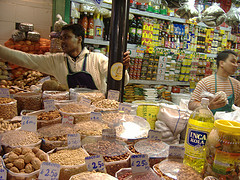
Nowt so queer as folk, and nowt like language to prove it.
A history of human eating habits
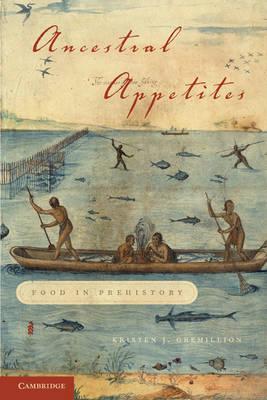
Cambridge University Press, pp 182, 2011
The sheer range of things that people consider edible is bewildering. So too the disagreements among people. Your mopane worms turn my stomach. My horsemeat lasagne is an affront to far more than your desire for truth in labelling. So are there any valid generalisations about human diets and appetites and how they came to be? Kristen J. Gremillion, a professor of anthropology at Ohio State University, thinks so. Biological evolution equipped us with the physical and biochemical machinery for processing some kinds of foods and not others. Social and cultural evolution then added layers of adaptability and flexibility. Of course there are differences in the apparatus, most famously perhaps the ability of adults to digest the lactose in milk, but the cultural differences are far more important and make us what we are: consumate omnivores.
Ancestral Appetites is by no means a comprehensive or exhaustive survey, but it is all the more readable and enjoyable for that. This is fine popular science, with none of the excesses that accompany other similar efforts to explore human diet. To begin with Gremillion takes a straightforward chronological approach, but rather than starting a little before the birth of agriculture she takes us right back to the golden age of hominins, as we must learn to call our ancestors who aren’t also ancestors of chimpanzees or gorillas. And she explains how researchers today know what our ancestors ate with much more accuracy than before thanks to vastly improved analytical tools. Things like the ratio of strontium to calcium in the bones, which reveals the balance between plants and meat in the diet, or the prevalence of 13C, an indicator of dryer, hotter conditions, or a much finer understanding of the patterns of tooth wear and tear caused by different foods.
Social evolution and the culture it enables act as a store for the trial and error discoveries societies make. Each generation does not have to repeat the mistakes of its parents, but because this behaviour is learned, it isn’t a trap either. We don’t need to learn afresh, but nor are we constrained to do only what our parents did. We can discover new things to eat, new ways to prepare them, new ways to nourish ourselves; this combination of tradition and innovation is one of the primary factors that enabled humans to spread out around the world. At some stage, of course, it also enabled some bright sparks to start on the road from cultivation to domestication and hunting to husbandry.
At this point Gremillion cleverly switches tack, abandoning chronology in order to examine hunger and abundance, flip sides of the same coin. I warmed to the idea of the social stomach. When we have enough, we feed others, especially if the food is difficult to store or defend. When we lack, we expect others to feed us. Sharing like this shades into the use of food as expressions of power and privilege, another behaviour that is surprisingly ancient. All in all, Ancestral Appetites powerfully conveys the continuity of human foodways. Each band of African hominins presumably shared the same basic diet. As their descendants fanned out across the world, tradition and innovation allowed them to adapt to almost all circumstances.
Does knowing what we used to eat shed any light on what we ought to eat? Gremillion agrees that the Paleolithic diet offers health benefits, but it is not the only set of choices to do so, and she sees growing “nostalgia for the Pleistocene” as further evidence that our history has provided us with the creativity and intelligence to optimize nutrition in many, many ways. Some of those choices, however, just don’t make sense, and Gremillion touches on Richard Wrangham’s idea that cooking made us human at least partly to debunk raw food enthusiasts:
“[B]esides ruling out many of the foods that taste buds delight in, a raw food diet eliminates the rewards of cooking as well as the drawbacks. Cooking caught on for a reason; not only is it easier on the teeth and jaws than the tearing and crushing of hard, fibrous and elastic materials, but it has the benefit of breaking down the compounds in food in ways that facilitate the extraction of nutrients.”
That’s Wrangham’s primary point; cooking increases efficiency of eating, and we have to be very well supplied willingly to give that up. Increasingly, though, we are very well supplied. Indeed, the evolutionary argument — that until yesterday it was all but impossible to eat too much fat, sugar or salt — probably explains why our ability to control our appetites for those things is so ill developed. That doesn’t mean we shouldn’t try, and Gremillion welcomes the fact that some of us do limit our intake as support for her basic thesis.
“Paradoxically, our flexibility as a species allows us the freedom to constrain ourselves as individuals in ways our ancestors would probably find incomprehensible.”
If the past is any guide, our ancestral appetites, filtered through biological and social evolution, will keep some of us well fed well into the future; so bring on the mopane worms.
Ancestral Appetites: food in prehistory, by Kristen J. Gremillion, was published by Cambridge University Press in 2011 (although I found out about it very recently).
Paperback £17.99 US$27.99 ISBN: 9780521727075
Hardback £50.00 US$88.00 ISBN: 9780521898423
Yes, we have no banana statistics
My … hope is that people will eventually stop saying ‘bananas and plantains’. For one thing, it only makes sense is if the meaning of ‘banana’ is restricted to dessert bananas and the meaning of ‘plantain’ extended to all cooking bananas.
This, as you might imagine, is music to my ears. We’ve searched in vain, and often, and fruitlessly 1 for some kind of shibboleth to distinguish banana from plantain. There isn’t one. So to have the ProMusa blog standing up to be counted, again, is definitely something to welcome. And that’s not all.
In addition to taking aim at terminological inexactitude, our colleague-in-arms Anne Vezina, the blogger in question, also has a go at numerical fudge, with an attack on the “mythical fourth place ranking” of bananas on some ill-defined metric of global importance. Digging deep into FAOSTAT, she concludes:
Depending on the indicator and the year, bananas usually end up somewhere between the 8th and 10th position after discarding animal products and non-food crop commodities (adding plantains doesn’t change the ranking). But if instead of including all the banana-producing countries, only the least developed ones are considered, adding the values for plantains and bananas moves the duo up to fourth place, behind rice, cassava (instead of wheat) and maize.
The facts have spoken. Will anybody listen?