As it turns out, climate change is not the only thing coffee has to contend with in East Africa. There’s the Coffee Berry Borer too. Integrated pest management is showing some promise, but, as a comment on a recent Plantwise post reminds us, the effect of climate change on the pest is “forecasted to worsen in the current Coffea arabica producing areas of Ethiopia, the Ugandan part of the Lake Victoria and Mt. Elgon regions, Mt. Kenya and the Kenyan side of Mt. Elgon, and most of Rwanda and Burundi.” That’s for the crop, of course, and things may not be so bad for wild trees, for micro-environmental if not genetic reasons. But you never know.
Coconut Plan B needed
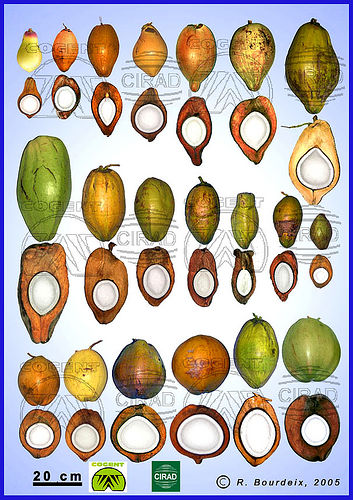 Bogia Coconut Syndrome is threatening the international coconut genebank in Papua New Guinea, one of several established in the 1990s under the International Coconut Genetic Resources Network (COGENT). That’s the warning coming out of a meeting on the Pacific coconut industry taking place in Samoa, as relayed by SciDevNet. Dr Richard Markham, now with the Australian Centre for International Agricultural Research, one of the co-sponsors of the meeting, but formerly of Bioversity, where he had responsibility for COGENT, is being admirably logical, calm and reassuring in his soundbites:
We are supporting research to try to identify the [Bogia Coconut Syndrome] vector and better understand the host range of this disease. Once we have that information, everyone will be better placed to assess the threat — both to coconuts and livelihoods in general.
But surely plans need to be put in place in case the worst happens. What to do? Roland Bourdeix, the current coordinator of COGENT, who’s responsible for the wonderful photo of coconut diversity I’m reproducing here, is talking of rescuing, relocating, duplicating. Possibly on those little isolated islets he’s so fond of. And that is no doubt an approach worth looking into. But there are 57 accessions to deal with from this genebank, and it’s going to take a while to find the necessary number of uninhabited island paradises, even if not all the 57 are unique. In vitro is an option too. COGENT has been working on an in vitro embryo collecting and transfer protocol, but it’s not quite there yet. Time to ramp that work up?
LATER: More reassuring words from Richard Markham on Facebook. No need to panic. But also no room for complacency.
Severe, grave and philosophical
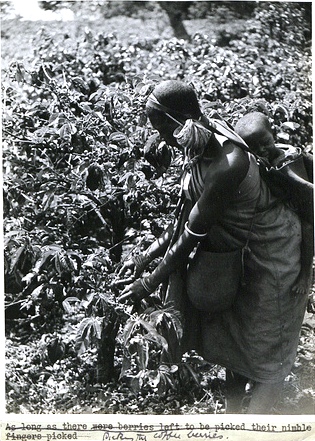 That, we are told by the BBC’s Material World presenter Quentin Cooper, is what Jonathan Swift thought coffee makes us. And I for one would agree with Mr Cooper that it is indeed also how Dr Aaron Davis, Head of Coffee Research at Kew Gardens, and global crop wild relative expert Dr Nigel Maxted, from the University of Birmingham, came over in an interview with him yesterday. It’s all because of that Kew study on the effects of climate change on wild arabica, which is really making the rounds, not least thanks to the BBC. You can download the whole podcast, but we’ve taken the liberty of filleting out the 10 minutes of the programme which feature Drs Davis and Maxted, with many thanks to the BBC. More background on crop wild relatives in Europe from the PGR Secure and the older PGR Forum project website. IUCN has a Red List. There’s a Global Portal. And a big global project on crop wild relatives too. Who says these things are not getting enough attention?
Read that paper on Arachis, Vigna and Solanum Nigel alluded to.
And dream about attending that FAO workshop he mentioned for next week.
UK Chancellor backs plant breeding
#OsborneSci Uses the @royalsociety's 'sustainable intensification' line. Nods to JIC and Rothamsted. I can feel @bbsrc beaming from here.
— Jack Stilgoe (@Jackstilgoe) November 9, 2012
Does that mean the UK’s genebanks are safe? More here. And here.
I wonder if he might be interested in what’s going on in Brussels at the same time. No, probably not.
Nibbling as the berries go round
Issue 56 of Berry Go Round – the botany blog carnival – is up at Seeds Aside. Plenty of goodies there, and here are the ones more directly related to our own interests:
- Phytophactor gives a one-word answer to the question “Can you eat flowering kale?” He also explains that “flowering” is a misnomer. To which I would add that as an ornamental, “flowering” kale is an abomination while as an edible, flowering kale is scrumptious.
- The great P.Z. Myers shares a photograph of a curcurbit tendril. And unleashes a storm of comment crap. Some people…
- And Joseph Craine has rounded up n most-important papers about N; where n=12 and N=nitrogen.
Now, why don’t you consider submitting to, or even hosting, the next Berry go Round?