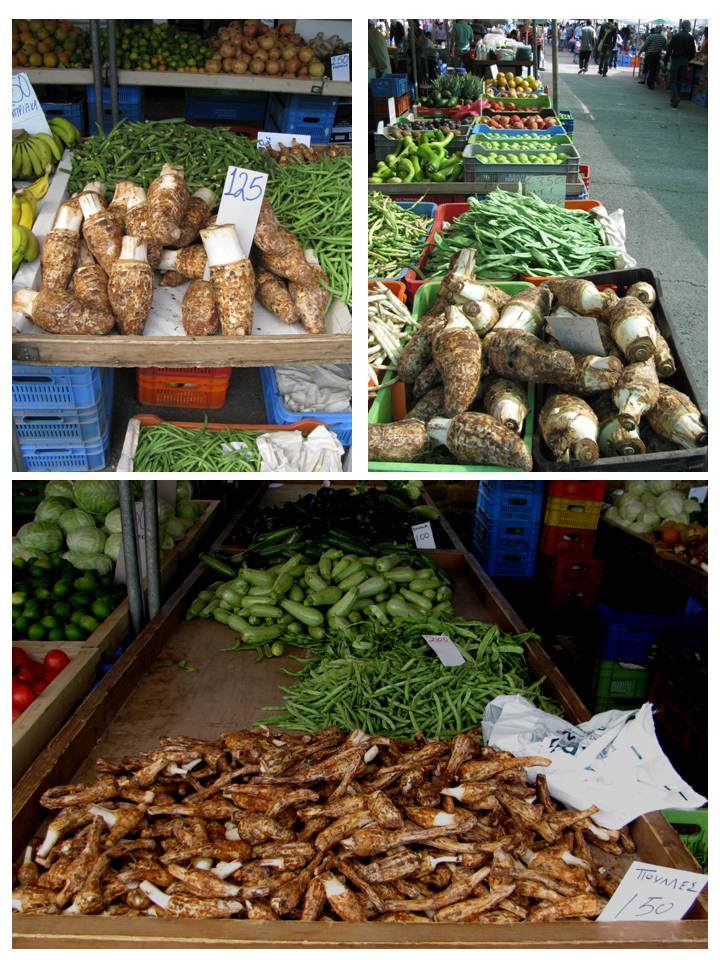
 I was reminded during a recent trip back to Cyprus (my first visit in 20 years after living there for quite a while) of the curious fact that taro is a staple of traditional Cypriot cuisine, something of an outlier in the Mediterranean. Called kolokassi, the tuber is prepared in a number of ways, and the young offshoots, or suckers, are also taken fried. You can see these in the photo, labelled “poulles.”. Peter J. Matthews has this to say in his “Genetic Diversity in Taro, and the Preservation of Culinary Knowledge“:
In Cyprus only one cultivar of taro is grown, but there are at least nine distinct ways of preparing taro (skhara, vrasto, souppa skourdalia, tiganites, kappamas, yiakhni, psito, moussakas, Matthews 1998a) (Figure 4). The fermentation of taro starch, and the edibility of leaves (petioles and blades) are not known in Cyprus. All the methods recorded use heat to reduce acridity — by simmering, boiling, stewing, frying, roasting, grilling, and baking (steaming was not reported). For each named dish, the details of preparation varied from person to person and village to village. The range of dishes is not large, compared to the range in Japan (Matthews 1995), but does involve a greater range of methods for applying heat.
You can find out more in the book “The Global Diversity of Taro: Ethnobotany and Conservation,” in which Dr Matthews has also had a hand. Poulles are not mentioned, which makes me think their consumption may be a relatively recent innovation.
It’s not clear where that one Cypriot cultivar may have come from, though Matthews says that the crop “is likely to have reached Cyprus in ancient times from India or Africa, via the Levant or Egypt.” That makes sense, but will be difficult to verify, as there is precious little in the way of germplasm collections in the region between Europe and India. I would imagine Egypt in particular would be fertile territory for a bit of collecting. I wasn’t able to find any ancient Egyptians representations of the plant, but I wouldn’t be surprised if they exist.