 Two recent papers — one a report of a long-term experiment, the other a literature review — point to the benefits of diversity in agricultural systems. Adam Davis and his colleagues report that Increasing Cropping System Diversity Balances Productivity, Profitability and Environmental Health, 1 a result that has already triggered all sorts of commentary on the web. By contrast, John Tooker and Steven Frank’s paper Genotypically diverse cultivar mixtures for insect pest management and increased crop yields 2 has not yet created much of a stir. But that’s OK. We’re equal opportunity bloggers here.
Lengthen those rotations
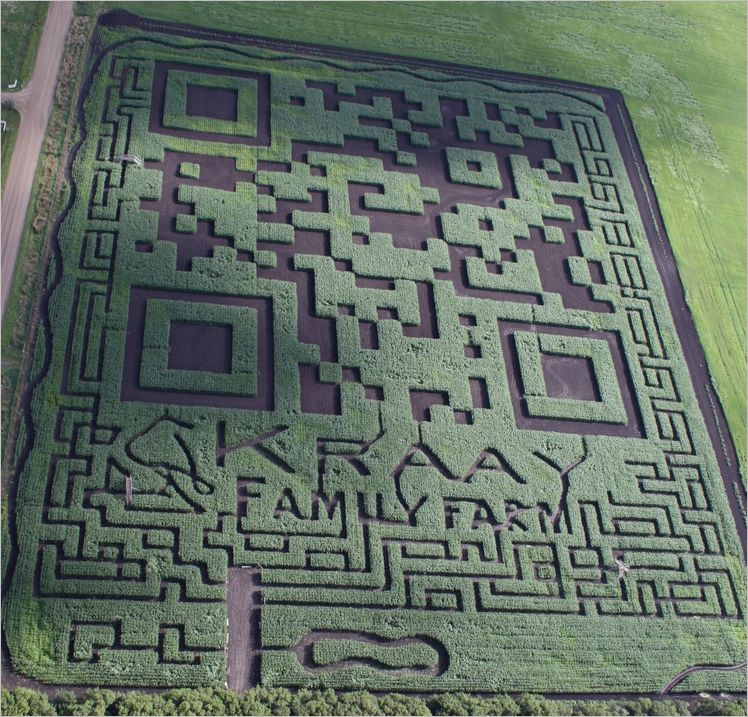
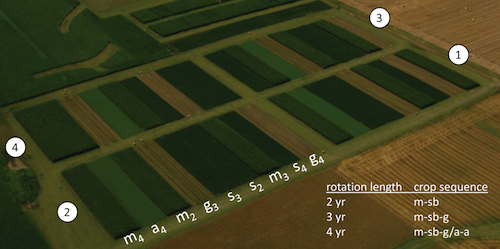
Davis et al. report on an experiment that ran from 2003-2011 at Marsden Farm, Boone, Iowa. (That’s it in the photograph at the top.) They compared three different regimes: a standard 2-year corn (maize)-soybean rotation, with ample nitrogen and herbicides to keep the weeds down; a 3-year rotation, adding a small grain (triticale and oats) with red clover in the third year; and a 4-year rotation that added an additional year of alfalfa after the small grain.The two more-diverse systems received some fertilisers and herbicides, but only as much as was needed, rather than at rates matching those of surrounding commercial farms.
The paper is open access, so you can go and read the whole thing, or just focus on the crucial results neatly depicted in this figure:
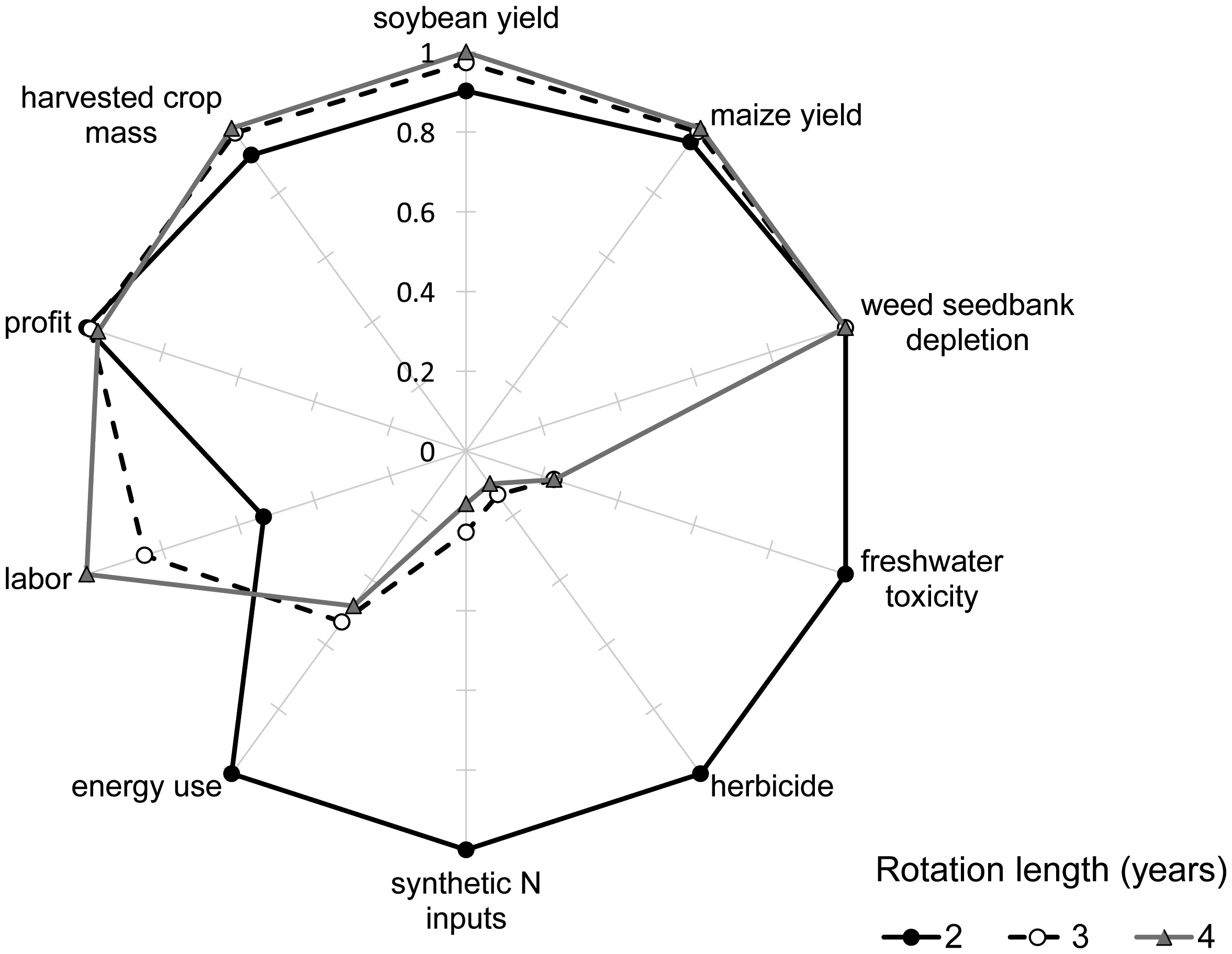
This shows 10 variables, with the levels of each treatment (rotation-length, or system diversity) normalised so that whichever has the top score is 1.0. Crucially, there are no significant differences among the treatments in profit, harvested crop mass, soybean yield, maize yield, or weed control. There are big differences in the toxicity of run-off water (200 times lower), herbicide use, nitrogen use, energy use and labour, the only variable in which the more complex systems scored higher than the less (and in an economy looking for jobs, that may be no bad thing).
One of the more interesting results, given the tendency to assume that greater diversity in a farming system inevitably stabilises yield, is that it doesn’t. In fact, “[v]ariance in mean harvested crop mass was greater in the 3-yr and 4-yr rotations than in the 2-yr rotation”. Ah but …
Conversely, cropping system diversification was associated with lower variance in profit during the established phase of the study. Variance in profit from 2006 to 2011 was lower in the 3-yr and 4-yr rotations than in the 2-yr rotation.
It would be nice to see more detail on this stability of profit, even in the face of less stable overall yields.
The other crucial point from this experiment is that the researchers didn’t turn their back on either synthetic nitrogen fertiliser or herbicides. They did, however, make much less use of them. And yet yields were maintained.
In the more diverse rotations, small amounts of synthetic agrichemical inputs thus served as powerful tools with which to tune, rather than drive, agroecosystem performance.
Reintegration of crop and livestock production, as represented by the forage legumes and manure applications present in the more diverse systems, is not simply another aspect of cropping system diversification. Instead, it embodies an important principle in sustainable agriculture: system boundaries should be drawn to minimize externalities. Animal manure is produced regardless of whether feed grains are shipped to centralized concentrated animal feeding operations, or produced within integrated crop-livestock farming operations. In the former case, the manure may become a waste product and water pollutant if quantities exceed available land area for field application [33], whereas in the latter case, it contributes directly to crop nutrient requirements, improves soil quality, and reduces fossil fuel subsidies associated with grain transport and external N fertilizer inputs [14].
Battling pests with biodiversity
Unlike Davis et al., Tooker and Frank present a review of existing evidence. Their article is behind a paywall, but to be honest unless you’re looking for a quick annotated bibliography on this important subject, I wouldn’t bother coughing up. The review is comprehensive enough (although some material is unaccountably missing), the goal being to demonstrate that despite the convergence of
[m]ultiple lines of evidence … to support the potential of intraspecific variation to contribute to improve insect pest control … very little work has sought to develop empirical support or viable implementation practices in agricultural systems. Thus, implementation of this practice is limited.
And yes, there really are multiple lines of evidence that genotypic diversity (variation among varieties) and genetic diversity (variation at the variety population level) generally diminish the impact of pests. Not as much as for diseases, mind, but enough to wonder why there hasn’t been as much in the way of implementation. The effects may be bottom up, diverse mechanisms that reduce the ability of pests to find suitable hosts, or top down, equally diverse mechanisms that act through natural enemies of the pests.
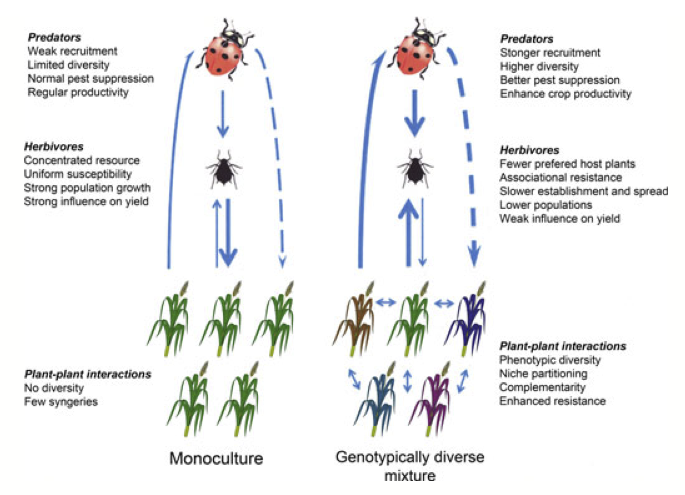
Tooker and Frank offer a helpful summary diagram, which makes it a little easier to conceptualise the different ways in which diversity can protect against pests. The results, though, can be elusive:
For example, in separate experiments, mixtures of two oat varieties or five corn varieties were found to harbour significantly fewer pests (aphids and leafhoppers, respectively) than monotypic stands, but this effect was only detected when pest populations were large.
Digging back into the literature, they uncover several studies that at the very least ought to encourage fresh research.
[W]hile much remains to be learned about the role of genotypic diversity in ecological interactions and ecosystem function, the existing evidence is particularly tantalizing for agriculture because productivity, resistance to herbivores and resiliency to abiotic stress are essential features of sustainable crop production. Moreover, genotypic diversity could be implemented with relatively minor changes to agricultural practice. If theory and empirical results continue to support the strong effects of genotypic diversity for plant productivity, a simple new approach to farming may transform planting strategies and agricultural productivity.
And there, really, is the value of both papers. Instead of taking an ideological stand on “sustainable intensification,” whatever that may be, they both show ways in which agricultural biodiversity could be deployed to help farm systems provide more, more sustainably.