Time to submit botany blogposts — your own or someone else’s — to Berry Go Round, the internet’s best (and perhaps only) botanical carnival. You have until Friday October 26th to get your plant-loving posts submitted. And if you would like to host this marvelous opportunity to share the botanical love, there’s a link for that too.
Featured: Barley domestication
Ian Dawson has a bone to pick with the authors of a study on barley domestication which we included in a recent Brainfood:
The main point is… properly geo-referenced samples give so much more insight in a paper such as this…
The original paper is in PNAS: “Tibet is one of the centers of domestication of cultivated barley.” So maybe it isn’t after all? Let the debate begin.
Brainfood: Biodiversity surveys, Potato innovation, Wild sorghum, Bumblebee decline, Naked barley, Primate deterrents, Pastoralism, Mapping, Japanese forests, Aquaculture, Birds, Lentil mixtures, Eucalypt plantations, Seed adoption, Altai nomadism, Dung beetle diversity
- Systematic, large-scale national biodiversity surveys: NeoMaps as a model for tropical regions. The Neotropical Biodiversity Mapping Initiative (NeoMaps) provides good estimates of species richness, composition and relative abundance, in about 1 month of fieldwork per major taxonomic group and about US$ 1–8 per sq km. Now to do something similar for crop diversity.
- Insights into potato innovation systems in Bolivia, Ethiopia, Peru and Uganda. Rapid appraisal of potato innovation system by CIP et al. reveals differences among countries, but significant role of CIP across countries. Roles of farmer organizations and input supply companies limited everywhere.
- Population genetic structure of in situ wild Sorghum bicolor in its Ethiopian center of origin based on SSR markers. Significant differentiation among populations, despite long-distance seed movement and introgression.
- Assessing declines of North American bumble bees (Bombus spp.) using museum specimens. Half of the species are declining.
- Is naked barley an eastern or a western crop? The combined evidence of archaeobotany and genetics. Well, it used to be western too, up to the Bronze Age. Now mainly eastern.
- Crop protection and conflict mitigation: reducing the costs of living alongside non-human primates. A diversity of strategies for coping with malevolent biodiversity.
- Conserving biodiversity in a changing world: land use change and species richness in northern Tanzania. But, would you know it, pastoral grazing threatens other mammals.
- Mapping from heterogeneous biodiversity monitoring data sources. Could be interesting when folks get around to mapping agricultural biodiversity by smart phone.
- Sustainable management of planted landscapes: lessons from Japan. They planted trees, then neglected them because imports were cheaper, and now they’re paying some kind of price.
- Aquaculture: a newly emergent food production sector—and perspectives of its impacts on biodiversity and conservation. Mixed …
- Protection strategies for farmland birds in legume–grass leys as trade-offs between nature conservation and farmers’ needs. Cut high for succesful skylark nests with minimal impact on milk.
- Optimizing lentil-based mixed cropping with different companion crops and plant densities in terms of crop yield and weed control. Mixtures might be better, especially with wheat and barley.
- Role of eucalypt and other planted forests in biodiversity conservation and the provision of biodiversity-related ecosystem services. They can provide an opportunity for forest restoration, but it will take some rethinking. The mother-in-law will be pleased.
- Influence of Sources of Seed on Varietal Adoption Behavior of Wheat Farmers in Indo-Gangetic Plains of India. You need to get the message out if you want your improved varieties adopted. Can’t imagine you’d need a multinomial logit model to figure that out.
- Pastoral nomadism in the forest-steppe of the Mongolian Altai under a changing economy and a warming climate. As transport costs go up, and goat numbers increase because of cash from cashmere, mobility decreases and overgrazing results. A traditional way of life becoming unsustainable before your eyes.
- Species-rich dung beetle communities buffer ecosystem services in perturbed agro-ecosystems. Functional redundancy is not redundant after all.
Do we need an archive of cluster diagrams?
Roderic Page has a perceptive, amusing rant over at iPhylo today on why people who come up with phylogenetic trees or cluster diagrams, say as a result of a fancy molecular study, don’t routinely archive them in TreeBASE. His answer is threefold:
1. It is not at all obvious that databasing trees is useful
2. The databases we have suck
3. There’s no obvious incentive for the people producing trees to database them
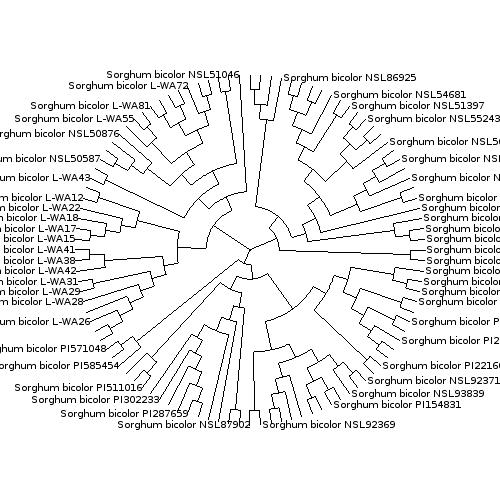 Having spent an hour or so with TreeBASE trying to get the diagram for cultivated sorghum reproduced here, I can certainly sympathize with point number 2. I can’t say much about “the underlying data model, the choice of programming language, the use of a Java applet to display trees” or “the voluminous XML output”, but “the Byzantine search interface” certainly contributes to TreeBASE being “a bag of hurt.”
And yet I’m not so sure about Dr Page’s point number 1. I have a feeling that a way of storing and comparing diagrams illustrating the genetic relationships among genebank accessions or the wild relatives of a crop (including genepool concepts) might well be welcome in the agrobiodiversity community. Which would render point 3 moot. At least if it wasn’t TreeBASE. But don’t let me speak on your behalf. If you have a strong opinion, one way or another, leave us a comment.
LATER: If not TreeBASE, then perhaps OneZoom?
Biotechnological success stories sought
Do you have examples of
…high impact and/or teachable instances where non-GMO agricultural biotechnologies are, and have been, used to serve the needs of smallholder farmers in developing countries in the crop, forestry, livestock and fisheries sectors.
If so, you might like to know that
FAO is opening a competition to identify … five case studies and the writers that will document them. The selected authors will each receive a small honorarium and will have their authorship reflected on the publication.
The publication being “Case Studies of use of Agricultural Biotechnologies in Developing Countries”, which is intended as a follow-up to FAO’s 2010 International Conference on Agricultural Biotechnologies in Developing Countries. The target audience is non-technical, and the term biotechnology covers a multitude of sins.
Read all the details. Good luck!