The variation of animals and plants under domestication was a major source of inspiration for Charles Darwin’s ideas about natural selection. Ford Denison repays the debt in Darwinian Agriculture: how understanding evolution can improve agriculture. The book had its genesis in a 2003 paper, and offers a wake-up call to some of the more starry-eyed optimists out there. “When can humans find solutions beyond the reach of natural selection?” the paper asked. The book expands on that and suggests a shortish answer: “not often”.
There are two main thrusts to Denison’s argument, and a rider that is possibly of greater value still. First, natural selection is unlikely to have left any trade-off free improvements unexplored. Secondly, ecosystems, unlike individual organisms, have not generally competed against one another, and so the mere fact that they have persisted is no guarantee that they are in any sense optimal. Finally, Denison advocates both a greater diversity of crops and a greater diversity of research to hedge bets against future uncertainty.
On the first point, it is surprising how seldom breeders and, even more so, biotechnologists, acknowledge that natural selection has had ample opportunity to try out almost anything they can think of. If it isn’t around today, that’s probably because it hasn’t conferred a long-lasting evolutionary advantage in the past. Denison offers many examples, one of the simplest being shorter stems – the fundamental underpinning of the wheat and rice varieties that gave us the green revolution. A short stem does two things. It enables the plant to divert more of its resources into grains, rather than stems, and it is structurally stronger, supporting weightier seeds without buckling. But we can reap the benefits of a short-stemmed plant only when it grows in the company of other short-stemmed plants. A short-stemmed mutant in a field of taller-stemmed plants is likely to be shaded and outcompeted, while a tall-stemmed mutant in a field of short-stemmed plants, even though it may not be able to devote as much to grains, is likely to have more resources in total, because it intercepts more light.
Similar arguments apply to many of the improvements that produced modern, extremely productive agriculture. One of the most urgent is the question of increasing the efficiency of photosynthesis. Scores of scientists and millions of dollars are chasing this tempting, and so far extremely elusive, goal. The story is quite complex. In essence there are two photosynthetic pathways, C4 and C3. They differ in their efficiency, one reason being that the C4 pathway does not “waste” energy in fixing oxygen instead of carbon. At the same time, C4 plants need less water, typically around a third less, to produce the same amount of photosynthate, one reason why C4 seems to be most common in plants that can withstand high temperatures and drought, such as maize, millet and sorghum. The C4 pathway involves a complex suite of changes in biochemistry and leaf anatomy, but despite the complexity of these changes, seems to have evolved independently around 40 times. But not in rice or wheat.
Denison does a brilliant job of explaining the differences between C3 and C4 and why, years after extravagant claims about how “relatively simple” it would be to make C4 plants, we’re still waiting. And while greater efficiency in either photosynthesis or water-use would be an undeniable long-term benefit, there are good reasons to suppose that they will be extremely difficult, if not impossible, to achieve. And the short-term benefits of biotechnology are just that, short-term, because pests and weeds continue to evolve, perhaps even faster under the intense selection pressure offered by genetically engineered crops than they might otherwise.
I found the first part of Denison’s book exciting and entertaining, most likely, some would say, the result of confirmation bias. The second part, where he turns to what he calls The Misguided Mimicry of Natural Ecosystems was, naturally, a little harder to swallow. If anything, however, it was even more instructive. The crucial point here is that unlike individual plants or animals, ecosystems do not compete against one another and so are quite unlikely to be in any sense optimal in the same way that a particular plant height might be optimal in a given environment. Merely copying, say, the spatial arrangement of plants in an ecosystem is therefore no guarantee that the resulting system will be more productive. On consideration this seems right, but it does take a bit of consideration. There are plenty of examples to demonstrate the point – indeed a problem with reviewing Darwinian Agriculture is the temptation to just repeat those examples – but take just one.
Ecosystems provide services, and those services would be really expensive if we had to pay for them, therefore ecosystems are worth preserving. This is becoming an article of faith in some agro-ecological circles. But it can be a hostage to fortune when the economic basis of the calculation shifts. Forest fragments of 147 ha provided pollination services worth an estimated $60,000 a year to a neighbouring 1065 ha coffee farm in Costa Rica. Then the price of coffee dropped, the farm switched to growing pineapples, and pineapples don’t need pollinators. “Did natural forests suddenly become much less valuable?” Denison asks.
That’s a particularly cute example, and far from making an argument against conservation, Denison is at pains to point out that one of the best arguments to conserve ecosystems is that it gives us the opportunity to study them properly, and that only with proper study, rather than well-meaning imitation, can we hope to benefit from Nature’s wisdom.
Part 2 of this review is here.
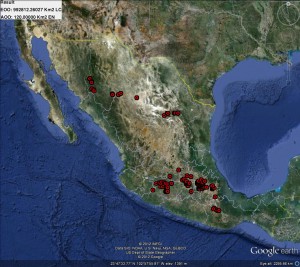 The CIMMYT genebank holds about 13,000 wheat lines (from a couple hundred populations) from Mexico that they call “sacramental wheats.” This collection was put together by the late Bent Skovmand, who established the CIMMYT genebank back in the 1970s. Sometimes collected in monasteries and cemeteries, and generally restricted to the fringes of cultivated zones, these mainly spring bread wheats are the remnants of the varieties introduced by the Spanish into the New World. You can see the collecting sites in the map above right. They were brought across the Atlantic both to provide familiar food, but also to make the sacramental bread used for Holy Communion. An excellent book relating this history is “Que vivan los tamales! Food and the making of Mexican identity” by Jeffrey M. Pilcher.
 Here’s my question. Are there some varieties that would have been used only for Holy Communion? I’ve heard it said that this was the case for grape varieties and sacramental wine, although I can find no evidence online for that, or indeed for purely sacramental bread wheat varieties. So I’m turning to the wisdom of the crowd. That means you. Are you aware of any wheat or grape varieties that are (or were) used solely (or mainly, let’s give ourselves some room for maneuver here) to produce sacramental bread or wine for the Eucharist? Or do you know someone who might know? Either way, leave us a comment, please.