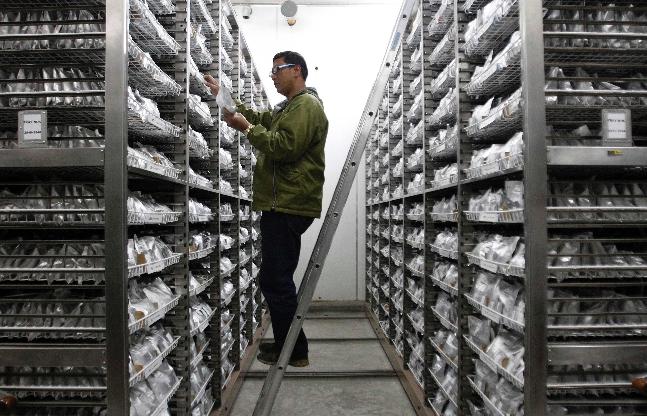
A certain Mario C. has collected 178 signatures for a petition to save the “Banca dei Semi di Bari”:
We the undersigned ask the judges responsible, the National Research Council, and the political authorities at national, regional, provincial and city levels to “Save at any cost the Seed Bank of Bari.” Including if necessary delivering these seeds to us or other third parties who love nature, so they do not die. For example, as has been done by the Public Prosecutor’s Office of Brescia when they delivered Green Hill beagle dogs to ordinary citizens (about 2500 beagles) to save them from vivisection.
The Italian genebank in question, the largest in the National Research Council’s (CNR) network, is thus described:
It’s the first seed bank in Italy and the second in Europe. It maintains 84,000 germplasm samples from more than 60 genera and over 600 species of cultivated plants. It was established by FAO to expose the high genetic erosion caused by the Green Revolution.
Skipping blithely over the somewhat distorted version of the history of the Bari genebank, the numbers quoted suggest that this is a reaction to a recent article in a local paper, which had this to say about the nature of the threat to the genebank, unhelpfully not mentioned in the petition:
Way back in 2003, the temperature of the cold rooms rose above the optimal, that is -20-0°. Failure to repair the rooms in timely fashion by the CNR has caused extensive damage to the genetic heritage so that, following a dispute between the Bank and the National Research Council (CNR), an investigation by the judiciary found CNR to be responsible. Although the samples have been released from seizure since 2009, the Region of Puglia apparently has not yet acquired them to provide for their regeneration. No one else has offered to do this and they are back in the hands of the CNR. Meanwhile an immense and invaluable genetic agrobiological patrimony is perishing abandoned.
In past years appeals by, among others, Dr Perrino to protect the biodiversity represented and perpetuated through these seeds from being destroyed have gone unheeded. To prevent the worst is simple, just regenerate this germplasm by planting it. Inexplicably, no one seems interested in doing this, starting with the political class, according to Perrino, former director of the Institute of Germplasm of CNR, Bari (1983-1993, 1998-2002).
Now, I don’t know to what extent these allegations are justified. There’s no mention of any problem in Italy in the recent big official EU document on PGRFA. Not that you’d necessarily expect to find mention of such problems in big official EU documents. There’s been nothing much on the grapevine. Not that that’s always reliable. The whole thing may just be a misunderstanding. But this has been going back and forth for years now. It would be nice to have some data from the Bari genebank to settle the question once and for all. Regular germination tests are surely carried out there. The results are surely documented. Why not publish them, and set everybody’s mind at rest? And to what extent is the issue moot anyway, the material in Bari being duplicated elsewhere?
Meanwhile, there’s a press release from the Italian ministry of agriculture contextualizing the recent EU court decision that the prohibition on commercializing seed of traditional varieties is invalid. Jeremy said there was probably more to it than that, and of course there is. Apparently, you still have to register your traditional variety in Italy. But it only takes 150 days, the ministry assures us, it’s not too difficult, and entirely free.
Ex situ or in situ, conserving crop diversity can sometimes seem a vale of tears.