Brainfood: Chestnut restoration, Zoo legislation, Millet landraces, Cassava in Congo, Agroforestry in Philippines, Baobab (again), Silvopastoral system taxonomy

Rice morphological diversity 1, Bloggers 0

Ruaraidh Sackville Hamilton of the IRRI genebank points out we are confusing clustered spikelets with multi-grained spikelets. Sorry.

Clustered spikelets are more common, and are recognized in the rice descriptors. We have 254 such varieties from 26 countries, mostly in S and SE Asia. Spikelets may be borne directly on the long primary branches of the panicle and/or on short secondary branches, in varying proportions. If none are directly on primary branches, or on the short secondary branches, they appear as clusters of three spikelets. See fig. 8 in the 2008 rice descriptors publication.

The multi-grained spikelets noted by Zakir are more unusual – multiple grains in single spikelets.

Old literature on developmental anatomy concludes that rice spikelets are primitively three-grained, of which the two lateral have become vestigial (hence “sterile lemma”). It would be interesting to know if the multi-grained spikelets are a reversion to primitive type, or a new splitting of the central grain.

Featured: Cucumber history

Alum quite rightly points out that our memory was faulty with regard to a recent paper on the lexicography of the cucumber’s spread into Europe:

I don’t think you’ve blogged on this cucumber paper. We had one recently about their appearance in French and Italian texts that cued up the next paper on routes into Europe.

To recap, that latter paper suggests that according to the lexicographic evidence the cucumber…

…was introduced to Europe [from the Indian subcontinent after 500 CE] by two independent diffusions. One diffusion appears to have been overland from Persia into eastern and northern Europe and preceded the Islamic conquests. The other, subsequent diffusion into western and southern Europe, was probably by a mostly maritime route from Persia or the Indian subcontinent into Andalusia.

The earlier paper, by the same authors, tells us about what happened subsequently, in medieval times once the cucumber had gained a foothold in Europe:

The absence of melon in some manuscripts and the expropriation of the Latin cucumis/cucumer indicate replacement of vegetable melons by cucumbers during the medieval period in Europe.

Triple-grained rice news

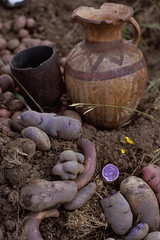
In this pre-digital, and alas out of focus, photo, a triple spikelet is visible above the thumbnail.

What it is to have friends, especially knowledgeable friends. Bhuwon Sthapit, local rice wallah extraordinaire, 1 responded quickly and in depth when asked what he knew about triple-grained rice.

In this pre-digital, and alas out of focus, photo, a triple spikelet is visible above the thumbnail.

Unique local rice landraces in Nepal are being lost, replaced by modern varieties. At least two of these are multi-seeded: Laila Majnu (the name refers to a pair of famous lovers, never separated until death) and Amaghauj (which means cluster of mango). Until 1999 Amaghauj was grown by one farmer on 3 katha of land, but was discontinued as the land was sold to another farmer. This local variety has a cluster of spikelets (at least 3 potential grains) originating from the same base; this heritable trait could potentially be used to breed new rice types offering increased yield. It is currently saved in community seed banks.

As Bhuwon also notes:

There is great potential to link community seed bank and national seed bank to harness such untapped and unknown resources.

And if you want even more, another friend, Ruaraidh Sackville Hamilton, Head of the IRRI genebank, points to Morphological Observations on Many Kerneled Grains in Rice. Don’t be scared by the Chinese; English follows.

LATER: For completeness, the name of the Bangladeshi variety which started all this, Biram Sundori, means “beautiful girl from Birampur,” which is the place where it is grown. Thanks to Zakir Sor for leading us all on this journey of discovery.

Looking for a (double) grain in a seedbank

Thanks to Mike Jackson for taking up the challenge of finding more examples of double-grained rice. He got in touch with friends at his old stomping grounds in the IRRI genebank, and the indispensable Ms Flora de Guzman there, who heads of that genebank past and present will I’m sure forgive me for saying actually runs the place, 2 came up with a variety from Nepal called Laila Majnu. This was sent to IRRI in 1981, and is conserved in the genebank as accession IRGC 59101 (and incidentally safety duplicated at Svalbard). The fact that IRGC 59101 (which is pictured below, thanks to Ms de Guzman again) is a bit of a strange morphological variant isn’t mentioned in the genebank database, however. Not the electronic version, anyway. Ms de Guzman simply remembered the variety and dove back into her notebooks to find it. Next time I think about venturing into Genebank Database Hell, I want her as my guide…