Bert Visser, director of the Centre for Genetic Resources, the Netherlands (CGN) has just sent the message below to colleagues in the European crop genebank network, and suggested that readers of this blog might also have an opinion. If you have, do leave it here as a comment.
Like so many genebanks, since a number of years CGN has been confronted with increasing costs and diminishing budgets for its core genebank tasks (collecting, regeneration, storage, evaluation, documentation, distribution). Moreover, CGN has observed a considerable increase in the number of distributed samples resulting in increased handling costs and accelerated exhaustion of our stocks with consequently higher yearly regeneration costs.
In order to manage a widening financial gap, in consultation with the Ministry of Economic Affairs, Agriculture and Innovation, CGN is considering a number of measures including a revision of seed viability testing protocols (based on recent findings regarding the storability of seeds under genebank conditions) and a much tighter planning of regeneration and acquisition activities. Furthermore, the private sector will be approached to discuss options for the sector’s continued involvement in regeneration of CGN germplasm.
In addition, we are considering a measure for which we seek your comments and advice. This measure regards the introduction of a handling fee for the distribution of CGN germplasm. The Treaty, in its Article 12, allows for a handling fee, whereas the distribution conditions under AEGIS do not exclude the possibility of such a fee. Globally, only few genebanks have introduced handling fees, notably NIAS (Japan) and AVRDC (global; vegetables). CGN handling fees would not apply to partners that carry out regeneration tasks for CGN, neither to NGOs.
CGN is considering handling fees that could amount up to € 50 per accession. Whereas we consider this a modest amount per accession, the request for large numbers of samples may be strongly discouraged. Therefore, discount fees for larger numbers of requested samples, or for pre-packed sets (core or elite collections) will be considered. In any case, a handling fee might encourage potential users to consider in more detail which accessions are really needed in planned research or breeding programmes, and may prevent poorly motivated requests or intended duplications of CGN germplasm in other collections.
We realise that any unilateral action of CGN may have an impact on you: users may shift from CGN to you assuming your distribution is still free, and you might be asked by your own government to introduce fees as well. There may be other consequences that we have not taken into account yet.
In any case, we do not wish to introduce a unilateral handling fee overnight and have not yet taken any definite decision, and this is why we are consulting you as our European colleagues to have your opinions and feed-back. In particular, we would be interested to hear of any other discussions on the introduction of a handling fee.
Following up on our recent post drawing attention to the overall decline in micronutrients in fruit and veg, here’s a 2008 paper dealing specifically with wheat. Ming-Sheng Fang and colleagues looked at levels of minerals in grain harvested from one of the longest-running agricultural experiments in the world, the Broadbalk Wheat Experiment. Not just grain, but soil too. And not just historical records — since 1843! — but a direct experiment growing an old variety alongside a modern one.
The paper 1 is honestly a model of clarity; anyone can read and understand it. And the conclusion is pretty straightforward too.
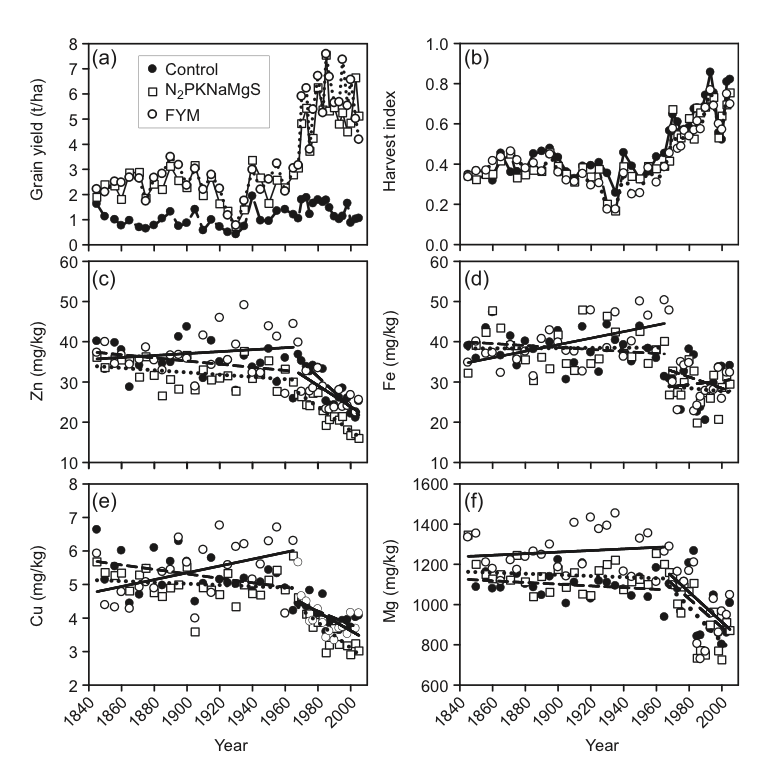
The concentrations of zinc, iron, copper and magnesium remained stable between 1845 and the mid 1960s, but since then have decreased significantly, which coincided with the introduction of semi-dwarf, high-yielding cultivars. In comparison, the concentrations in soil have either increased or remained stable. Similarly decreasing trends were observed in different treatments receiving no fertilizers, inorganic fertilizers or organic manure. Multiple regression analysis showed that both increasing yield and harvest index 2 were highly significant factors that explained the downward trend in grain mineral concentration.
Here’s a picture.
Click to embiggen
And here’s a final, circumspect, conclusion.
Results from the present study suggest that the Green Revolution has unintentionally contributed to decreased mineral density in wheat grain, at least in the Broadbalk Experiment. The study of Garvin et al. [9] suggests that this may also be the case for US wheat.
There are a few other papers showing very similar effects, not all of them straightforward. The general conclusion — that environmental and genetic dilution effects have reduced the concentration of many micronutrients in modern varieties — surely stands.
Genome-wide selection in cassava. High correlations between SNPs and several phenotypic traits of interest to breeders mean that selection time could be cut by half. Could.
I just added one yesterday: “Meta-analysis at the intersection of evolutionary ecology and conservation.” You’ve spotted the trend, right? I was planning to write about the whole bunch of them together, a mega-post on the latest thinking on the relationship between biodiversity on the one hand and ecosystem health on the other. They’ve been there for months. I just haven’t been able to get round to them, what with one thing and another. Like work, mainly. And maybe a bit of laziness.
But there’s an upside to prevarication. You wait long enough to do something, if the thing is really important, you’ll find someone does it for you. And so it has proved on this occasion, because “Biodiversity loss and its impact on humanity” has just come out in Nature, and it provides a comprehensive review of the sort of papers that have been sitting in that corner of my desk, lots of them, going back years.
Which means all I need to do here is further summarize the already admirably succinct synthesis that the authors provide. 3 And that I think I can do in a few bullet-points:
Loss of biodiversity (really loss of diversity in functional traits) decreases the efficiency and stability of ecosystems.
The impacts of biodiversity loss on ecosystem functioning are big, accelerating and predictable.
Biodiversity is predictably positively correlated with the provisioning of some ecosystem services, but the data in the case of other services is either mixed, insufficient or runs counter to expectation.
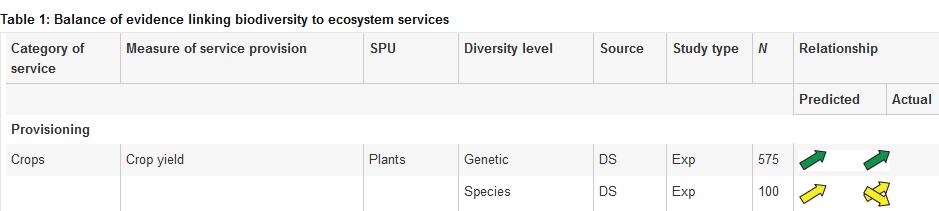
And yes, the dataset included crops, and here’s the snippet of the summary table that deals with agrobiodiversity and ecosystem services: 4
No doubt about the importance of genetic diversity to yield, though surprisingly mixed results for species diversity. But look at the numbers of data points involved (N): 575 data syntheses (DS) for genetic diversity and 100 for species diversity. Makes that pile of papers I’ve been avoiding look rather puny. And me not just a bit lazy.
The internet has been a bit a-flutter recently on the subject of declining nutrients, particularly in fruit and veg. We nibbled as much a week or so ago, and I asked whether the data had been published. 5 Indeed it had, as Amanda Rose graciously pointed out. As for reasons, Amanda said:
An editor of Organic Gardening magazine suggested that use of chemical fertilizers and subsequent decline in soil minerals was the cause. A peer reviewed study of the data provides another explanation: commercial cultivation of seed has traded nutrient density for yield, pest resistance, and transportability, factors critical to the commercial success of any crop.
Off, then, to the peer reviewed study. The best I can say is: it’s complex. Don Davis, of the University of Texas, and his colleagues used existing USDA data on the nutrient content of 43 garden crops, mostly vegetables, to compare quantities from the 1950 edition of the USDA’s “Composition of Foods” with those in the 1999 edition. Many pitfalls await the unwary in such an exercise, not least of which is the lack of basic information about some of the sample sizes and distribution of the results. Davis and his colleagues seem to have thought of them all, and worked round them as far as possible in various ways. 6 In essence, Davis et. al compare median values in 1950 with medians in 1999; less than 1 represents a decrease, more than 1 an increase. And the bottom line:
As a group, the 43 foods show apparent, statistically reliable declines (R < 1) for 6 nutrients (protein, Ca, P, Fe, riboflavin and ascorbic acid), but no statistically reliable changes for 7 other nutrients. Declines in the medians range from 6% for protein to 38% for riboflavin. When evaluated for individual foods and nutrients, R-values are usually not distinguishable from 1 with current data. Depending on whether we use low or high estimates of the 1950 SEs, respectively 33% or 20% of the apparent R-values differ reliably from 1. Significantly, about 28% of these R-values exceed 1.
That needs unpacking. First, there’s the question of “apparent” declines. Davis points out that while his statistical approaches eliminate random uncertainties, it is always possible to postulate a systematic error affecting any particular nutrient in either direction. Iron, for example, is tens of thousands of times more abundant in soil than in crops; merely changing the way samples are washed, to remove more soil in the 1999 samples, would result in a large decrease in iron.
That is why I call these R values “apparent”.
But there’s a kicker:
However, it would seem scarcely credible to attribute all the statistically significant median R < 1 to multiple systematic errors, each one operating in only one direction.
So the overall decline, considering all the crops and all the nutrients, is real enough, even though for each crop and each nutrient most of the differences (between 67% and 80%) are not statistically significant.
What, no vitamin A?
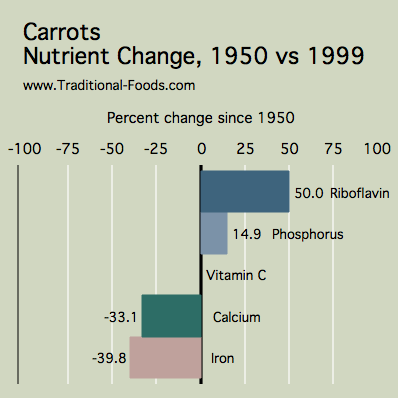
Some nutrients did increase, most notably vitamin A and riboflavin. Which makes it plenty delicious that in all the fluttering about declining nutrients, Scientific American (no less) chose to major on carrots, 7 and to blame it all on “soil depletion”.
You mean it isn’t soil depletion?
Davis comes down firmly against the “organic” idea that “chemical fertilizers and subsequent decline in soil minerals” is the problem. The fact that some nutrients definitely increased, coupled with the observation that protein (mostly nitrogen, N), phosphorus (P) and ash (mostly potassium, K) each declined from 1950 to 1999 – despite the fact that “chemical fertilizers” are largely N, P and K – puts paid to that idea.
Instead, Davis et al. focus on two different “dilution” effects. Environmental dilution is an idea that has been around a while. In essence, plants in well-fertilized, well-watered soil grow larger but take up the same total nutrients. So the nutrients are spread through a larger crop, giving a lower concentration per gram of dry matter.
Davis also identified another effect that he called genetic dilution. The bulk of the dry weight yield of most fruits, vegetables and grains is carbohydrate. When breeders select for high yield, they are effectively selecting for high carbohydrates …
… with no assurance that dozens of other nutrients and thousands of phytochemicals will all increase in proportion to yield. Thus, genetic dilution effects seem unsurprising.
The best evidence for genetic dilution comes from contemporary studies in which a time-series of varieties is grown side by side, eliminating all the problems of historical data, agronomic practices, etc etc. Davis cites a few such studies, and more are being published. In general, they do show declines in nutrient density, which can be ascribed to breeder selection.
So what about the question Luigi posed a while back? Is modern plant breeding bad for your health? Possibly, a little, but not in the way most people think. The big problem isn’t that nutrients in fruit and vegetables have decreased; despite the decline, they remain among the most nutrient dense foods you can eat. So eat them. Choosing one growing regime rather than another isn’t going to make any difference. The big problem is that we’re still eating too little fruit and veg and too much refined staples. Last word to Don Davis:
Our findings give one more reason to eat more vegetables and fruits, because for nearly all nutrients they remain our most nutrient-dense foods. Our findings also give one more reason to eat fewer refined foods (added sugars, added fats and oils, and white flour and rice), because their refining causes much deeper and broader nutrient losses than the declines we find for garden crops.
Technology should allow us to increase selected nutrient concentrations. 8 But will we learn 20 or 40 years later that there were new, unintended side effects? Another question looms large: Is it wise, in the era of technology, to keep crop size (or even the concentrations of a few, selected nutrients) as our primary measure of farming success?