Church forests in Ethiopia

For ages now scientists and others have spoken about working with sacred spaces, such as temple groves, to conserve the biodiversity they harbour. At a PLoS blog (which bills itself as “Diverse perspectives on science and medicine”) is a fascinating account of a very special set of sacred forests and recent attempts to improve their conservation.

Followers of the Ethiopian Orthodox Tewahido Churches believe they should maintain a home for all of God’s creatures around their places of worship. The result? Forests ringing churches.

There are some 35,000 church forests in Ethiopia, ranging in size from a few acres to 300 hectares. Some churches and their forests may date back to the fourth century, and all are remnants of Ethiopia’s historic Afromontane forests. To their followers, they are a sacred symbol of the garden of Eden — to be loved and cared for, but not worshipped.

Read the full article and you might agree that “not worshipped” is putting it mildly. The dominant ground insects are dung beetles adapted to work with human material. Latrines will probably do the forests a power of good. As will fences to keep livestock out. But the crucial need will be to work with the local farmers, to ensure that they can grow more on less land, allowing the forests breathing space and maybe even a bit of expansion. To what extent, I wonder, do crops in the surrounding fields depend on ecosystem services such as pollination and pest and disease control provided by the inhabitants of the forests?

Featured: Transhumance

Irish researcher Theresa McDonald has a request:

I am currently researching transhumance in the West of Ireland and would appreciate any information, photographs of this practice in the Mediterranean region of Europe. I am familiar with the Vlach shepherds of Greece and hope to visit the Pindus Mountains sometime in the future.

Can you help her?

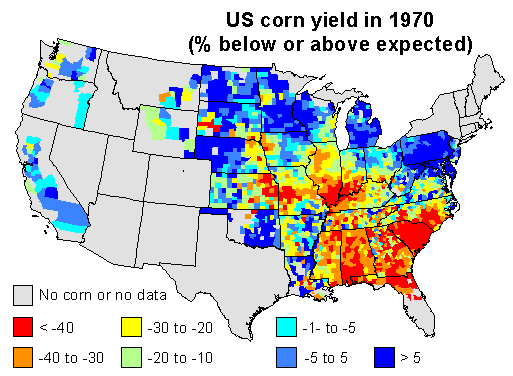
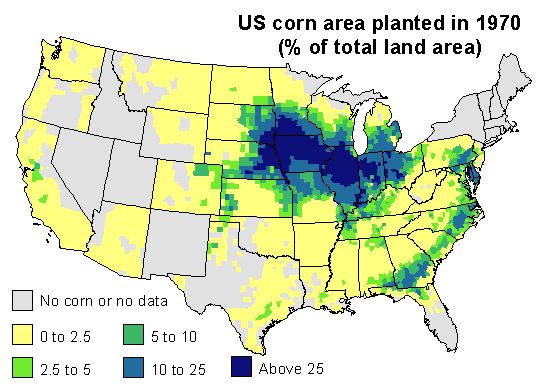
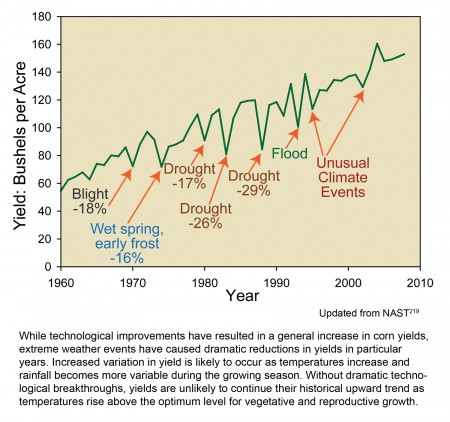
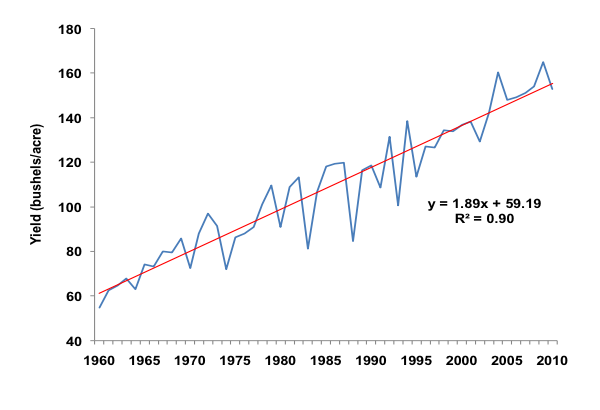
Predictions for 2012: maize will be affected by climate

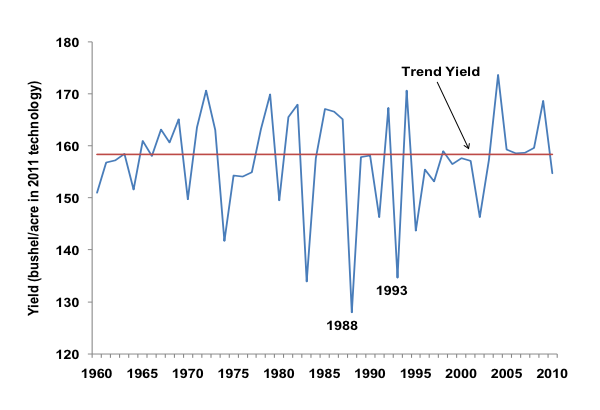
I predict that we (using the term in its widest possible sense) will understand the links between growing conditions and yield much more deeply. In particular, how changes in a plant’s environment will affect its output.

This is based on Heat, Humidity and Crop Yields, a post by Michael J Roberts, who has an economist’s ability to build complex models that explain some things rather well. The latest looks at how much better predictions of yield are when vapour pressure deficit is added to the model. As Roberts explains:

Vapor pressure deficit, a close cousin to relative humidity, has a linear relationship with evaporation, and is a key input in many crop models.

The point is that VPD is not that easy to measure, but that if you manage to do so, it is very handy.

There are two interesting things about the VPD measure we construct. First, average VPD for July and August is closely associated with our best-fitting extreme heat measure, at least in Illinois. Second, adding VPD for the season and VPD for July and August to our standard regression greatly improves prediction. Using just five variables, these two plus growing degree days (degree days between 10C and 29C), extreme heat degree days (degree days above 29C) and precipitation, we can explain over 70 percent of the variance of Illinois yields, excluding the upward trend. That’s better than USDA’s August and September forecasts, which are based on field-level samples and farmer interviews. The model can explain almost half the difference between the August forecast and the final yield for Illinois.

OK, so it is only in Illinois. And only for maize. But it might yet end up improving crop prediction models more generally.

This would appear to be post No. 5000. That it deals not with agrobiodiversity but with the effects of climate change on a single species, and probably very few varieties of that species, seems rather fitting.

A belated merry berry go round

While we were away, the resourceful Nicole at The Roaming Naturalist was busy compiling a bunch of botanical blog posts into the latest Berry go Round carnival. And a fascinating bunch it is too, not least, from our particular point of view, for the extensive explanation of tomato pollination.

Thanks equally to those who hosted BGR in 2011 and to those who submitted posts, their own or someone else’s. First up hosting in 2012 will be Moss Plants and More.

Volunteers for subsequent months most welcome, and as Nicole will tell you, it is actually both fun and rewarding.

Parmigiano Reggiano on the wheel

I’m not sure how widely known it is that the two recent earthquakes in northern Italy, apart from the tragic loss of life, destruction of homes and damage to historical buildings, are also likely to have a significant effect on livelihoods, and not least because of the impact on the production of the iconic cheese of the region, Parmigiano Reggiano. From the Facebook fan page of the consortium of producers, I see that 24 firms are affected, for a total of 300,000 40kg wheels damaged, or 10% of production. The advice of the Consorzio del Parmigiano Reggiano for those who would like to help is to keep buying the stuff. No need to ask me twice.