Sad to hear that Dr Ed Percival, a world expert on cotton and its genetic resources, passed away last month. He collected wild and cultivated germplasm widely, and he was formerly curator of the USDA cotton germplasm collection at College Station, Texas, one of the more important in the world. 1
Kermit sings the malnutrition blues
When you start really looking out for something, you quickly get to wondering how you could possibly have missed it all before. Case in point: maps of the USA which hint at “a complex association where interactions between a variety of factors could produce reinforcing effects.” That’s in the words of an Annals of Botany Google+ pointer to a recent post of ours here which included maps of obesity and food insecurity and mused vaguely about the coolness of mashups.
After that, of course I started seeing such maps everywhere. Of renewable resources, including biomass. Of landuse. Of poverty. Of, errr, the names of soft drinks.
Some regions jump up at you during the even briefest of looks at the maps of poverty, obesity and food insecurity. Like the Mississippi Valley, for instance. So it is at least somewhat reassuring that other people have noticed that too, and are doing something about it. Even doing multiple things about it, in fact. USDA probably didn’t need fancy maps to identify this particular nexus of deprivation, but maybe there are others that are not so obvious, and which an in-depth perusal of these maps will bring to light. Along with, hopefully, some possible solutions. Even if they are only farmers markets.
But to end on a lighter note, this region is not just known for poverty and malnutrition. The blues came from there, of course, but also, ahem, Kermit the Frog. In fact, there’s a connection between our green friend and agriculture. I am reliably informed that Jim Henson’s father was superintendent of the USDA-ARS research station in Stoneville, MS and worked closely with researchers there. Perhaps Kermit should be asked to spread the nutrition and exercise message around his old hopping grounds? I can’t think of a more suitable role model.
Consolidation in the seed industry
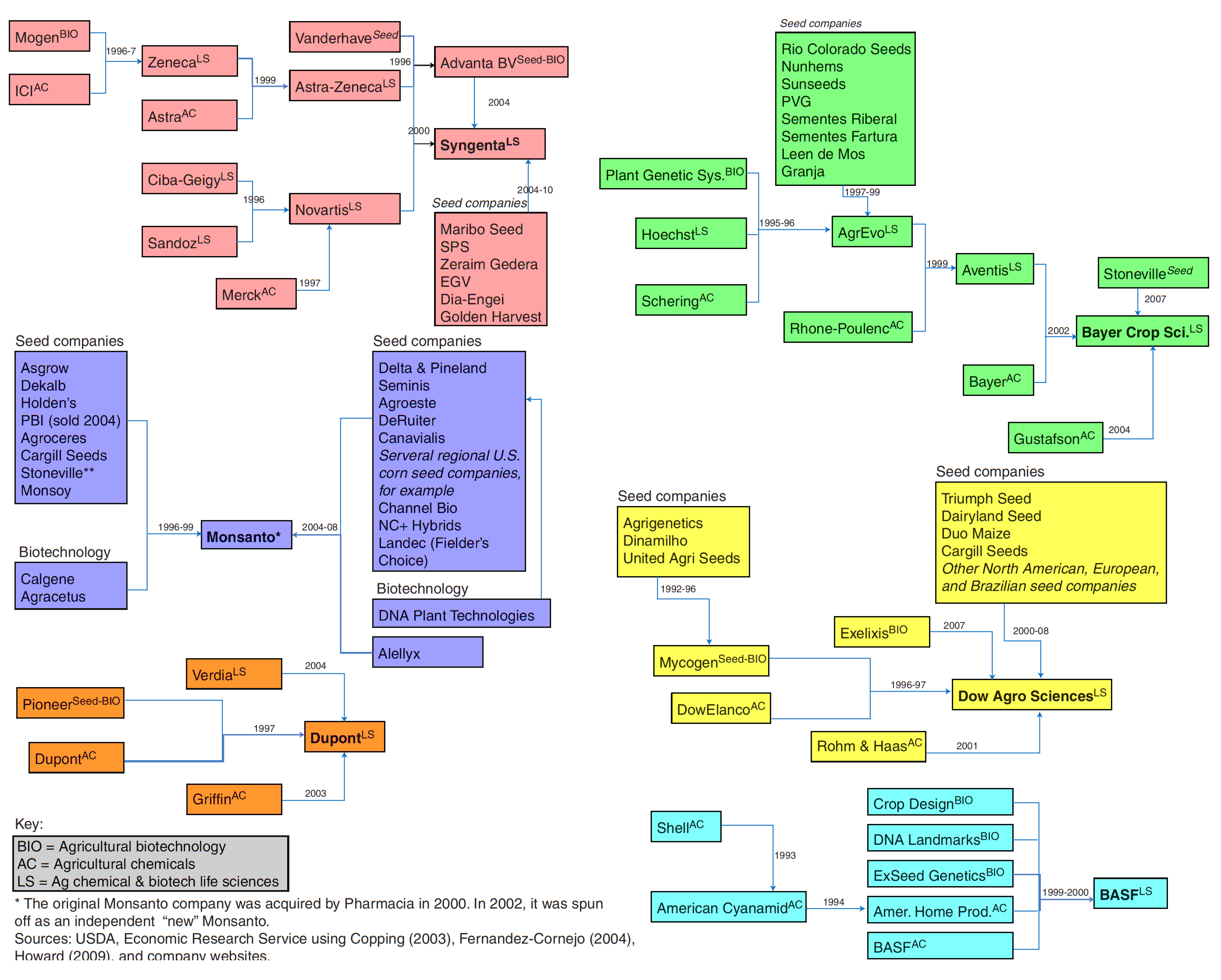
We’ve written before about consolidation in the seed industry making the same tired joke that I want to make again now, that a picture is worth 1000 words. It doesn’t hurt to stay up to date though, which is why I am grateful to Resources Research for finding, and colouring in, the diagram from the USDA report on Research Investments and Market Structure in the Food Processing, Agricultural Input, and Biofuel Industries Worldwide.
The USDA report is not, as far as I can tell, anything to do with the US Department of Justice’s investigation of antitrust practices in the seed industry, announced a couple of years ago. So what has become of that? Anyone know?
Brainfood: Falcons, Wild soybean squared, Horse domestication
- Effects of Introducing Threatened Falcons into Vineyards on Abundance of Passeriformes and Bird Damage to Grapes. Potential savings of US$234/ha for Sauvignon Blanc, more for Pinot Noir.
- Genetic characterization and gene flow in different geographical-distance neighbouring natural populations of wild soybean (Glycine soja Sieb. & Zucc.) and implications for protection from GM soybeans. There is a small amount of outcrossing, which decreases with distance. GM crops should be grown far from wild populations, certainly more than 1.5km. And we can work out better ways to collect for ex situ conservation.
- Phylogenetic relationships, interspecific hybridization and origin of some rare characters of wild soybean in the subgenus Glycine soja in China. Intermediate forms are closer to the wild than the cultivated species.
- Mitochondrial genomes from modern horses reveal the major haplogroups that underwent domestication. A diversity of maternal lines were domesticated about 150,000 years ago, leading to about 18 modern haplogroups. One of them is only found in the only remaining wild horse, E. przewalskii.
How they make cheese
This Sunday, an estimated 58 percent of Americans will order pizza for Super Bowl parties around the country. To celebrate Game Day classics like pizza, cheese dips and nachos, we went to Wisconsin — the American dairyland that produces 35 percent of the country’s cheese — to find out the chemistry behind cheesemaking.
The “we” in this case is the American Chemical Society, and having been to the University of Wisconsin and sampled the delights of the Babcock Hall experimental ice-cream shop, I was anxious to see the ACS video. Alas, it is as dull as factory cheese. And in light of that “58% will order pizza” statistic, I wish instead the ACS — or the University of Wisconsin-Madison — had investigated the whole business of analog, imitation substitute cheese which, and I’m guessing here, probably feature prominently, and possibly exclusively, on 98.2% of the pizzas those 58% of Americans are going to order.