Late blight resistant potato varieties don’t just come from Hungary, for use in Europe. They’re also increasingly important back in potato’s homeland, Peru. The CGIAR Consortium had a short story a couple of days back about Pallay Poncho and Puka Lliclla, two late blight resistant clones that CIP has been developing in collaboration with 200 Andean families in an area where an outbreak in 2003 devastated the harvest, the first time that has happened at such high altitude. But hopefully now the last, at least for a while, because of these new varieties. I wanted to know if material from countries other than Peru was involved in this work, but a glitch in CIP’s online database doesn’t make it easy to check that. Although you do get a pedigree for each variety, when you click on the ancestors you mainly get an error, which just means that particular clone is not conserved. You’d have to search for the family from which that clone came to trace back the full ancestry of each variety (by cutting off the digits after the decimal point in the accession number), which would be interesting to do, no doubt, but too laborious for me just now in my fragile, jetlagged state. Maybe the CIP informatics unit will look into it? I’ll let you know if they do.
Biodiversity is more than a matter of breeding
One of the great problems in talking about biodiversity is that it has so many different meanings. 1 That makes it easy to misunderstand one another, and to make mistakes.
So, for example, we pointed out that having great diversity in your pedigree does not confer any diversity in the here and now if all the offspring of those highly diversified matings are genetically identical. Our friend Mike Jackson was quick to point this out, and he recently followed up with a link to an IRRI annual report for 1997-98. Delivering Diversity to the Field amplifies the confusion, talking about the huge increase in the number of ancestors in a variety’s pedigree 2 and telling us that “these varieties have also increased the danger of genetic vulnerability to major disease or insect pest outbreaks”. Modern varieties, then, are more diverse because they have many “parents” and more vulnerable because they are more uniform. 3
All this is important because it addresses something that Bruce Chassy brought up in response to our criticism of his effort to debunk an anti-GMO paper by bringing biodiversity into the picture. Chassy wrote:
Biodiversity has taken on an almost spiritual meaning. I do not mean to in any way diminish the importance of biodiversity but sometimes when people start believing they stop thinking.
Amen to that. Chassy goes on to illustrate, as follows:
The American Chestnut comes to mind as species that was diverse and widespread through diverse ecosystems in the US. Three billion trees, 25-30% of all trees in the Eastern US, were nonetheless wiped out by a single disease, Asian bark fungus (Cryphonectria parasitica) in a few short decades. Just a few scattered individuals remain of this once common tree. Biodiversity did not save them.
On the other hand, the Quaking Aspen (Populus tremuloides) is propagated by root and shoots. A grove of these Aspen is essentially a giant monoclone; the specie itself appears to have very little biodiversity. They have survived for perhaps 100s of millions of years and have been called the largest living organisms since all the trees in a grove are connected by roots and can be thought of as part of one distributed organism. Lack of diversity appears not to have hurt this specie.
A number of common crops are propagated clonally as well. Naval oranges, bananas, potatoes, pineapples, apples are examples. Why doesn’t biodiversity matter to these crops? Because they were produced by plant breeders and are propagated commercially before being planted by farmers.
Where to begin?
At the beginning. Biodiversity can exist at several different levels. A landscape contains different species from different kingdoms. Populations of a single species will differ from one another. And individuals in a population will differ genetically from one another. So all those chestnuts may have been “diverse” but not where it counted, in their susceptibility to Chestnut blight, although at least one resistant individual has been found. As for Quaking Aspen, some groves are indeed large clones (as are groves of many other trees) but groves differ greatly from one another, and aspens will reproduce sexually, for example after fire, increasing the genetic diversity among stands. Aspens are also threatened by many pests and diseases.
I could make the same points with regard to vegetatively propagated crops and obligate out breeders. Clubroot, anyone?
One measure of diversity is the probability that two individuals chosen at random will share some specified quality, but it really matters what that quality is. Could be something as simple as a specific sequence of DNA. Could be a specific protein coded by the DNA (which can be identical even if there are differences in the DNA). Could be something as complicated as susceptibility to a disease, or resistance to drought. It’s complicated. But that’s no excuse for wilfully misusing an important concept.
Agrobiodiversity in ice-cream
Virginity is an untouchable metaphor
Nobody else seems to find the “800-year-old farmers” of a recent headline (and a Nibble) funny. 4 And personally I don’t care that the authors seem to have misplaced the Amazon. What does concern me is the narrative that the Amazon is somehow an untouched wilderness, which remains dominant, and to a lesser extent the sub-dominant narrative that we have nothing (or everything) to learn from our farming forebears.
The point about the Amazon and other forests being untouched is examined in loving detail by Sharon Friedman in Face it: All forests are “sluts”. She blows a hole in the whole idea of “virgin” forests, for all sorts of reasons.
Calling anything involving forests “virgin” muddles the concepts of “old-growth,” “native forests” and “past practices,” promotes the notion of nature as female and humans as male, and slanders all the non-virgins in the world. It’s so sloppy a usage that it conveys a trifecta of trickiness: three bad ideas surreptitiously conveyed in one word.
Friedman makes many choice points, including the whole question of revirgination and whether “rape” is a good metaphor for what people do to landscapes. But might there, I wonder, be a sense in which biodiversity is a reasonable proxy for untouchedness? Not all biodiversity loss is going to be a bad thing, just as not all virginity loss is a bad thing either. Frankly, I don’t think Friedman’s plea — “to stop using any sexual terms in these kinds of discussions” — has a snowball’s chance in hell, not around here at any rate. And there has to be a bad-taste pun involving sluts, virgins and Amazons, but I’m blowed if I can find it now.
A glass vial of beans is worth a thousand database entries
Check out one of the illustrations in Brainpicking’s review of a recent book on the Academy of Natural Sciences of Philadelphia (“which stands today as the oldest natural history museum in the Western Hemisphere,” and just celebrated its 200th anniversary). It’s the one labelled “Agricultural seed samples collected by Charles F. Kuenne, 1948,” towards the bottom of the page. I’m trying to find out who Mr Kuenne was. Or is. He’s not mentioned in GRIN, alas. But what I wanted to talk about was the sort of glass jars that he — and many others — used to store and display his seeds.
I always thought they were pretty useless, as you can virtually guarantee that the seeds will be dead in short order stored like that. Of course keeping them alive was not the point, and you can now extract DNA from much worse samples. But the fact of the matter is it that during last week’s trip to the CIAT genebank I saw bean breeders look at the assembled ranks of little grain-filled vials on display there so longingly, and lovingly, I cannot but revise my opinion.
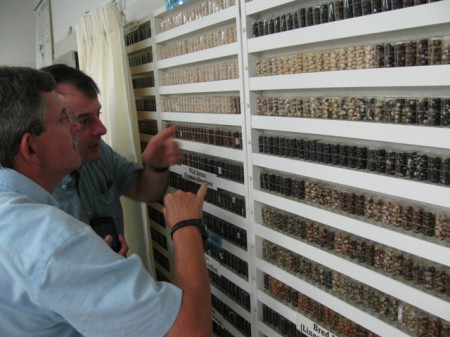
Who needs fancy databases when you can just run your eyes past thousands of different bean samples in a few seconds? Having said that, if you search the CIAT database you will find the varieties Red Valentine (G07707) and Rust Proof Golden Wax (G09523) collected by Kuenne — though not his actual samples, of course. They’re in Philadelphia.