We unfortunately seem to be doing a lot of this lately. Dirk Enneking informs us on Facebook that Prof. Clive Francis, a famous Australian genetic resources scientist, has died. You can get an idea of his influence from a blog post by Ken Street dating back to 2008, but describing a situation that, alas, has not changed much. Sad to remember that one of the commenters to the post, my one-time collecting partner in Sicily Geoff Auricht, is also now deceased.
Brainfood: Chestnut restoration, Zoo legislation, Millet landraces, Cassava in Congo, Agroforestry in Philippines, Baobab (again), Silvopastoral system taxonomy
- Modelling chestnut biogeography for American chestnut restoration. As all 7 species have very similar climatic niches, if you could get a blight-resistant hybrid, it would probably be adapted to North American conditions.
- Ex situ conservation programmes in European zoological gardens: Can we afford to lose them? No, and therefore the EU needs to step in. Whoa, talk about a non sequitur.
- The Fine Scale Ethnotaxa Classification of Millets in Southern India. Malayali farmers can consistently recognize more phenotypes than DNA analysis, and some of the cryptic landraces might be really useful.
- Diversity of cassava (Manihot esculenta Crantz) cultivars and its management in the department of Bouenza in the Republic of Congo. High, but decreasing, at least in some villages. But overall? Any collections made?
- Indigenous agroforestry in a changing context: The case of the Erumanen ne Menuvu in Southern Philippines. Despite being divinely-sanctioned, the pengegnewiran swidden system is changing, in response to socio-economic changes. It needs to, and blaming the people because you don’t like the result is not very helpful.
- Variation in biochemical composition of baobab (Adansonia digitata) pulp, leaves and seeds in relation to soil types and tree provenances. Soil has a big effect. At least in Benin.
- Comparing silvopastoral systems and prospects in eight regions of the world. They’re all going to need more active management.
Rice morphological diversity 1, Bloggers 0
Ruaraidh Sackville Hamilton of the IRRI genebank points out we are confusing clustered spikelets with multi-grained spikelets. Sorry.
Clustered spikelets are more common, and are recognized in the rice descriptors. We have 254 such varieties from 26 countries, mostly in S and SE Asia. Spikelets may be borne directly on the long primary branches of the panicle and/or on short secondary branches, in varying proportions. If none are directly on primary branches, or on the short secondary branches, they appear as clusters of three spikelets. See fig. 8 in the 2008 rice descriptors publication.
The multi-grained spikelets noted by Zakir are more unusual – multiple grains in single spikelets.
Old literature on developmental anatomy concludes that rice spikelets are primitively three-grained, of which the two lateral have become vestigial (hence “sterile lemma”). It would be interesting to know if the multi-grained spikelets are a reversion to primitive type, or a new splitting of the central grain.
Featured: Cucumber history
Alum quite rightly points out that our memory was faulty with regard to a recent paper on the lexicography of the cucumber’s spread into Europe:
I don’t think you’ve blogged on this cucumber paper. We had one recently about their appearance in French and Italian texts that cued up the next paper on routes into Europe.
To recap, that latter paper suggests that according to the lexicographic evidence the cucumber…
…was introduced to Europe [from the Indian subcontinent after 500 CE] by two independent diffusions. One diffusion appears to have been overland from Persia into eastern and northern Europe and preceded the Islamic conquests. The other, subsequent diffusion into western and southern Europe, was probably by a mostly maritime route from Persia or the Indian subcontinent into Andalusia.
The earlier paper, by the same authors, tells us about what happened subsequently, in medieval times once the cucumber had gained a foothold in Europe:
The absence of melon in some manuscripts and the expropriation of the Latin cucumis/cucumer indicate replacement of vegetable melons by cucumbers during the medieval period in Europe.
Triple-grained rice news
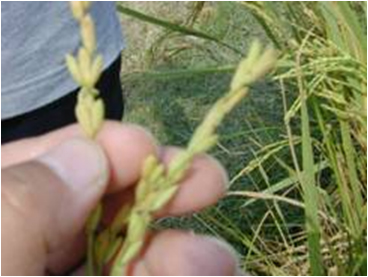
What it is to have friends, especially knowledgeable friends. Bhuwon Sthapit, local rice wallah extraordinaire, 1 responded quickly and in depth when asked what he knew about triple-grained rice.
Unique local rice landraces in Nepal are being lost, replaced by modern varieties. At least two of these are multi-seeded: Laila Majnu (the name refers to a pair of famous lovers, never separated until death) and Amaghauj (which means cluster of mango). Until 1999 Amaghauj was grown by one farmer on 3 katha of land, but was discontinued as the land was sold to another farmer. This local variety has a cluster of spikelets (at least 3 potential grains) originating from the same base; this heritable trait could potentially be used to breed new rice types offering increased yield. It is currently saved in community seed banks.
As Bhuwon also notes:
There is great potential to link community seed bank and national seed bank to harness such untapped and unknown resources.
And if you want even more, another friend, Ruaraidh Sackville Hamilton, Head of the IRRI genebank, points to Morphological Observations on Many Kerneled Grains in Rice. Don’t be scared by the Chinese; English follows.
LATER: For completeness, the name of the Bangladeshi variety which started all this, Biram Sundori, means “beautiful girl from Birampur,” which is the place where it is grown. Thanks to Zakir Sor for leading us all on this journey of discovery.