Grass pea (Lathyrus sativus L.) is an important crop in Ethiopia. Its vital importance in the Ethiopian agriculture emanates from its resistance to drought, salinity, waterlogging and low soil fertility. However, low levels of the amino acids methionine and tryptophan and the presence of the neurotoxin β-N-oxalyl-L-α,β-diaminopropanoic acid (ODAP) in the seeds are the major limitations of the crop. Genetic improvement of grass pea in Ethiopia has been started in the 1960s at Holetta Agricultural Research Center. The major objectives of the grass pea research were to develop and promote high-yielding cultivars with low ODAP content coupled with improved management production packages. However, the 50 years of on-station and on-farm research was not successful in producing outstanding varieties with the desired traits. Compared to other grain legumes, the poor success of varietal development endeavours within the context of grass pea improvement philosophy is typically related to the failure of the conventional breeding approach to fix a zero or low ODAP content because this trait is highly influenced by climatic and edaphic environment.
That’s the abstract of the Plant Breeding paper “Genetic improvement of grass pea (Lathyrus sativus) in Ethiopia: an unfulfilled promise” by Dejene Girma and Lijalem Korbu. 1 You may remember it as the one I summarized in yesterday’s Brainfood as: “Conventional breeding for low ODAP hasn’t worked, so forget about solving that problem through conventional breeding, and move on to other problems, or use genetic transformation.”
I took the liberty of running the paper by a few experts to get a bit of a more rounded assessment. This is what Dr Dirk Enneking, legume breeder and frequent commenter here, had to say:
The challenge is to develop high yielding grasspea crops regardless of ODAP content, while ensuring that the people who, sooner or later, will be forced to subsist on an almost exclusive diet of grasspea know what they need to do to detoxify the seed prior to consumption. They also need the means to dilute their diet with other food, containing sufficient sulphur amino acids, to prevent toxicity. There is a need for an animal model of neurolathyrism to scrutinise such an approach by experiment. Further details: Special issue March 2011 Food and Chemical Toxicology.
One first practical step to prevent neurolathyrism might be the identification and education of those most at risk, the human grasspea consumers, usually the poorest of the poor, often in remote villages, in areas where grasspea is used as a food. They do not necessarily look malnourished, so conventional nutritional surveys easily miss them. Once they are identified they can be targeted with specific interventions: a) to alleviate their poverty, b) education, c) during famines with food aid. Considering an area of ca. 150 000 ha of grasspea production in Ethiopia and trade of the crop as seed or in split form in markets, [unfortunately not part of current donor funded routine market monitoring programs] the task of locating grasspea consumers is quite manageable in that country.
So Dirk agrees on the advisability of moderating the obsession with low-ODAP breeding. Dr Tadesse Wuletaw, who worked on Lathyrus breeding in Ethiopia and is now at ICARDA, has a somewhat different take.
This is a good review. I do agree on the importance of molecular/biotech approaches in grasspea breeding. However, the shift in focus from ODAP to improving other proteins would be misleading. Especially in countries like Ethiopia where grasspea is principally grown for human consumption, the focus should remain on the development of toxin free lines. Though this is a huge task… I see possibilities through interspecific hybridization and transformation. Mutation breeding would also help especially by using combination of physical and chemical mutagens (personal experience).
Dr Ahmed Amri is the head of the ICARDA genebank, one of the best sources of Lathyrus diversity. He agrees on the possible role of wild relatives in breeding for low ODAP, and points to some (possibly temporary?) successes.
I would like also to inform you that ICARDA has developed in late 1990’s somaclonal variants with low ODAP. I still think that the rate of outcrossing detected in grasspea could revert them back to percent of ODAP higher that the threshold when growing low-ODAP varieties for several generations. This is an area which can also be handled through research. There are some Lathyrus species within the genepool 2 which are free from ODAP such as L. tangitanus which could be used in interspecific crosses. Related to breeding for high yield in grass pea mainly grown under harsh conditions might not be the priority as this potential will never be expressed. Breeding for low ODAP and for tolerance to Orobanche are urgent breeding objectives.
And finally, here is ICARDA’s senior Lathyrus breeder Dr Shiv Kumar Agrawal. He also points to some successes of conventional breeding, while not minimizing their ambiguities. He sees great promise in new methods too.
Thanks for sharing this review. I do agree with the reviewers that breeding success in Lathyrus is not as apparent as we see in other crops. One has to see also how much breeding efforts were directed to this crop in spite of its importance in climate change scenario. In India, efforts were made, resulting in successful release of very low ODAP varieties (Ratan, Prateek and Mahateora) using conventional breeding methods. All these cultivars with 0.07% ODAP over the years are grown by farmers. Let me make it clear that in India, there is no ban on research and cultivation of Lathyrus. There is a ban on trade in some states but at the same, it is officially traded in some states like Maharashtra. This year, we have released one Lathyrus variety BARI Khesari-3, an ICARDA line in Bangladesh. This variety has also shown below 0.1% ODAP over the years.
At ICARDA, we evaluated 260 somaclones to assess variability for ODAP besides generation of second cycle somaclones from low and high ODAP lines. Influence of environmental factors particularly water stress on ODAP content is substantial. At the same time, low ODAP lines remain low in ranking (we are in the process of preparing a manuscript from our work on this aspect). At present at ICARDA, we employ mutation, tissue culture and inter-specific hybridization along with our conventional breeding methods using genetic variability for ODAP in our germplasm. Results are encouraging. New tools including transformation are useful for directed improvement in reducing ODAP content. However, the concern of environment effect and outcrossing will still be the issues.
The variety Wasie which was released in Ethiopia from ICARDA material, when estimated for ODAP, has below 0.1% ODAP over the years of testing. We will get seeds of Wasie from Ethiopia and test it for the genetic purity along with our original seeds.
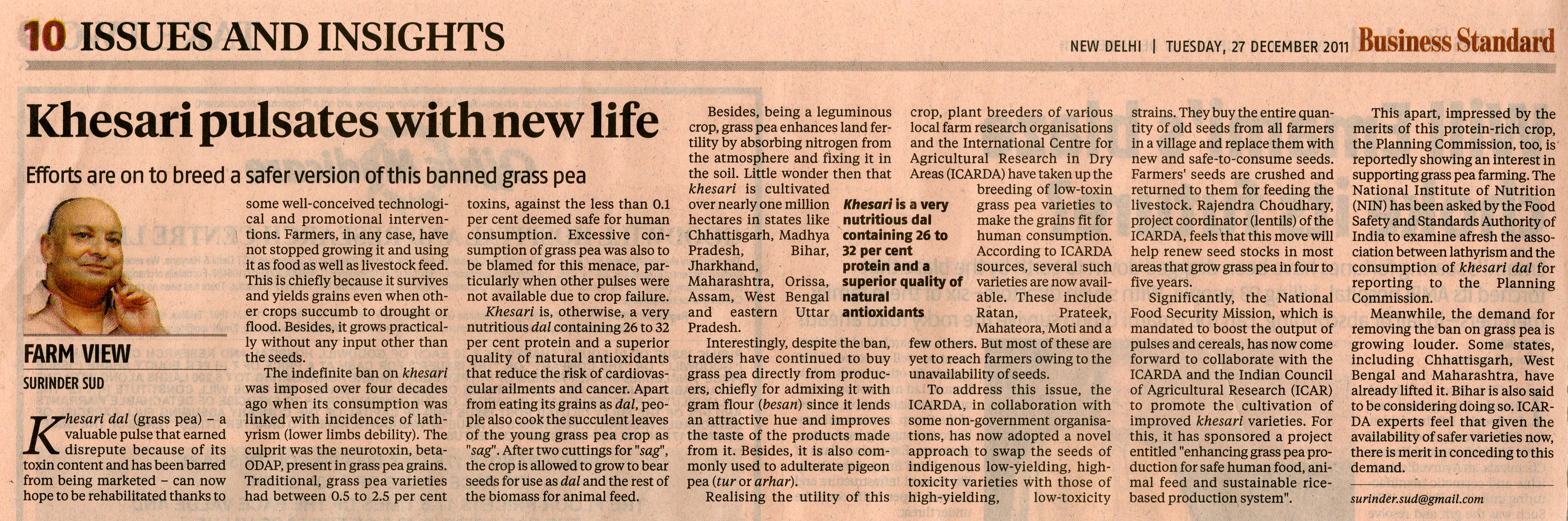
Dr Agrawal has kindly provided a clipping from an Indian newspaper discussing grasspea breeding in that country. It is clearly not the case, as I’ve occasionally heard it suggested, that there is a prohibition on breeding of this crop in India, although Dr Agrawal implies that it is seriously under-funded.
We’ll investigate the possibility of getting these reactions to the authors, to see if they’d like to respond. In the meantime, if you would like to contribute to the debate, do comment below.