The latest IUCN assessment of the conservation status of European biodiversity is out, and is making the news. The bit on plants is co-authored by Melanie Bilz, Shelagh P. Kell, Nigel Maxted and Richard V. Lansdown and, unsurprisingly perhaps given their track record, includes, I believe for the first time, extensive discussion of crop wild relatives as a distinct class. 1 The authors, which coordinated input from dozens of experts, conclude that out of a total of 591 CWR species:
Within the EU 27, at least 10.5% of the CWR species assessed are threatened, of which at least 3.5% are Critically Endangered, 3.3% Endangered and 3.8% Vulnerable – in addition, 4.0% of the species are considered as Near Threatened. One species, Allium jubatum, is Regionally Extinct within Europe and the EU; it is native to Asiatic Turkey and Bulgaria, but has not been found in Bulgaria since its original collection in 1844.
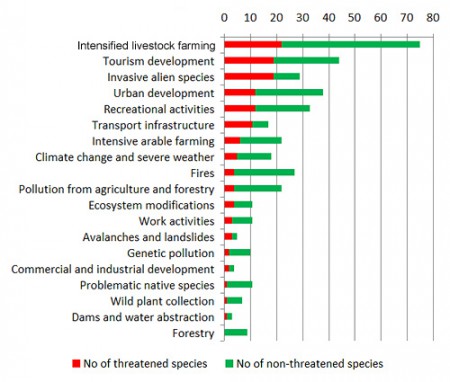
It does not even seem to be available from botanic gardens, according to Botanic Gardens Conservation International’s database. I don’t know what has caused its disappearance in Bulgaria, but currently the main threats to CWRs seem to be intensified livestock farming, tourist development and invasives:
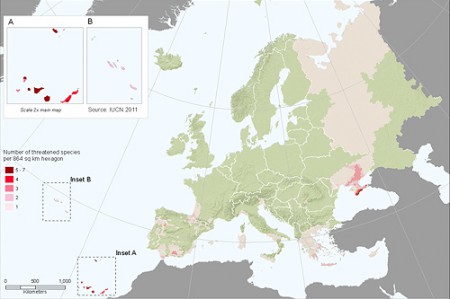
And there are maps 2 of both the distribution of overall CWR species richness and of the most threatened species:
An extremely useful review is provided of previous work assessing the extent to which CWRs are conserved in genebanks, botanical gardens and protected areas in Europe. But here perhaps I would like to quibble with the authors. Although their listing of existing conservation efforts seems to me thorough and comprehensive, there is no attempt made to synthesize the results of all the different initiatives and come up with a list, however preliminary, of high priority plants for immediate conservation intervention. Surely it would not have been particularly difficult to cross-reference their list of threatened species with listings of accessions in Eurisco and the BGCI database, for example. Maybe this was beyond the scope of this particular exercise and is the focus of parallel work. Perhaps Nigel or Shelagh will respond here.
This is a very important contribution to raising the profile of CWRs within the biodiversity conservation community. Let us hope that it will translate into increased support for their conservation, both ex situ and in situ, along the lines so usefully set out by the authors in their recommendations.