Happier days for Greece, celebrating the orange harvest in 1966. And if you don’t waste at least a couple of minutes at that sight, you’re a better person than I am. But why no embedding?
Not potatoes
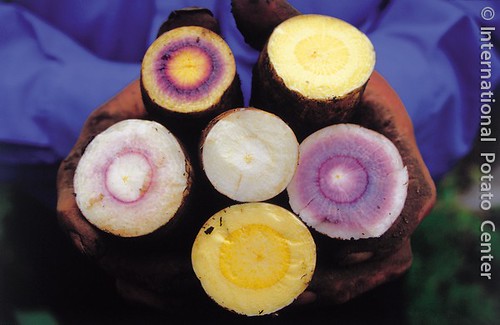
But colourful nevertheless. giving the lie to their binomial, Arracaccia xanthorrhiza.
Protected areas in China: more and better needed
A big article in BioScience looks at the state of nature reserves in China, and finds them lacking. According to the press release:
Protected area managers in many cases currently lack basic data about which plant species are present on their reserves and even the exact area and extent of the reserves. Consequently, the effects of China’s rapid economic development, the related spread of invasive species, and the growth of tourism could drive to extinction species that could be sources of future crops and medicine.
Some things worth mentioning, from the article itself. 1 First, nice to see crop wild relatives getting a look in, although there is no mention of the agricultural biodiversity already being used by farmers either in the protected areas or outside them. Secondly, although the authors suggest preserving “very rare and threatened species” in some of China’s more than 140 botanic gardens, they don’t talk about conservation in genebanks, and they don’t talk about incentives for in-situ or on-farm conservation. In fact, the only incentives mentioned are those government should offer to persuade people to move out of the protected areas and into the cities.
So, once again, people are the problem. “Conflicts between the interests of rural communities and nature conservation need to be resolved,” and the way to do that is to move the people out of the way of conservation.
China has an opportunity to lead the world in developing a coherent conservation policy for plants important to agriculture, one that recognises the importance of diversity (as much Chinese agriculture has done), that integrates the various different forms of conservations, and that enlists the people who actually interact with plant diversity, manage it, even if only by default, and thus help to determine its future.
Some goings-on at Kew; advance notice
Happy to share some information about future events at the Royal Botanic Gardens, Kew, with the customary offer to host a report from anyone who is able to be there.
Saturday 17/Sunday 18 September 2011 — Behind the scenes in Museum No. 2
For one weekend only, as part of the annual Open House London celebrations, Kew is re-opening the world’s first museum of economic botany, closed to the public since 1960 and now used as Kew’s School of Horticulture. Decimus Burton converted George III’s fruit store into a museum in 1847, and little has changed since then. With help from students and staff at Royal Holloway, we will have plenty of interpretation and information, and are also displaying a wide range of artefacts from the Economic Botany Collection, illustrating themes such as basketry, explorers, timbers,and Kew’s history.
Tuesday 11 October 2011, 5pm — Annual Ethnobotany Lecture
Prof. Will McClatchey on “Ethnobotany of the Home and Hearth”. Will McClatchey, a renowned speaker, is a leading ethnobotanist with special expertise in methodology, the evolution of patterns of human interactions with plants and ecosystems, and the ethnobotany of Pacific islands. His talk is in the Jodrell Lecture Theatre at Kew. No need to book in advance; just go to the Jodrell Gate. The lecture will be followed by further discussions in the Botanist pub on Kew Green. (More details at Kew’s Economic Botany page.)
Friday 9 December 2011. Sir Joseph Dalton Hooker — a centenary celebration
The Economic Botany collection is participating in this conference with displays of Hooker artefacts from his Himalayan expedition. The day will be fun, with a varied programme and expert speakers. Early booking advised.
The fate of the global jute collection
I think a brief follow-up to yesterday’s foray down Memory Lane might be in order, lest you all go away thinking that I’ve lost my marbles. So, yes, according to Ramnath’s comment I was right, the large, global collection of jute assembled at the Bangladesh Jute Research Institute starting in the 70s did indeed receive a sort of blessing from IBPGR (the International Board for Plant Genetic Resources) in the late 1980s when it became part of the Global Network of Base Collections. It wasn’t on the list in 1985. But it had made it by the time of the IBPGR Annual report for 1989. I know that because googling threw up a link to the paper “Plant Genetic Resources Activities: International Perspective” by R.K Arora, R.S. Paroda and J.M.M. Engels, and that includes a handy table. Alas, that link, which should take one to Bioversity International’s (that’s what IBPGR became) website, is broken. Fortunately, the cache is there, at least for a while, and I have been able to save the paper as a pdf for you.
We don’t hear much about the Global Network of Base Collections any more. It would be interesting to know if the Bangladesh Jute Research Institute still feels itself to be part of it. I suspect not. Of course, things have changed a lot since 1989. But what’s to stop BJRI proposing to place its collection under Article 15 of the International Treaty on PGRFA? Others have…
And as for that IBPGR-funded collecting for Corchorus in Kenya that I could find no evidence of before, that must have been because I was searching for it incorrectly. My mole at the Collecting Missions Files Repository was able to identify it pretty quickly. 2 For the record, the missions took place in 1987-1988, under the leadership of I.R Denton of the International Jute Organization. And the material is still being used, as searching for that name in Google Scholar can tell you. But here’s how the source of material from those expeditions is being described in a fairly recent paper:
All the materials were obtained through the courtesy of the Director, Central Research Institute for Jute and Allied Fibers, Barrackpore, India, from the IJO world collection.
So people still recognize a “global jute collection,” but is it now located at the Central Research Institute for Jute and Allied Fibers, Barrackpore, India? Time for some further sleuthing, I guess.