Googling crop production

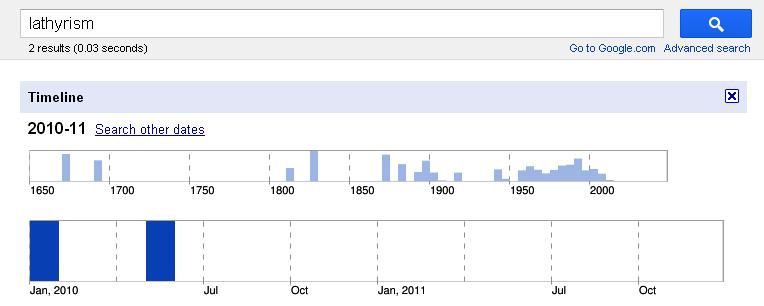
Speaking of Google, can it be used to map crop production, the way it can be used to map outbreaks of flu or dengue? Well, according to Google Insight for Search, this is the pattern of searching for the word “soybean” you get for China.

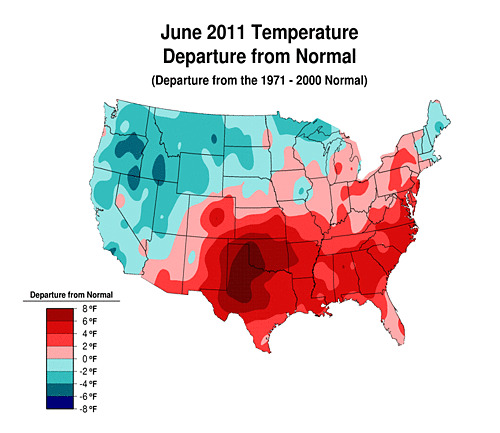
And this is one of the nicer maps of soybean production in China I was able to find online:

Not bad, but not great. Pretty much the same for Brazil. I guess it was worth a try, but if you want production maps for crop X, your best bet is still to just search Google Images for, well “X production map.” Or maybe ask the CGIAR or FAO GIS tribe. No, wait

EU needs to coordinate to strategize to conserve genetic diversity

Last week we briefly Nibbled the Seeds for a Sustainable Future conference organised by European Greens and held yesterday. Despite the very short notice, an agrobiodiverse mole tunnelled her way into the proceedings and sent back a report.

Claudia Olazabal, Head of Biodiversity, which comes under the Nature Conservation & Biodiversity Unit at DG ENVI, asked “Is agricultural biodiversity part of the equation?” in her presentation on diversity of genetic resources in the context of international commitments and the EU’s Biodiversity Strategy. During which presentation, she referred to Action 10, that “The Commission and Member States will encourage the uptake of agri-environmental measures to support genetic diversity in agriculture and explore the scope for developing a strategy for the conservation of genetic diversity.”

A questioner managed to ask: Hadn’t the Commission been working on just such a strategy since 1994? 1

To which Mrs Olabazal extemporized thusly:

“There are lots of different actors in the Commission who work on agricultural genetic diversity – Directorate General for Environment, Directorate General for Agriculture, Directorate General for Research … we need to coordinate … “

Ah yes. A need to coordinate across Europe’s complex network of interests. It wasn’t like that in 1994, when everything was at least under one roof. But then again, maybe that’s why there still isn’t really a strategy for the conservation of genetic diversity …

Alas, I think you’ve missed your chance to tell the EU what you think of its “Options and analysis of possible scenarios for the review of the European Union legislation on the marketing of seed and plant propagating material”.

Important Plant Areas documented

More than 200 areas across North Africa and the Middle East have been identified as wild plant hotspots, a report has revealed. The research lists 207 places which are internationally important for the plants they contain, including 33 in Syria, 20 in Lebanon, 20 in Egypt, 21 in Algeria, 13 in Tunisia and five in Libya.

The report in question is “Important Plant Areas of the south and east Mediterranean region,” 2 just out thanks to IUCN, Plantlife International and WWF, and downloadable for free. The maps are nice, of course, and I hope they’ll be available in digital form in due course, if they are not already. 3 And it is also great to see a list of species with restricted ranges; it includes quite a few crop wild relatives, in particular Allium and Vicia spp.

Ethiopian Agriculture Portal misplaces crop diversity

The Ethiopian Agriculture Portal (EAP) is a gateway to agricultural information relevant to development of Ethiopian agriculture. EAP makes access to information easier because it uses a simple, logically laid-out web interface from which users can access documents on agricultural commodities important to Ethiopia. The collection includes many documents in local languages mainly Amharic…

The intended audiences of the portal are all those engaged in public or private agricultural development endeavors in Ethiopia; including extension, research, higher education, private sector, and other government and non-government stakeholders. In short, it serves national and international entities interested in Ethiopian agriculture as partners in trade, investment, or development.

A very worthy effort, and not badly done. But one is sorry not to see any mention of the Institute of Biodiversity Conservation in Addis Ababa, with it’s storied genebank housing a unique collection of local crop germplasm. And although it is welcome to see, under “Other Resources”, reference to the Domestic Animal Diversity Information System and the Domestic Animal Genetic Resources Information System, one longs for similar exposure for international databases on plant genetic resources, in particular those of the CGIAR Centres, whose data is of course also now available through Genesys.