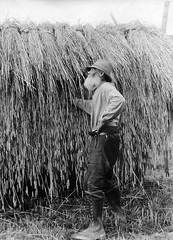
Just a great photo from the Swedish National Heritage Board, taken ca 1944, that I found on Flickr’s Economic Botany Pool.
Climate change: thanks for all the dead fish
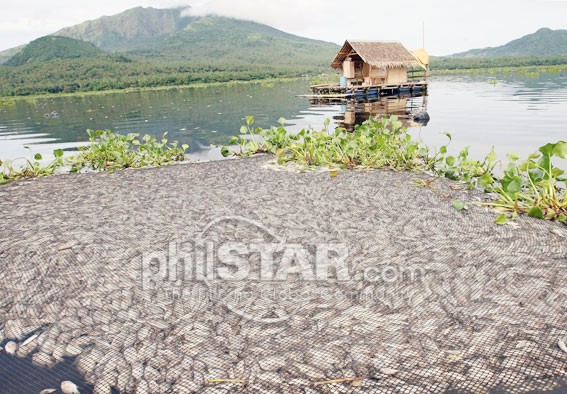
One of the little-appreciated aspects of climate change is that greater variability brings with it more frequent extremes, and if a system is already stressed it doesn’t take much to tip it over the edge. In many places, aquaculture is such a system. The photo 1 is from November 2010, but a glance at the news shows that massive fishkills are a common feature, and not just in The Philippines.
What seems to happen is a series of “unlucky” breaks. The fish are already densely stocked and overfed, and in the morning oxygen levels in the water can be dangerously low because the plants don’t produce oxygen in the dark. Most days, that’s alright, because the algae and plants in the water start to photosynthesise and put out oxygen. A cloudy morning, however, can reduce photosynthesis, and if the day is also hot oxygen levels fall even further as dissolved oxygen escapes. Worse, in hotter water the metabolism of the fish revs up, so they need more oxygen. Throw in a rainstorm, especially if soils around the fish farms are bare, and you get an influx of turbid water that further blocks photosynthesis, dropping oxygen lower still. Tonnes of fish suffocate. And lakes may take years to recover.
Authorities recommend “premature harvest” but that is clearly a Band-aid. The sustainable solution is to make the system more resilient, by decreasing stocking levels and feeding, and trying to ensure that rainwater inflows do not carry too much sediment into the water. Fish farmers cannot control the weather; can they adapt to extremes that can certainly control their business?
Unlocking agriculture’s past to feed the future world
 That’s the title of a talk our friend and occasional contributor Jacob van Etten will give in the National Geographic store in Madrid next week, on the 28th to be precise. If you can’t be there in person, you can follow Jacob online. And if that doesn’t work, no doubt he’ll tell us here how it all went. I just hope he explains to National Geographic the difference between a potato and an oca. In fact, why not open with that, Jacob? That’ll grab their attention.
Using data to inform nutrition security policy
You only have a few more weeks to get your abstract in for the “International Scientific Symposium on Food & Nutrition Security Information: From valid measurement to effective decision-making” early next year. I like the sound of it. Here are the three topic areas:
1. Measuring and analyzing food and nutrition security to improve the availability and quality of information for decision making — advances made since the 2002 International Scientific Symposium.
2. Impact evaluation — understanding what works in humanitarian and development contexts to improve food and nutrition insecurity.
3. Food and nutrition security information — from evidence to policy impact.
Plenty of opportunities for agricultural biodiversity to make an appearance. I hope.
Never too late to link to old(ish) FAO nutrition factsheets
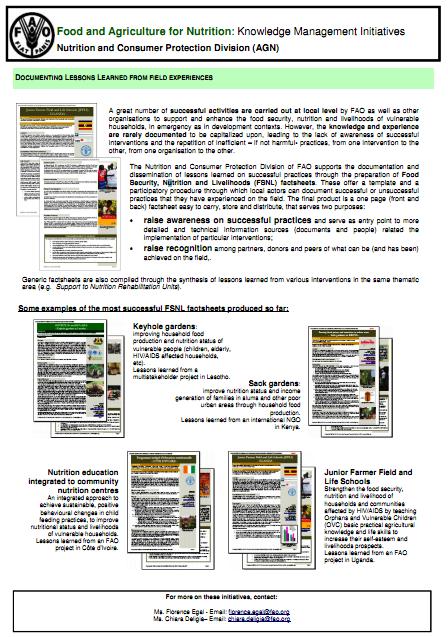 I’m ashamed to say I knew nothing about these rather nice-looking Food Security, Nutrition and Livelihoods (FSNL) factsheets from FAO. Until I came across a tweet today from a “social media enthusiast,” that is. Thanks, Gauri.