In the original the monkey is being offered a peanut.
Really? Well, it’s an innocent enough statement in most circumstances. But a little problematic if the monkey is being held by Katherine of Aragon in a portrait from the 1530s. Were there really peanuts, a South American crop, so easily available at Henry VIII’s court in England only forty years after Columbus? 1 It’s not inconceivable, but really?
Ok, so how did we get here? It all started with a podcast from the BBC History Magazine which came out in April 2009. 2 In it, Brett Dolman, the Curator of Collections at Hampton Court makes the peanut comment in an interview with the magazine’s editor about an exhibition of portraits of Henry’s wives that was on at the time, and which was featured in the magazine. You can hear it at about 8:40 minutes into the podcast.
What Dolman says is that the portrait of Katherine of Aragon they had in the exhibition, which I take to be the one on the Hampton Court website, 3 is a copy of an earlier painting. It is in the original that the monkey is being offered a peanut by the queen. In the copy, it is being offered a coin, but instead reaches for the crucifix at her neck. That’s apparently symbolic of Katherine’s belief in the sanctity of her marriage to Henry, and her refusal to accept money for a divorce.
Whatever. What we’re really interested is the original. The one with the peanut, remember? Well, I can’t be sure without too much more research than I can devote to this at the moment, but I think that original is probably “Katharine of Aragon with a monkey” (c1525) by Lucas Horenbout/Horenbolte, who was an official court painter. And here it is.
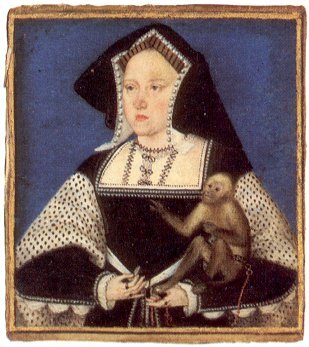
So is it a peanut? It’s difficult to tell, but I’m inclined to doubt it. The first European image of a peanut appears to come from a century later:
Another description of the Katherine portrait refers to “a scrap of food.” All in all, I’d go with that. And art historians of the world, I’m available for consultancies.