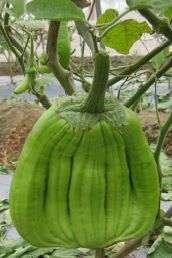
 You heard of Buddha’s hands citrus, right? Well, now get a load of Buddha’s hands eggplant.
A more strategic approach to evaluation?
I feel we need evaluation data on ‘agronomic’ performance. Morphological description, in most cases, totally pointless.
That was the first response to my posting of the rice sheath blight story on GIPB the other day.
Somewhat provoked, one of the authors of the paper prepared this reposte.
Consider this like a “morphological FIGS” (Focused Identification of Germplasm Strategy), selecting the “best bet” set of accessions to meet the researchers’ objectives.
Yes of course we need more evaluation.
But look at the effort that went in to the screening of these 200. Imagine scaling that up to the whole collection of 110,000+ accessions. Impossible. Imagine even scaling up to the 5,000 we can characterize in one year. Impossible.
Then consider all the evaluation data IRRI has collected in the past on the genebank accessions and effectively discarded. (“Don’t throw it away! Give it to me … Thank you … Oh, I see what you mean. Throw it away” is the typical sequence of reactions we get from people convinced we shouldn’t discard it). Why discard it? Because it was all done using the quick-and-dirty anything-is-better-than-nothing approach of genebanks to characterizing and evaluating large collections. The experts won’t do it, we don’t know how to do it properly, so let’s just do what we can do. Silly.
When we evaluate accessions we have to evaluate them properly, led by the trait experts, and we can only ever hope to do that for small subsets of accessions.
Then consider the lack of progress even by the experts in evaluating diverse subsets (dare I say core collections?) for resistance to sheath blight.
Sheath blight is an unusual disease. Because of the mode of spread from one plant to the next (by fungal hyphae), the rate of spread is highly dependent on plant architecture. The experts felt this “noise” might be hiding the signal of physiological resistance that they wanted to detect. Therefore they should control for canopy architecture; therefore we should use characterization data to select accessions for evaluation.
The real message is not that characterization data are useful. The real message is that evaluation efforts must be focused more carefully on the right subset of accessions, choosing the “best bet” set for each request. Characterization data are just another type of data that may or may not help us to choose in the concept elaborated in FIGS.
Let the debate continue!
Japanese genebank data online
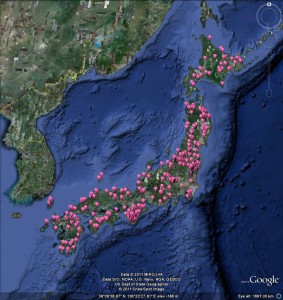 While looking for something else, I happened across a paper describing the Japanese genebank’s new(ish) information system, NIASGBdb. I have some issues about the downloading options (e.g., there are annoying limits to the number of accessions), but it is nice to be able to search both characterization and evaluation data. I know you want to know, so I’ll tell you that the average culm height of accessions with very high resistance to sheath blight is 104cm, whereas that of those with very low resistance is 81cm. And no, I didn’t calculate any standard errors, or do any fancy multivariate statistics. But there’s nothing to stop you doing so.
Brainfood: Baby’s veggies, Chickpea and drought, Vine cactus breeding, Paleolithic rabbits, California protected areas, Wild pigeonpea, Pecorino classification, Milk composition, Phenotyping, Wild peas
- Vegetables by Stealth: an exploratory study investigating the introduction of vegetables in the weaning period. Sneaking them into the diet is the most common strategy used by mothers to introduce their kids to vegetables. Reeeeeally?
- Assessment of Iranian chickpea (Cicer arietinum L.) germplasms for drought tolerance. Four out of 150 local landraces showed promise. It really is a numbers game, isn’t it?
- In situ induction of chromosome doubling in vine cacti (Cactaceae). Potentially valuable autopolyploids were produced. Not that it was easy or anything.
- Who brought in the rabbits? Taphonomical analysis of Mousterian and Solutrean leporid accumulations from Gruta Do Caldeirão (Tomar, Portugal). People did, that’s who, but only during the later Upper Paleolithic. Before that it was mainly owls.
- Protected areas in climate space: What will the future bring? Nothing good. Both novel and disappearing climates are over-represented in current protected areas, at least in California.
- Progress in the utilization of Cajanus platycarpus (Benth.) Maesen in pigeonpea improvement. Baby steps.
- Classification of pecorino cheeses using electronic nose combined with artificial neural network and comparison with GC-MS analysis of volatile compounds. Wait, there are different kinds of pecorino?
- The need for country specific composition data on milk. Well, you’ve got me convinced.
- Rate-distortion tradeoff to optimize high-throughput phenotyping systems. Application to X-ray images of seeds. So, let me get this straight, basically, gauging the optimal trade-off between speed and accuracy in high-throughput phenotyping systems depends on what you’re measuring? Who writes these grant applications?
- Experimental growing of wild pea in Israel and its bearing on Near Eastern plant domestication. First pea growers were either very patient or very quick workers.
The revenge of characterization data
It is a truth universally acknowledged that characterization data are useless to breeders. Well, universally acknowledged by breeders anyway. Morphological data are all well and good for genebank curators looking for duplicates and old-fashioned taxonomists, they say. But what we need is evaluation data, and lots of it.
As usual, I exaggerate; for effect, as usual. But I think it would certainly be true to say that detailed morphological descriptions of germplasm are not the highest priority thing breeders want out of genetic resources databases. That would probably be information on resistance to biotic and abiotic stresses.
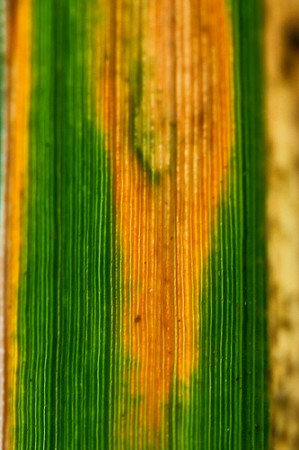 And yet a paper just out in Euphytica shows that the former can be clues to the latter. A team at IRRI 1 looked at the susceptibility of rice to sheath blight, an important disease throughout rice-growing areas, especially under intensive systems. 2 They measured how 200 accessions did when inoculated with Rhizoctonia solani in the field. So far, so conventional.
But because the accessions were very carefully chosen (out of a total of over 100,000 in the IRRI genebank), the team, which included the genebank manager, were able to estimate to what extent differences in disease intensity were due to plant and canopy architecture — in other words, morphology — and how much to genetic susceptibility.
The accessions tested were selected to represent contrasting morphologies (based on leaf length, leaf angle and number of tillers, typical characterization descriptors), different phenologies (number of days to 80% flowering) and all the major varietal groups (indica, aus, aromatic, temperate, japonica and tropical japonica). It turned out that the lowest levels of disease intensity were found on a particular morpho-phenological group, and that this effect of morphology on disease intensity was much greater than any effect of genetic group, although the aus varietal group was markedly superior to the others.
The authors therefore recommend that breeders looking for sources of reduced susceptibility to sheath blight will find it most efficient to select taller accessions with wider leaves. Let us see what the breeders think. I’ll post this on GIPB and report back if there’s any reaction.