
This is where Kew’s seed research programme, including the genebank, was housed before they built the Millennium Seed Bank. Pretty cool, eh?
US lawmakers taking irony supplements
Missed this first time around, but courtesy of the magic of interconnectivity — Thanks Sam — I am able to reflect on some reflections.
If you’re eager to improve the food (and other) security of smallholder farmers, or the nutritional status of young people you might, once, have looked to the US to lead the way, at least as far as smallholder farmers and young people in other countries, poor countries, are concerned. At home? No such luck.

As Alex Tabarrok said in his post Not from the Onion, over at Marginal Revolution, “The headline says it all”.
Tabarrok quotes extensively from the Washington Post article that furnished the fine headline above. I can do no better than to quote him.
[A]nyone who argues against making school meals healthier because it’s too expensive at the same time as they vote for keeping billions of dollars in farm subsidies is not concerned about expenses. What unites the bill is not ideology but protection of agribusiness.
Say it isn’t so!
Not a peep out of the G20 meeting, yet; although much has been said about controlling prices, the only mentions of subsidies I’ve found are in the context of biofuels which, according to the US, “are job creators, not hunger villain” (sic). (I don’t suppose they could be both?) Far keener intellects than mine have considered the influence of rich-world agricultural subsidies on poor-world food insecurity, and the overall message is that they malevolent.
It’s just a shame, I suppose, that what happens to smallholder farmers and poorly nourished young people at home more or less mirrors what happens to them in other countries, poorer countries.
The future of rice in Mozambique
Readers with long memories who had time on their hands back in January may remember a post we did then on IR80482-64-3-3-3, a new rice tailor-made for Mozambique. There was some discussion at the time about the claims being made in the original SciDevNet piece about the new variety on which we based our post, but what really struck me was this statement:
Work began when the International Rice Research Institute (IRRI), in the Philippines, sent Mozambique 11,200 rice varieties for testing.
That just sounded like quite a lot of varieties, and I remember wondering at the time how long it took the Mozambique national rice programme to get through that little lot. But anyway, I bring this up now not only because someone from IRRI has very kindly left a comment on the original post. But also because IR80482-64-3-3-3 is back in the news, cannily renamed Makassane. The IRRI press release has been widely picked up.
Following the approval of Makassane for release by the Mozambique Variety Release Committee earlier this month, IRRI provided government agencies and farmers “foundation seed” to use in bulking up the seed so that more can be produced and distributed to more farmers.
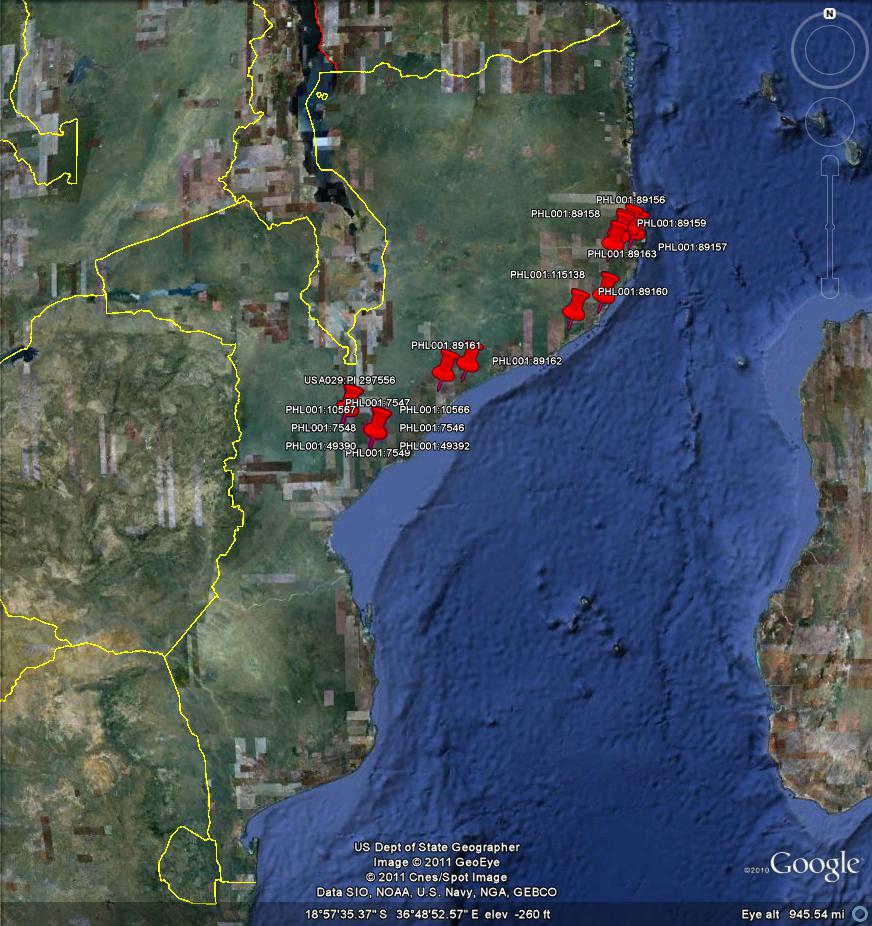 Two things about this. First, I look forward to regular updates on Makassane’s uptake by farmers. And second, I hope the IRRI and Mozambique national genebanks are confident that they already have good representation of the local landraces. Sophie, who left the aforementioned comment, says there are 76 rice types from Mozambique at IRRI. Genesys gives us just over 120 worldwide, between landraces and wild species, but only a few are geo-referenced (see map).
Picking a good agrobiodiversity beach
My apologies to Robert Hijmans, the developer of DIVA-GIS. I had forgotten how awsomely awesome his software. It was really only the work of half an hour to export a shapefile of the distribution of wild and weedy accessions from Genesys, open it in DIVA-GIS, produce a gridfile of taxon richness, export it as a KMZ, and open it in Google Earth, together with The Guardian’s European bathing places dataset, which I had prepared earlier.
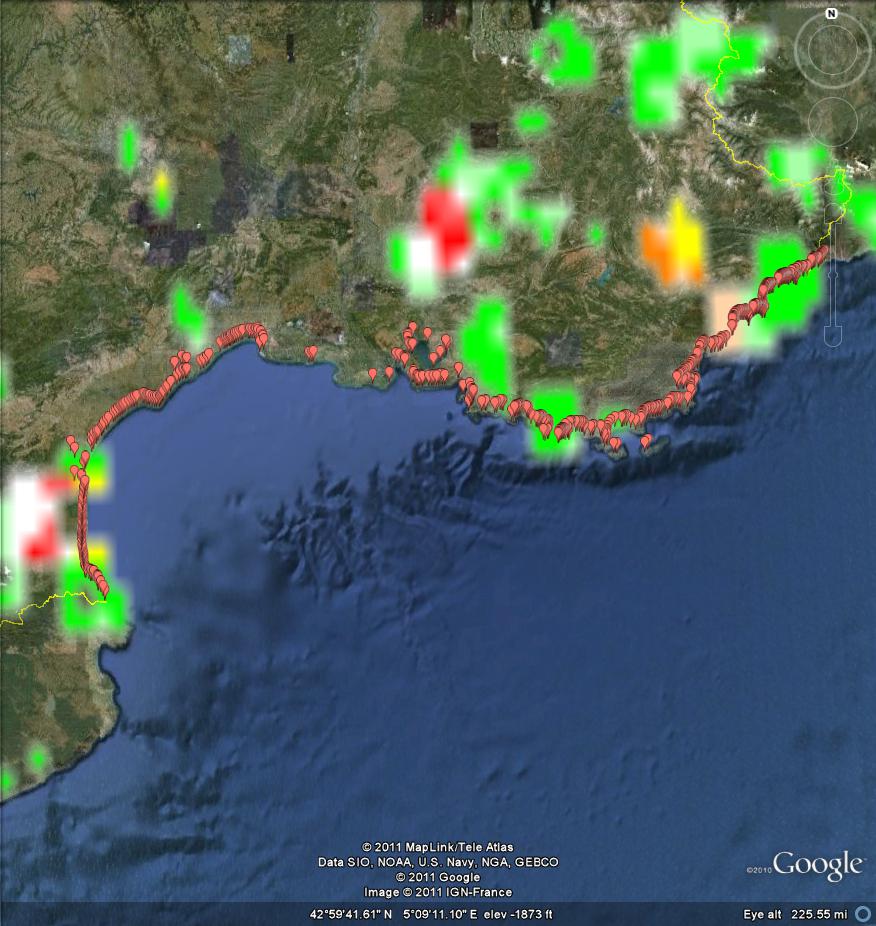
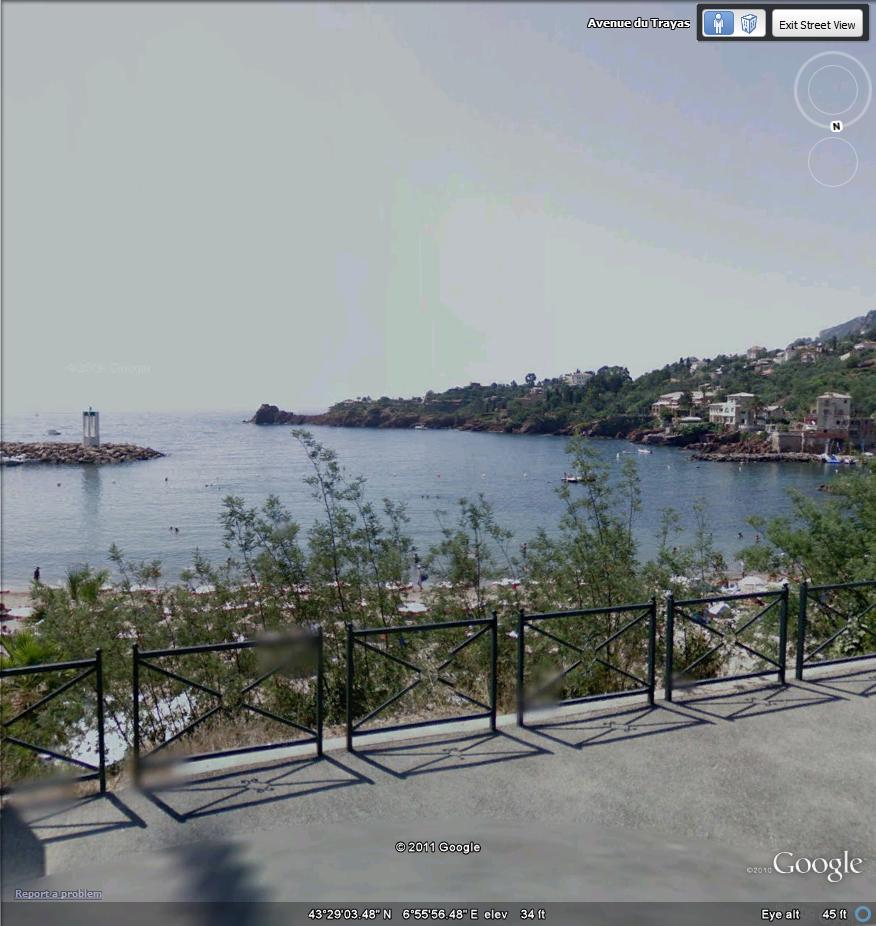
A beach called La Figueirette at Theoule-sur-Mer is right in the middle of that (relative) hotspot of species richness not far from the Italian border shown in light orange on the map above. And the beach doesn’t look too bad either, at least on StreetView.
Now, to check out the lakes…
Not all Andean tubers are potatoes
Our regular reader botany professor Eve Emshwiller makes a plea on behalf of some under-appreciated — though not by her — Andean crops.
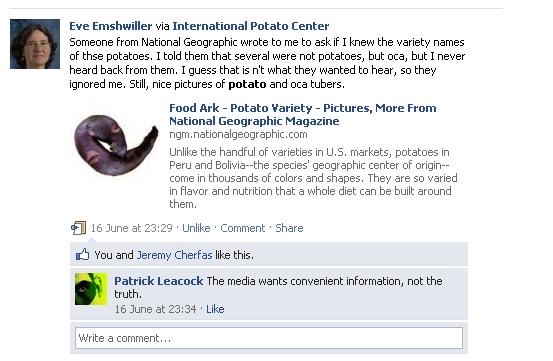
“That’s a potato?” asks the heading of the photo gallery called “Potato Variety” in the “Food Ark” feature on the loss and conservation of agricultural biodiversity in the latest National Geographic Magazine. Well, actually, no. No, not all of the images shown are potatoes. Five of the eighteen tubers shown are oca, Oxalis tuberosa, one of the three other Andean tuber crops.
As far as I can tell, the gallery of “Uncommon Chickens” and the one for “Rare Cattle” didn’t include any ducks, turkeys, or goats. People would have noticed. In the case of their “Potato Variety” gallery, on the other hand, they missed half of the story. If they’d gotten it right, they would have been able to educate their readers about more than variation within a single crop. They could have gone on to explain about the values of cultivating a diversity of different species, diversity that far exceeds even that in the amazing native Andean potatoes.
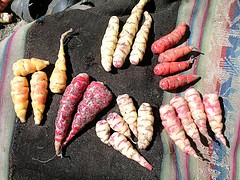 The three “minor” tuber crops may not have gained the worldwide importance of the potato, but for a story that focused on the loss of diversity, these other tubers offer even more poignant examples. In my travels in Peru with the germplasm coordinators of INIA (which currently stands for Instituto Nacional de Innovación Agraria), we came across many places where oca was being abandoned by farmers, due either to severe weevil larvae infestations, or in favor of more marketable crops such as commercial potato varieties.
Among the not-so-lost crops from long-before-the-Incas, are a whole bunch of Andean root and tuber crops (often lumped together as ARTs). Ancient Andean people not only domesticated potatoes in all their incredible diversity, but also other tuber crops from three completely different plant families. For those who haven’t met them yet, the three non-potato Andean tubers are (1) oca, Oxalis tuberosa, of the Oxalidaceae, the wood sorrel family; (2) ulluco or papa lisa, Ullucos tuberosus, of the Basellaceae, the same family as Malabar spinach; and (3) mashua, añu, or isañu, Tropaeolum tuberosum, from the Tropaeolaceae, the family of garden nasturtiums. None of these are closely related to each other, or closely related to the family to which potatoes belong (Solanaceae, the nightshade family). No other area of the world domesticated so many different tubers.
Ancient Andean people also domesticated several root crops as well, which are also each from a different plant family. 1
Don’t get me wrong, I think it is absolutely wonderful that the NGS is featuring agricultural biodiversity in their magazine and online. Maybe it bodes well for another spurt of attention to this theme from magazine journalists — don’t they return to it every 25 years or so?
In truth, people are constantly mixing up the Andean tubers, so it is really no surprise that it is happening again. Ulluco is often mistaken for a colorful potato, and it seems as if oca and mashua are mistaken for each other more often than not. Many of the images online that are purporting to be oca, are not. Meanwhile, oca is often mistaken for a native Andean potato, just as in the case of the five tubers of oca (one of them fasciated) that were called potato by National Geographic. So, this is not an unusual case.
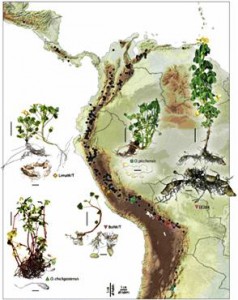
But, looking on the bright side, at least CIP has a program on ARTs, now prominently displayed on their newly redesigned website, including a brief introduction to the non-potato Andean tuber crops. And I trust that some of the many celebrations of Peruvian food recently featured on this blog certainly must include dishes made with ARTs, in an effort to overcome these crops’ stigma as “poor person’s tubers.”
In fact, perhaps things are better than I thought. See the image in the Food Ark Photo Gallery that has a caption that begins “A nest of hay preserves harvested potatoes and tubers in Pampallacta, Peru.” Pampallacta is part of the Parque de la Papa, yet the tubers pictured are oca again. So, does that mean that the Parque de la Papa is indeed working to preserve the non-potato Andean tubers as well?