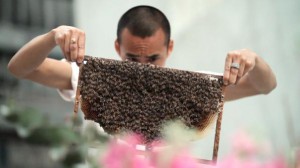
 I can’t resist sharing this wonderful video about a guy I found, well, inspirational is the only way I can describe him. And believe me, I don’t often use that word, at least about people. Clicking on the photo will take you to Vimeo. Thanks, Grist.
Climate Change and Indigenous Knowledge Systems: conference
AYSICCIK is, believe it or not, the snappy acronym for the African Young Scientists Initiative on Climate Change and Indigenous Knowledge. And they’re drawing attention to an International Student Conference on Climate Change and Indigenous Knowledge Systems, to be held in Johannesburg, South Africa, on 15-17 August 2011. It is probably too late to apply for a scholarship, but you have until next Tuesday (31 May) to submit an abstract on one of the six conference themes. Food security is in there, as are indigenous knowledge, biodiversity management and other topics dear to us.
So, what are you waiting for? And if you do go, we would welcome reports.
What is and is not going to happen with antimalarial trees
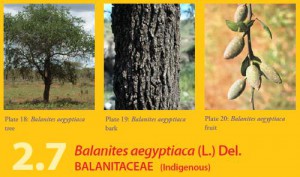 ICRAF’s project and publication on trees with antimalarial properties has made it into the prestigious medical journal The Lancet. Kudos indeed.
 UnLike that article, fortunately, the ICRAF publication is not behind a paywall. The project has been much in the news, and rightly so, but at least one report is inaccurate in suggesting that ICRAF are planning a major effort on ex situ conservation of antimalarial trees. This is how The Star entitled its article when the book was launched: “ICRAF starts trees gene bank project in Nairobi.” And this was their lede:
A project to document genetic properties of more than 3,000 forest trees across the continent has started in Nairobi.
In fact, ICRAF already has a genebank, of about 200 species, and there are no plans to either expand that to 3000 species or specifically focus on collecting antimalarials in the future. According to our sources, The Star correspondent may simply have conflated the malaria book project with the results of a recent meeting at ICRAF on the State of the World’s Forest Genetic Resources.
LATER: My sincere apologies to The Lancet. That paper is NOT behind a paywall. You just need to register. Which takes a bit of time and effort but does not involve the exchange of currency. Sorry!
Veggie genebank gets its seeds out
The University of California Davis (UC Davis) leads an international effort to help developing countries through improved marketing and production of high-value horticultural crops. Established by the United States Agency for International Development (USAID), the Horticulture Collaborative Research Support Program (HortCRSP) supports projects to improve the livelihoods of the world’s poor and builds on their needs highlighted in the Global Horticulture Assessment.
Oh hum, right? Not so fast. One of the projects being supported is this:
Dr. Ricky Bates, Horticulture Department of Penn State University has received a one-year exploratory grant from HortCRSP to look at methodologies for strengthening informal indigenous seed systems in Northern Thailand and Cambodia.
And it gets better. A genebank is involved. My cup runneth over.
The ECHO seed bank partnership is a very important integral part of this project. Dr. Bates states that, “ECHO has been around for awhile. ECHO is located in Ft. Myers Florida and has been around for at least 20 years. They see themselves more or less as an extension service where they are there to resource and support NGOs and people working all around the world with poor farmers. It is a little like an extension system where they provide information and printed material via online or telephone calls to people who may find themselves perhaps in India with World Vision. ECHO is there as a resource for NGOs that do not have an agricultural background. What grew up with the development of ECHO has been the development of a vey innovative seed bank in Ft. Myers Florida where they sort of specialize in tropical fruits and vegetables. They make these seeds available at low cost or no cost to individuals and NGOs working around the globe in development.
Can biodiversity research change the future of agriculture?
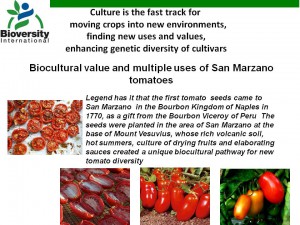 Our friend, colleague and, apparently, occasional reader Pablo Eyzaguirre, an anthropologist at Bioversity International, by all accounts gave a barnstorming performance in an internal seminar recently, but alas all that is available of it at the moment for those of us who were not there is his PowerPoint presentation, whose title we have stolen for this post. That is, of course, better than nothing, and I’m certainly not complaining. 1
It’s worth going through the whole thing, imagining Pablo in full flood. But if one were to boil his argument down to essentials, something that I feel sure Pablo himself would abhor, it might go something like this, and I use Pablo’s own words from the slides, only slightly re-arranged:
- You cannot solve problems with the same mentality that created them: intensification through simplification and increased inputs.
- Agrobiodiversity provides an answer as a source of inputs to address the problems arising from simplification of agriculture and depletion of the natural resource base.
- But diverse traditional agricultural systems are also crucibles for the development of innovative new ways of producing food linking agriculture more responsively to consumers and emerging movements on food culture, health and territory, and building on synergies among crop varieties, species and breeds, wild and cultivated spaces.
- So where can we find, and scale out, the new models for bio-intensification and increased resilience in agriculture? Where local institutions and knowledge systems exist to embed, govern and transmit the value and potential of their agricultural biodiversity and biocultural landscapes to young people and allies in conservation and development.
Well, there’s much more to the presentation than that, of course, and lots of wonderful examples to reinforce each point. Go check it out for yourself. And Pablo, if you’re reading this, maybe you’d like to write a summary for your fellow readers?
The question it leaves me with is this: with no agrobiodiversity “megaprogramme” in the CGIAR, will there be enough of the “alternative” mentality around to take up Pablo’s gauntlet?