Spend a few minutes watching this wonderful Ted Talk by Louie Schwartzberg, a film-maker with a thing for time-lapse flowers and slo-mo birds, butterflies, bluebottles, bees, and bats.
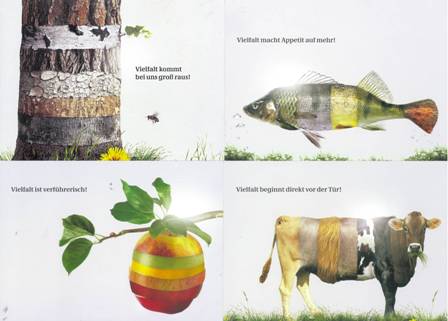
German agricultural biodiversity illustrated
I rather liked these depictions of agrobiodiversity from the German Federal Ministry of Food, Agriculture and Consumer Protection (BMELV).
You say diversity
From the way she’s linking it to health in this snippet from her speech at FAO today, I suspect Hillary meant crop diversification when she talked about the work on “crop diversity” being done by Feed the Future. I wonder if anyone will be able to point out to her that there’s another, often overlooked, dimension to the diversity in farmers’ fields, which underpins the other, very sensible stuff she said about the need for improved varieties.
H.R. Clinton favours increased crop diversity shock
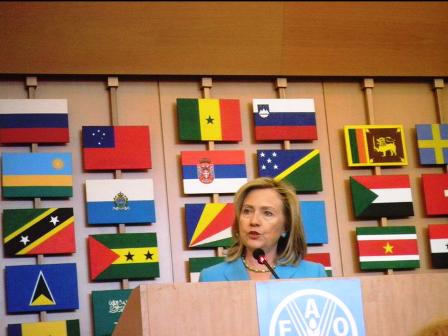
This just in from our colleague with the FAO building pass. (Photo hacked from IFAD’s Facebook page.
Just went and heard Hillary at FAO. She was brilliant and spoke very sensibly about food security.
She said we need higher quality seeds (more nutritious, more drought tolerant and disease resistant), we need to connect farmers to local markets and local markets to global markets. She also said we need to increase crop diversity!!
Hopefully the full transcript will be available on the FAO website at some point – she spoke very quickly!
She ended by saying that in spite of all the current headlines, she keeps her eye on the ‘trendlines’ and that we need to make advancing food security a cause for our time and deal with it now, or else we may never catch up.
LATER: Here’s the audio.
The latest on the Haitian seed donation controversy
You may remember a number of posts we did last year on the Monsanto donation of maize and vegetable seed to Haiti in the wake of the earthquake, and what Catholic Relief Services and others thought about it, which was, in a nutshell, not much. Now, via Truthout, comes news of an investigation by Haiti Grassroots Watch of what happened to the seed. The article also usefully recounts the whole story. And there’s a summary, with added video goodness. These three points from the summary probably best describe where Haiti Grassroots Watch are coming from:
At least some of the peasant farmer groups receiving Monsanto and other hybrid maize and other cereal seeds have little understanding of the implications of getting “hooked” on hybrid seeds. (Most Haitian farmers select seeds from their own harvests.) One of the USAID/WINNER trained extension agents told Haiti Grassroots Watch that in his region, farmers won’t need to save seeds anymore: “They don’t have to kill themselves like before. They can plant, harvest, sell or eat. They don’t have to save seeds anymore because they know they will get seeds from the [WINNER-subsidized] store.” When it was pointed out that WINNER’s subsidies end when the project ends (in four years), he had no logical response. At least some of the farmer groups interviewed also don’t appear to understand the health and environmental risks involved with the fungicide- and herbicide-coated hybrids. In at least one location, it is quite possible farmers plant seed without the use of recommended gloves, masks and other protections, and – until Haiti Grassroots Watch intervened – they were planning to grind up the toxic seed to use as chicken feed. In at least several places around the country, donated seeds produced no or little yield. “What I would like to tell the NGOs it that, just because we are the poorest country doesn’t mean they should give us whatever, whenever,” disgruntled Bainet farmer Jean Robert Cadichon told Haiti Grassroots Watch.
But, as a pithy encapsulation of the Haitian seed donation conundrum, I liked this comment from an interviewee:
“We love Monsanto seeds,” Farmer said again. Although he noted that the bigger kernels don’t always fit in farmers’ corn mills.
Farmers! Always wanting more.