AgriCultures Network has a couple more modules in its Learning AgriCultures series up on the website, on “Labour and energy” and “Markets and finance” for small-scale farmers. Module 3 is the one with the discussion of agrobiodiversity.
David Attenborough on Foreign Fare
Anyone got a copy of David Attenborough’s Life Stories, Series 2, Foreign Fare radio programme about the potatoes, Irish and sweet? For personal use only, you understand.
Later: I discovered that it was on the BBC World Service this morning, and is still available, for almost another week. And after just 30 seconds of listening, I feel it my duty to point out that there are not two but three kinds of artichoke, at least in English. Attenborough forgot about Stachys affinis, the Chinese artichoke. Common names, again. But an entertaining enough romp through the Solanaceae.
Training manual for GIS analysis of agrobiodiversity data
Great to see “Training Manual on Spatial Analysis of Plant Diversity and Distribution” finally out, courtesy of Bioversity International. Well worth the wait, and not just because I get called a pioneer in it. Congratulations to Xavier Scheldeman and Maarten van Zonneveld for addressing a very important need.
This manual has been published as a result of the increasing number of requests received by Bioversity International for capacity building on the spatial analysis of biodiversity data. The authors have developed a set of step-by-step instructions, accompanied by a series of analyses, based on free and publically available software: DIVA-GIS, a GIS programme specifically designed to undertake spatial diversity analysis; and Maxent, a species distribution modelling programme. The manual does not aim to illustrate the use of each individual DIVA-GIS and Maxent command/option, but focuses on using GIS tools to help answer common questions relating to the spatial analysis of biodiversity data. Throughout the manual, the importance of proper sampling is stressed; however, it is beyond the scope of the document to elaborate on sampling theories. The manual also does not discuss the statistical analysis of diversity data in detail; instead, when statistical methods and programmes are mentioned in the text, the reader is referred to alternative reference materials for further information.
Agrobiodiversity from the air
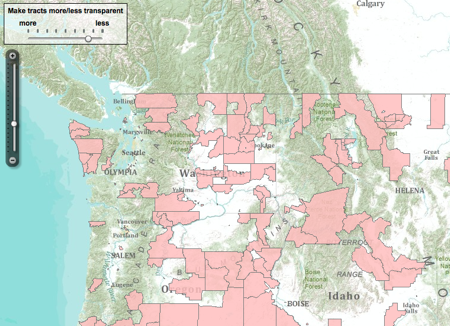
I see yesterday’s Wired article on agricultural landscapes from space and raise you our post from months back.
Promote better nutrition and self-sufficiency with a few clicks
The Cooperative Society in the UK recently launched a scheme called Join the Revolution. People submit projects and other people vote for them. Winners get money — GBP 5000 — towards their project.
A project I already knew about alerted me and asked me to vote, which I have done even though, to be perfectly honest, the proposal didn’t exactly set the heart aflutter. There’s another project in similar vein that is currently doing better, so I won’t link to that, but it isn’t hard to scan all the submissions and pick the revolution you would most like to foment. In fact, you’re allowed to vote for as many as you want, which seems a little odd. On the other hand, having clicked the few times needed to register on the site, it seems wasteful not to vote often.
There are some videos about projects which, I think, were funded in an earlier round. Here’s one I could relate to.
Are there any other Coop-funded revolutions we should promote? Other competitions?