From the way she’s linking it to health in this snippet from her speech at FAO today, I suspect Hillary meant crop diversification when she talked about the work on “crop diversity” being done by Feed the Future. I wonder if anyone will be able to point out to her that there’s another, often overlooked, dimension to the diversity in farmers’ fields, which underpins the other, very sensible stuff she said about the need for improved varieties.
H.R. Clinton favours increased crop diversity shock
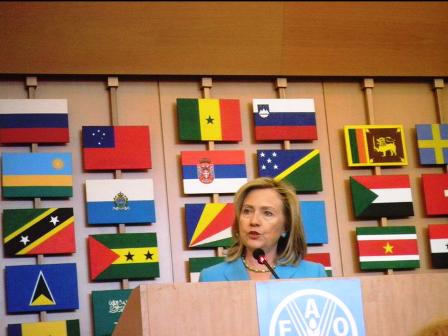
This just in from our colleague with the FAO building pass. (Photo hacked from IFAD’s Facebook page.
Just went and heard Hillary at FAO. She was brilliant and spoke very sensibly about food security.
She said we need higher quality seeds (more nutritious, more drought tolerant and disease resistant), we need to connect farmers to local markets and local markets to global markets. She also said we need to increase crop diversity!!
Hopefully the full transcript will be available on the FAO website at some point – she spoke very quickly!
She ended by saying that in spite of all the current headlines, she keeps her eye on the ‘trendlines’ and that we need to make advancing food security a cause for our time and deal with it now, or else we may never catch up.
LATER: Here’s the audio.
The latest on the Haitian seed donation controversy
You may remember a number of posts we did last year on the Monsanto donation of maize and vegetable seed to Haiti in the wake of the earthquake, and what Catholic Relief Services and others thought about it, which was, in a nutshell, not much. Now, via Truthout, comes news of an investigation by Haiti Grassroots Watch of what happened to the seed. The article also usefully recounts the whole story. And there’s a summary, with added video goodness. These three points from the summary probably best describe where Haiti Grassroots Watch are coming from:
At least some of the peasant farmer groups receiving Monsanto and other hybrid maize and other cereal seeds have little understanding of the implications of getting “hooked” on hybrid seeds. (Most Haitian farmers select seeds from their own harvests.) One of the USAID/WINNER trained extension agents told Haiti Grassroots Watch that in his region, farmers won’t need to save seeds anymore: “They don’t have to kill themselves like before. They can plant, harvest, sell or eat. They don’t have to save seeds anymore because they know they will get seeds from the [WINNER-subsidized] store.” When it was pointed out that WINNER’s subsidies end when the project ends (in four years), he had no logical response. At least some of the farmer groups interviewed also don’t appear to understand the health and environmental risks involved with the fungicide- and herbicide-coated hybrids. In at least one location, it is quite possible farmers plant seed without the use of recommended gloves, masks and other protections, and – until Haiti Grassroots Watch intervened – they were planning to grind up the toxic seed to use as chicken feed. In at least several places around the country, donated seeds produced no or little yield. “What I would like to tell the NGOs it that, just because we are the poorest country doesn’t mean they should give us whatever, whenever,” disgruntled Bainet farmer Jean Robert Cadichon told Haiti Grassroots Watch.
But, as a pithy encapsulation of the Haitian seed donation conundrum, I liked this comment from an interviewee:
“We love Monsanto seeds,” Farmer said again. Although he noted that the bigger kernels don’t always fit in farmers’ corn mills.
Farmers! Always wanting more.
Plant traits analyzed globally
 When we talk about plant traits here we are usually referring to things like characterization and evaluation descriptors, and how they vary within crops. But there’s an ambitious initiative underway to document “the morphological, anatomical, physiological, biochemical, and phenological characteristics of plants and their organs” — some 1500 of them — across the world’s entire wild flora. It’s called TRY, and it is described in a new paper in Climate Change Biology. 1 It works by bringing together existing datasets in a data warehouse, like this:
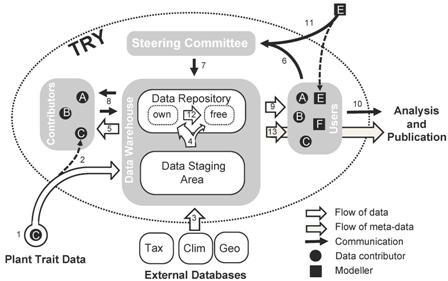
I think the caption to this diagram (Fig. 1 in the paper) is worth quoting in full, as it may give some ideas to people developing similar systems more aimed at agrobiodiversity, like Genesys.
The TRY process of data sharing. Researcher C contributes plant trait data to TRY (1) and becomes a member of the TRY consortium (2). The data are transferred to the Staging Area, where they are extracted and imported, dimensionally and taxonomically cleaned, checked for consistency against all other similar trait entries and complemented with covariates from external databases (3; Tax = taxonomic databases, IPNI/TROPICOS accessed via TaxonScrubber (Boyle 2006), Clim = climate databases, e.g. CRU, Geo = geographic databases). Cleaned and complemented data are transferred to the Data Repository (4). If researcher C wants to retain full ownership, the data are labelled accordingly. Otherwise they obtain the status ‘freely available within TRY’. Researcher C can request her/his own data – now cleaned and complemented – at any time (5). If she/he has contributed a minimum amount of data (currently >500 entries), she/he automatically is entitled to request data other than her/his own from TRY. In order to receive data she/he has to submit a short proposal explaining the project rationale and the data requirements to the TRY steering committee (6). Upon acceptance (7) the proposal is published on the Intranet of the TRY website (title on the public domain) and the data management automatically identifies the potential data contributors affected by the request. Researcher C then contacts the contributors who have to grant permission to use the data and to indicate whether they request co-authorship in turn (8). All this is handled via standard e-mails and forms. The permitted data are then provided to researcher C (9), who is entitled to carry out and publish the data analysis (10). To make trait data also available to vegetation modellers (e.g. modeller E) – one of the pioneering motivations of the TRY initiative – modellers are also allowed to directly submit proposals (11) without prior data submission provided the data are to be used for model parameter estimation and evaluation. We encourage contributors to change the status of their data from ‘own’ to ‘free’ (12) as they have successfully contributed to publications. With consent of contributors this part of the database is being made publicly available without restriction. So far look-up tables for several qualitative traits (see Table 2) have been published on the website of the TRY initiative (http://www.try-db.org). Meta-data are also provided without restriction (13).
How far has it worked?
As of 31.03.2011 the TRY data repository contains 2.88 million trait entries for 69,000 plant species, accompanied by 3.0 million ancillary data entries15. About 2.8 million of the trait entries have been measured in natural environment, less then 100.000 in experimental conditions (e.g. glasshouse, climate or open top chambers).
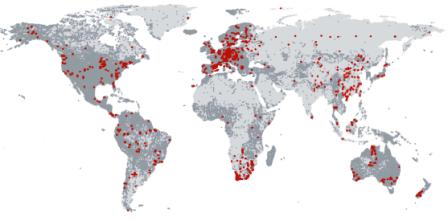
Here’s the distribution of the 3458 geo-referenced sites where leaf nitrogen content per dry mass was measured. The grey areas are places where the various species on which the measurements were made can be found, according to GBIF. Not exactly global coverage just yet, but not bad. Interestingly, an analysis of the data available thus far showed that though most of the variation in most traits was at the species level, up to 40% was intraspecific.
Coincidentally (or maybe not?) there’s also a paper just out in New Phytologist which looks at the global distribution of a particular class of plant traits, those associated with resistance to herbivores. There’s no reference to TRY in the paper, but a couple of the same people are involved, and I think this is one of the datasets that have been contributed to the warehouse. 2
We worked at 75 study sites, distributed from 74.5°N to 51.5°S… Sites were selected to sample the dominant vegetation types at a wide range of latitudes… [T]he primary criterion [for site selection] was that the levels of herbivory, disturbance regime and plant community composition should be relatively natural (i.e. as close as possible to those with which the plant traits we are measuring are thought to have evolved). At each site, we sampled the four most abundant species…
The key finding was that despite the long-held belief that tropical plants are in general more resistant to herbivory than those from temperate climes, there is actually little evidence of this in the data. If anything, the trend is in the opposite direction. I wonder whether that will hold within species (or genepools) as well as across them.
Sending the future up in smoke
Here, as our informant put it, is “today’s chapter in a seemingly never-ending story”.
The state legislature of North Carolina in the United States is minded to cut all funding to the North Carolina Tobacco Trust Fund. That’s short-sighted and a great shame.
Tobacco, unlike, say, opium poppy, is not an easy crop, to grow or to defend. Wendell Berry, although he doesn’t himself grow it, is surrounded by people, including family, who do and he has worked for many of them. Berry has written elegiacally about tobacco, and the essential dilemma it presents, now that demand has fallen. I can’t find my copy of that essay right now (or on the web) but the gist of it was that a high-value crop like tobacco spared the environment because by dint of skill and hard work a family could make a decent living from a relatively small patch of land for the tobacco and the food they needed.
North Carolina’s Tobacco Trust Fund was established with the state’s share of money that the tobacco companies paid in settlement of lawsuits, and is intended to protect farms and smooth the transition from tobacco to new crops, new farming systems, and new approaches to local sales. In other words, to promote diversification. By all accounts, it has worked. One advocate for, and beneficiary of, the Fund put forward these numbers:
In the past three years alone, RAFI’s Tobacco Community Reinvestment Fund has brought over $733 million into communities throughout the state and created or preserved more than 4,100 jobs. All these benefits come from a relatively modest investment: $3.6 million of Tobacco Trust Fund money distributed to 367 innovative farmers in awards of less than $10,000 per individual or $30,000 per community project. Each dollar invested has led to $205 circulating in our state’s economy, an incredible return on investment with direct benefits to our tax base.
Why North Carolina is planning to cut the Fund is not at all clear to me. This certainly isn’t a case like that of the genebanks at Pavlovsk, or Wellesbourne, or Jharkand, where land is deemed more valuable for other purposes. But it shares the same basic underlying premise; that the future can take care of itself. Where agriculture is concerned, with its dependence on living resources and human ingenuity and knowledge, that is often simply wrong. There’s money to be saved (or made) now, but only because those who make and save it now will not have to pay out in future for what they destroy now.
Not every piddling genebank or subsidy scheme deserves to remain untouched, but it doesn’t take a genius or a seer to realize that the costs down the line often far outweigh the benefits here and now. We don’t really know how to measure those costs properly, but that’s not the real problem. The real problem is that the rules of the game require that we do, and there doesn’t seem to be any way to change the rules.