Getting curators to think like breeders

The presentation on genomics and fruit genebanks Cameron Peace gave at the recent PAG symposium deserved more than the nibble we gave it. Dr Peace, who is an assistant professor in tree fruit genetics at Washington State University, is advocating nothing less than a complete change in the mindset of genebank curators. Here’s how he characterizes the current system:
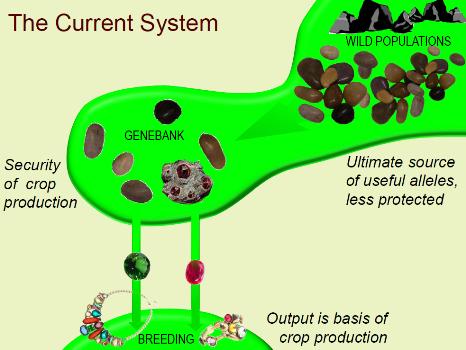
Notice the mere trickle of material from the genebank to the user. All too true. I would say that there is also much less movement of material from wild populations to genebanks than is suggested by the diagram. But that’s at least partially down to the fundamental fact that flow of material to breeders is fairly limited. No demand, no supply. This, in contrast, is what Dr Peace wants to see:
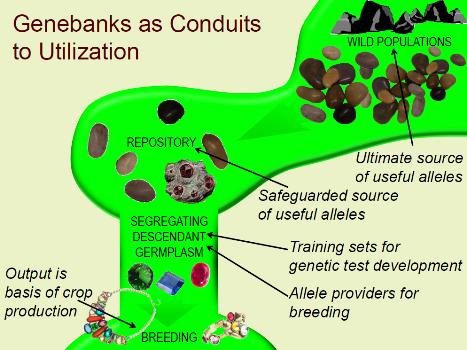
He wants genebanks to get their skates on and, to mix a metaphor, not wait for the breeders to pull. He wants them to push. He wants them to provide performance information, and not just data on morphological descriptors; performance-predictive DNA information, and not just genetic diversity data; segregating descendant populations, and not just landraces or wild populations.

In essence, Dr Peace wants genebank curators to think like breeders. More, he wants them to be breeders. Or at least pre-breeders.

There’s much to be said for this. The latest State of the World’s Plant Genetic Resources for Food and Agriculture (SOW2) bemoans the continuing obstacles to use of collections. Something Must Be Done, it suggests. But curators have their hands full. The same SOW2 says that they have no money. That they need more equipment. That they have regeneration backlogs. That people are telling them to conserve more neglected and underutilized plants, and more crop wild relatives. That’s when armed gangs of looters are not ransacking their facilities. Now they should be plant breeders as well? Sheesh!

Well, the fact is that with the International Treaty on PGRFA, most curators don’t have to worry about basic conservation. Not really. Not for Annex 1 crops anyway. They can choose to outsource that stuff, for example to the international centres of the CGIAR, secure in the knowledge that they can have access to the material whenever they want it.

With the ITPGRFA, curators have the space to think like breeders. But do they have the training? And will the breeders return the compliment, and think a bit like curators?
Egyptian genebank looted

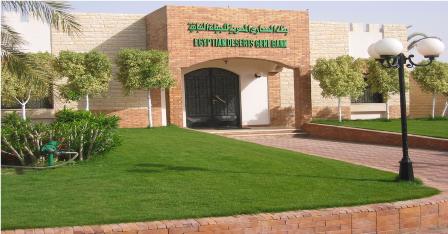
I suppose it’s only a small blip in the great scheme of things, but you know what they say: to a hammer everything is a nail. And to a genebank guy everything that happens affects genebanks. In this case, the Egyptian Deserts Gene Bank at Sheikh Zowaid Station in North Sinai, which we are told has been trashed during the current turmoil in Egypt. 1 It specializes in desert plants, and has wide international partnerships, including with the Millennium Seed Bank at Kew and the Genetic Resources Policy Initiative. The manager had to abandon the place when its security detail disappeared and an armed gang warned him that they would be coming in the night. Which they indeed did, to devastating effect, getting away with lots of equipment and wrecking the cooling system. The collection is not duplicated in the national genebank in Giza, which apparently has not suffered similar looting. 2 The genebank manager called a few people in Cairo before having to abandon the place, including our informant, so the problem is known to the national agricultural research authorities, but there’s nothing anyone can do at the moment, clearly.

LATER: Nourishing the Planet weighs in with a nice article.

Seed dispersal: how far is far enough?

ResearchBlogging.org This barely merits the Research Blogging tag, because all I want to do here is raise a possibility, and a tenuous one at that. I confess that I was attracted in a high-speed scan of headlines, by this one: Leaving home ain’t easy: non-local seed dispersal is only evolutionarily stable in highly unpredictable environments. 3 The starting point is the common armchair argument that seeds disperse for three non-exclusive reasons: to escape changes in the environment they are leaving, to avoid overcrowding (and competition with sibs?) and to find and exploit new environments before other competitors.

Robin Snyder’s mathematical model seeks to understand how far seeds need to move from their parent to be reasonably certain of encountering different growing conditions. After all, “why ‘escape in space’ only to land somewhere more or less like where they started?” The models show that in almost all cases, dispersal tends to be not far enough to get away from the “parental” conditions. Only when favourable conditions are very fleeting is it worthwhile for some seeds to leave home far behind, as a “response to environmental unpredictability”.

Why bring this up here? Because the seeds of high-performing agricultural varieties are often dispersed hundreds or thousands of kilometres from the environments in which they were deemed successful. In theory they are being sent to places with very similar growing environments. But might this actually be an argument for sending seeds far from home specifically as a strategy to enable the farmers selecting them to respond to environmental unpredictability?

Many recipes to cope with food production needs

It’s been a busy week or two for food and agricultural policy news, what with the Arab world supposedly ignited by high food prices and weighty documents elsewhere calling forth high-minded rhetoric and tosh in roughly equal measure. To be honest it doesn’t feel right to do more than offer our endless refrain: that there is no one-size-fits-all solution out there, and that diversity brings resilience at levels from the individual meal to the global food network. And to point to some thought-provoking items. To whit:

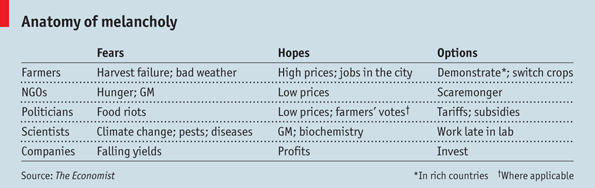
The Economist’s deeply cynical story How much do rich governments really worry about feeding the world? seems to hit all the right spots.

The UN’s Special Rapporteur on the right to food seems to hit all the spots you might have expected him to hit, buttering parsnips like nobody’s business.

And the European Union has, as usual come up with a very snappy acronym for a million euro project to tackle malnutrition in Africa: SUNRAY, short for Sustainable Nutrition Research for Africa in the Years to come. Here’s what they’ll be doing.

  • WP1 optimises communication and coordination within the Consortium.
  • WP2 maps current nutrition research activities in sub-Saharan Africa, and examines the operating environment.
  • WP3 analyses the views of stakeholders.
  • WP4 examines the impact of environmental changes on nutrition.
  • WP5 builds consensus on research priorities through workshops in three African regions.
  • WP6 develops a strategic framework for future research in the form of a roadmap.
  • WP7 disseminates project outputs.