Thanks to the excellent DAD-Net 1 comes news of the 5th European Seminar on AgroBiodiversity: “Preservation or Adaptation? – Conservation in the face of a changing environment.” It’s to be held 25 September 2011 in Dimitrovgrad, Serbia (that’s near the Bulgarian border), as part of the annual meeting of the SAVE Foundation and the European SAVE Network. Sounds like great fun, especially the “Regional Fair of Balkan AgroBiodiversity.” Anyone going?
Satoyama in peril?
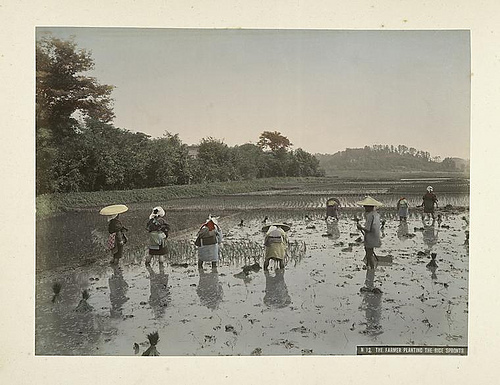
It may not be the thing that’s at the top of people’s agendas in Japan at the moment, but one does wonder what the long-term effect of the tsunami will be on the satoyama of the region, their agrobiodiversity and the people who maintain it. 2 The BBC series on the satoyama from a few years back is no longer available on the BBC’s website, but some of the documentaries can be found elsewhere. 3
Balinese news massage
I’m sure our readers do not have to be reminded that they can follow the deliberations of the Fourth Session of the Governing Body of the International Treaty on Plant Genetic Resources for Food and Agriculture online. Almost as good as being there in a fancy hotel in Bali. As ever, we will publish all gossip, the more scandalous the better.
Featured: Impact
Robert is unimpressed by at least one of the CGIAR’s 40 talents, “biological control of two devastating insect pests”.
This was about fixing what other researchers had broken when they shipped infected South American cassava to Africa. I understand it was fixed by finding a natural enemy in South America and bringing that to Africa as well.
It was great that the CGIAR did this, and employed an entomologist to do it, but there would have alternative suppliers aplenty. Any decent entomologist could have done that.
So wouldn’t this have happened anyway, perhaps a little bit later? If so the counter-factual is “basically the same result” (no impact). Entirely different thing from investing in a breeding program. Or a genebank.
And he has a nice little coda on using such efforts as a tool for extortion.
The CGIAR’s impact spelled out
The collaborative work of the Consultative Group on International Agricultural Research (CGIAR) has resulted in development impacts on a scale that is without parallel in the international community.
And there are 40 of them, more than half in crop improvement, half a dozen in natural resources management, a few in the policy arena. Anyone out there disagree? Anything left out? Anyone think some of “impacts” included are not so great after all? Let us know.
Let me start the ball rolling. I happen to think that putting together and maintaining the international germplasm collections, and placing them under the aegis of the International Treaty, is a significant technical and policy achievement in its own right. After all, they underpinned all that crop improvement. Maybe that doesn’t count as an “impact.” But perhaps it should.