Where do bananas grow anyway?

Where does crop X grow? Important question. And pretty simple too, no? No! Because just a little looking around yields about half a dozen different answers, and no clear idea of which to trust, or how they relate to each other, or how they were arrived at, or even if there are more.

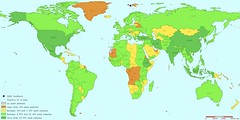
Here’s what I came up with in only about half an hour of searching. The following are all data for banana/plantains. First, there’s MapSpaM (that would be Spatial Production Allocation Model), from HarvestChoice:

Then there’s FAO’s AgroMAPS, which has some really weird data in it. Try looking at the distribution of cassava in Africa, for example. Anyway, here’s banana, which actually looks pretty weird itself:

And then there’s CIAT’s Crop Atlas of the World. 1 That says it is based on the FAO data, but doesn’t really seem like it to me, at least not on this evidence:

In its time, CIAT has also used the dataset from the Land Use and Global Environmental Change project called “Harvested Area and Yields of 175 crops (M3-Crops Data),” but I haven’t been able to get a map of that.

And then there’s IITA’s banana mapping effort, which admittedly is very much still a work in progress:

Well, I suppose I could sort out some of the questions I have about all this if I spent a little more time at it. But really, should a poor boy have to? Shouldn’t FAO, or the CGIAR, have all this sorted out by now? Anyone out there want to guide me through this?

The magic number is 5000

How many times have we heard the (para-) phrase: “It’s simply impractical to bring populations of critically endangered species up into the thousands”?

Well, my friends, if you’re not talking thousands, you’re wasting everyone’s time and money. You are essentially managing for extinction.

Ouch.

Where are the variety-level food composition data?

FAO has just announced the publication of Composition of Selected Foods from West Africa.

The table includes 173 foods and 30 components. It is mainly a compilation of data from other food composition tables, theses and the scientific literature. It is one of the first regional food composition tables not only including data on commonly consumed raw foods but also cooked foods and on food biodiversity, i.e. data on variety level and on underutilized foods.

Well, that is all true as far as it goes, but I’m afraid it doesn’t really go very far. There are indeed data on things like fonio and baobab leaves in the table, which is very welcome. But the variety-level data are very limited, with maybe a dozen pearl millet and a few maize entries. Still a lot of work to be done there. Interestingly, the pearl millet varieties all have ikmp numbers (like ikmp-5), which suggests that they are selections made in Burkina Faso by INERA (Institut de l’Environnement et de Recherches Agricoles).

Is diet on the agenda or not?

I’m puzzled. Having taken one attendee at the recent biofortification conference to task for utterly ignoring dietary diversity as a source of good nutrition, we were told, privately, that “biodiverse diets are 1st choice, but high nutrient crops can help in the mean time or in addition to a diverse diet”. And yet I have just read another stirring report from that conference that does not mention diversity of diet.

Am I still missing something?