
You think they’re discussing this sort of thing at the “Leveraging Agriculture for Improving Nutrition and Health” conference? You think they’re also discussing dietary diversity?
Agriculture being leveraged in Delhi
The IFPRI 2020 Conference on “Leveraging Agriculture for Improving Nutrition and Health,” is off and running in New Delhi, India. If you can’t be there in person, at least there’s a Twitter feed. Impressions from participants always welcome.
LATER: There’s a blog too, of course.
Herdwick sheep pass viability test
Embryos and sperm collected almost 10 years ago at the height of the Foot and Mouth epidemic in the UK have proved viable, according to a report from the UK’s Channel 4 News. Five ewes are carrying lambs fathered by rams lost to foot and mouth disease, and another three are surrogate mothers to embryos taken from sheep culled during the epidemic.
The threat to Herdwicks, one of several hardy heritage sheep breeds particularly valued for crossbred animals, prompted a rescue mission and resulted in the formation of The Sheep Trust. The report points out that in the end the precautions weren’t necessary — only about a third of the Herdwick flock was culled — but that it was impossible to know that in advance.
The Sheep Trust has taken on 12 heritage breeds, and calculates that 10 of those are geographically very concentrated, with 95% of the animals within 65 km of the centre of the breed’s distribution. This, the Trust warns, makes them vulnerable to future outbreaks of disease.
Food on a pedestal
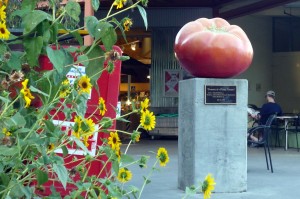 Inspired by Jeremy’s posts on corn statues and tomato experiments in Davis, California, I offer you the “Portrait of a plump tomato”, by Gerald Heffernon. It stands in front of a Davis shop that sells heirloom tomatoes and other agricultural biodiversity (20 rice varieties!).
 I wonder if the tomato is celebrated here for the many (industrial use) tomato fields in the Davis area. Gerald Heffernon is somewhat of a fruit specialist: he also made apricot, pear, plum and cherry statues, but food statues are rare in the USA and elsewhere.
 As far as I know, and do correct me if I am wrong, the Philippines is the only country where food gets due respect, and the statues that come with that.
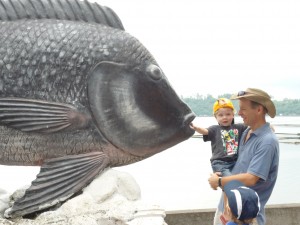
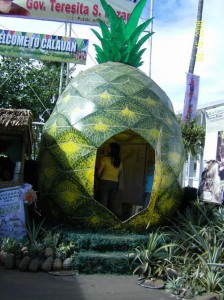
I believe the highest density to be in a small area, roughly forming a triangle with 10 km edges, in Laguna province. San Pablo — with its many lakes — has a big tilapia. Victoria, known for its sweet pinya, a fierce pineapple.
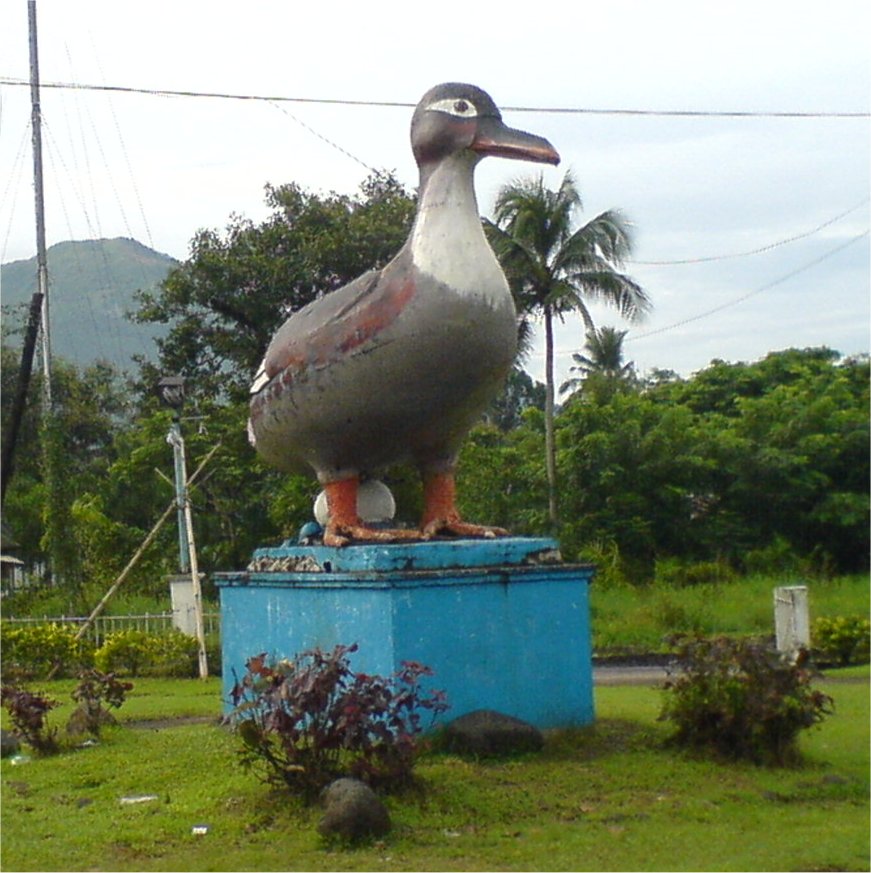 Laguna de Bay, the place to eat ducklings-in-the-egg known as balut (not for the faint of heart) has duck statues (here is another good one).

There are plenty of (golden and other) cow statues, in Asian temples, and elsewhere. Do you know of other statues that honor the the organisms that feed us?
A great quiz, not so well done
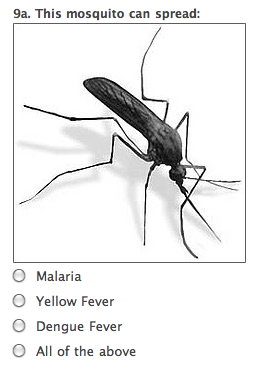 I was thrilled to see a Tweet from Farming First asking How much do you know about agriculture, nutrition and health? Lots, and I love online quizzes and the opportunity to show off. Who doesn’t? So I hurried on over, to discover a quiz from IFPRI, tied to the meeting on Leveraging Agriculture for Improving Nutrition & Health, which opens tomorrow in New Delhi. 1 It is really nice, with a good mix of questions and types of answers. I only really carped at one, pictured over there. Perhaps you can guess why. Anyway, I had a good time answering all the questions, definitely stumped for a few. Discovered I had to give them all sorts of demographic information; well, there’s no free lunch. So now can I have my results and the obligatory share this with all your friends or we’ll hate you forever link? No such luck. Instead I got sent to the answers, 2 and instructions to give myself one point for every right answer and zero for wrong answers. But not my own answers, right or wrong. I couldn’t precisely remember them either, and we all know how easy it is to misremember in one’s favour. I think I got five wrong, four if we can have an argument about the way the question was worded. I did get the mosquito question right, because I knew what they meant, even if they didn’t.
Bottom line: It’s a good quiz, worth spending a few minutes on.