
Giant southern curled mustard in the Traditional Croplands
I couldn’t identify one of the plants in the Traditional Croplands exhibit at the National Museum of the American Indian, but a quick post on their Facebook page solved the puzzle. Here’s the plant.
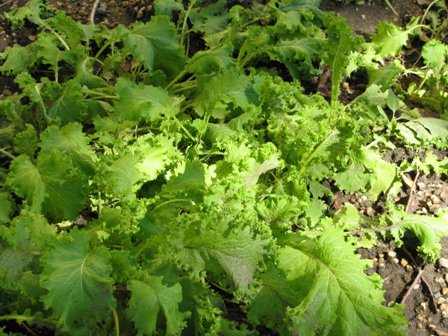
It turns out to be Giant Southern Curled Mustard, which GRIN suggests is Brassica juncea subsp. integrifolia var. crispifolia. This is described as an “old southern favourite,” or words to that effect, by many of the heirloom seed merchants I consulted online. There is also an ethnobotanical record online of the species being used by Native Americans, but only as a medicinal, at least in the book I was able to consult. Perhaps it is a relatively recent adoption.
The revenge of history
Three papers today which look into the role of history in determining patterns of diversity, at the species and genetic level. I don’t have much time today, so descriptions will have to be quick and dirty for now.
In Molecular Ecology, Hoban et al. used microsatellites to genotype 29 populations of Juglans cinerea from throughout the eastern US. 1 They wanted to know whether the observed pattern of genetic diversity was best explained by the spread of the species from refugia after the last glaciation, by its recent dramatic decline due to a fungal pathogen, or by a core-vs-periphery effect. It turned out to be the first of these. One of the consequences is that southern populations are the most diverse, and should be the ones to be targeted for ex situ conservation in the face of the depredations of the fungus.
Meanwhile, over at the Journal of Applied Ecology, Reitalu et al. looked at species diversity in Swedish grasslands in relation to various aspects of management. 2 They found that distance to the nearest historical village was an excellent predictor of grassland diversity, integrating various management variables. Diversity peaked at 1-1.5 km from the nearest village, and declined thereafter with distance. This finding could be used to prioritize grasslands for conservation, and to devise appropriate management programmes, which should involve moderate grazing pressure.
Finally, again in the Journal of Applied Ecology, González-Varo et al. describe a somewhat retro study on the Mediterranean Shrub Myrtus communis in SW Spain using isozymes. 3 Working not only on the actual natural populations but also on progenies, they wanted to know the relative importance of the past and the present effects of fragmentation of populations on fitness. The past effects were represented by the genetic diversity of populations, the present effects by outcrossing rates. In contrast to the previous two papers, they found that the present is a better guide to conservation that the past. It was outcrossing rates that had the strongest effect on the fitness of progenies. The recommendation is for honeybee hives to be controlled in the vicinity of these populations, to foster a diverse assemblage of local pollinators, and thus increased outcrossing.
Great to see very clear conservation recommendations being made in all cases, solidly based on the results. It is not always so.
Amaranth: from pigweed to superweed to superfood
A comprehensive account of the many joys of amaranth from Willem Malten, who has done his fair share of putting the plant to good use. His conclusion:
I propose that we adjust our research, technology and diets and start a more wide-spread processing of the mighty amaranth into food. We potentially have millions of acres of it. Amaranth is a gift and we better learn how to use it.
I’ve done my part in the past, growing amaranths for seed and leaves, and eating both. I see it everywhere in Rome, clogging the gutters and pavements of little-used streets. And that’s the problem; delicious as it is, I’m not ready to rescue it from the deposits of diesel particulates and dog droppings.
Information overload beckons
More reading to do, damn. Thanks to Jacob for finding a pointer to Kyoto Journal’s Biodiversity Edition. It includes a special section on satoyama, a hymn to the attractions of biodiverse diets, and a paean to seedbanking. Among many other things. Meanwhile, there’s also the new issue of Biodiversity Informatics, which focuses on the digitization of natural history collections. When am I going to be able to get any work done?