
Agricultural biodiversity on display for Christmas in a Parisian street market.
Genebanks and climate change adaptation
Gary Nabhan has had a letter published in the Christmas edition of The Economist.
SIR – Your otherwise excellent leader on adapting to climate change was marred by the assertion that people should abandon their “prejudice” against genetic engineering in order to secure food supplies (“How to live with climate change”, November 27th). Although it is true that drought-resistant seeds will be needed—as will low-chill fruit trees and root crops—they are not likely to come from genetic engineering. This is because it can cost up to $5m and take up to 15 years of R&D for each new patented biotech cultivar. It is unlikely that genetically engineered organisms can be deployed quickly enough to respond to climate change.
It would be far more cost-effective to support local farmers in their breeding and evaluation of selected varieties already in community seed banks. The diversity of heirloom seeds offers rural communities far more pragmatic options than the Gates Foundation and Monsanto can generate with all their wealth.
Gary Paul Nabhan
Professor, University of Arizona, TucsonCarol Thompson
Professor, Northern Arizona University, Flagstaff
I won’t comment on the GMO angle, except to say that Gary’s point is debatable. What I wanted to point out is that it’s not just “community seed banks” that house the seeds of adaptation to climate change. 1 National and, in particular, international genebanks will also be important. That’s because the climates experienced by rural communities in the future will increasingly come to resemble those experienced in the past by communities further and further away. Adaptation will lie in other people’s seeds.
Featured: Genebank history
Dave corrects what he sees as a mistake:
IBPGR (founded in 1974) had nothing to do with the recommendation by the CGIAR TAC in 1972 to establish or amplify a global network of genebanks.
If it is broke, fix it
Is more always better? Of course not. The Western Farm Press 2 had an intriguing headline a couple of days ago: “Genebanks increase in importance, number 1,700 worldwide”. The bulk of the article wasn’t really about the number of genebanks, but rather about the Crop Genebank Knowledge Base put together by the System-wide Genetic Resources Programme of the CGIAR. 3 The one thing that Western Farm Press did do was to conflate an increased number of genebanks with their increased importance. I found this particularly odd given a recent piece by Cary Fowler, Executive Director of the Global Crop Diversity Trust, which argued forcefully that 1700 genebanks was almost certainly about 1694 too many. Here’s a taste:
In the early 1970s, the grand old men and women associated with the International Board for Plant Genetic Resources suggested that the world needed 6-7 international genebanks to conserve crop diversity and supply the needs of plant breeders and researchers. This, presumably, was in addition to a few good genebanks already operating. Today, FAO’s registry of genebanks lists 1700 facilities! Were the experts off by a factor of 250? Or do we have a bubble?
It is tempting to equate more genebanks with more and better conservation. But in the case of genebanks, the establishment of more and more facilities has not automatically translated into expanded conservation because (a.) many of those facilities were stocked with samples already being stored elsewhere, and/ or (b.) professional and financial capacity were insufficient to ensure effective conservation over time.
The motivations for establishing so many facilities were certainly positive. Scientists and administrators realized crop diversity was endangered and wanted to save it. But, as political interest heightened, saving something important evolved into shielding it from others. Sharing between farmers, scientists and countries – the very act that lay at the heart of the establishment of the banks – morphed into a negative.
Today, the tiny “network” of genebanks to which the early experts referred provides the overwhelming majority of samples distributed to farmers and breeders. Very little escapes from other collections. Dozens of “important” genebanks have not conveyed samples even to domestic researchers, much less foreign ones in recent years.
Of course I tried to ask the Western Farm Press whether they really thought that the number of genebanks was a measure of their importance, rather than, as Fowler suggests, evidence that people are not taking them seriously. Unfortunately, the WFP website is badly broken, asking me to verify a word that doesn’t appear in at least three browsers on two different platforms. Honestly. Ho hum.
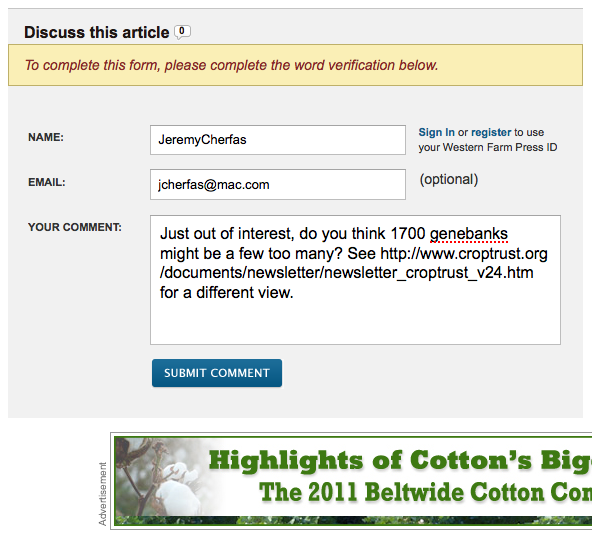
Frankly, it’d be nice if WFP mended its site, although it isn’t exactly a matter of life and death. It’d be much nicer if the global genebank community (for that is what it is, as Fowler reminds us) cleaned up its own act and moved towards the rationally organized system that future food security requires, which is a matter of life and death.
Maize mystery solved
 Joost van Heerwarden and co-workers 4 have solved a problem in our understanding of maize domestication. Previous work had shown that maize originated from Balsas teosinte, Zea mays subspecies parviglumis, a wild species that occurs in low and mid-elevation regions of south-west Mexico 5. This made the Rio Balsas area, where parviglumis occurs, the most likely area of maize domestication. This was corroborated by Piperno et al.‘s 6 discovery of 8,700 years old maize remains in that area; the oldest evidence of maize unearthed to date.
The problem was that the maize land races genetically most similar to parviglumis are not found there. They occur in the Mexican highlands. And that’s awkward, particularly because highland maize has a rather different set of ecological adaptations than lowland maize.
Van Heerwaarden et al. say this is a paradox caused by the role of another wild species: Zea mays subspecies mexicana. This species occurs in the highlands, and it is inter-fertile with cultivated maize. The tricky thing is that because the two wild species, parviglumis and mexicana, both referred to as teosinte, are closely related, more closely to each other than to their cultivated cousin, geneflow from mexicana makes the genes of highland maize look more like those of parviglumis!
This means that you cannot directly identify the most ancestral maize populations from genetic similarity with their putative ancestor. Instead, Van Heerwaarden et al. estimated ancestral gene frequencies from cultivated maize populations, without direct reference to the wild species. And, Bingo! Western lowland populations are indeed more ancestral than the highland populations. Maize did originate in the lowlands, and from there it spread to the highlands and to other parts of the Americas.