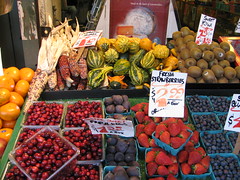
On local greens and homegardens and local greens

ResearchBlogging.orgGreat to see two papers by our friends at Bioversity come out in rapid succession recently relating to two project with which I was marginally connected in their early stages back in the 90s. One is on African leafy vegetables (ALV) 1, a common subject here. And the other on homegardens 2.

The ALV paper tries to measure the impact of the work carried out starting in the mid-90s to identify and address key constraints to production and consumption. This is fairly easy to do in terms of research papers published and MSc degrees awarded, but more tricky when it comes to measuring what ALVs mean to the people who eat them. The authors tried to do this through fieldwork at four sites in Kenya. There’s no doubt there has been an increase in ALV production and marketing during the past 10 years, and a significant change in perceptions about these species, which are no longer considered simply “food for the poor.” Their presence in upmarket Nairobi supermarkets is testament to that. What still needs to be verified is that this is leading to significant nutrition and health benefits.

A particularly poignant aspect of this study was the way it highlighted the importance of one person, the late Prof. James Chewya of the University of Nairobi, in driving the early ALV work, in particular by influencing young researchers to get involved. Jim is still much missed.

The homegardens paper is less specifically tied in to the Bioversity project on this topic which began in the early 90s, being essentially a review of the literature of the past couple of decades. 3 It rehearses the biological features of homegardens, in particular their complexity and diversity, stresses their cultural and socio-economic importance, and describes how these drive each other. The section on the future of homegardens as loci for research and conservation is especially interesting in its juxtaposition of the somewhat different roles of these intensive micro-environments in developing and high-income countries. 4

In developing countries, the nutritional value of local, neglected horticultural species has been assessed and their cultivation in family gardens promoted to guarantee the intake of vitamins and micro-nutrients aiding in the control of HIV infections and other diseases. Establishment of food producing gardens, often based on local seed systems and traditional crops, in areas of explosive urbanization is becoming an important tool for making cities more sustainable while also providing marginal sectors of the population with working opportunities, healthier food and reinforcing their cultural identity.

Well, couldn’t you say much the same of the situation in the US and Europe?

In high-income countries the growing demand for healthier lifestyles and closer connection with nature has driven a renewed interest towards sustainable agricultural systems and ‘‘traditional’’ food products, capable of connecting consumers to the natural and cultural heritage of a community or a geographical region.

True enough, but the ALV experience in Kenya shows that this trend is not confined to places where Slow Food is active. Surely there is more scope for mutual learning.

If there’s one thing that disappointed me a little in reading through these two papers is the seeming lack of cross-fertilization between them. ALV are increasingly common in urban homegardens in Kenya. It would have been nice to see the lessons learned in the course of these two major projects brought together somehow. Maybe something along those lines is in the offing. I hope so. But that is to quibble. It is wonderful to see undervalued species, and the overlooked micro-environments where they often grow, coming into their own.

Protecting the potato one variety at the time

FreshInfo has just published a little piece saying that a foundation has been set up to save potato varieties in perpetuity. Alas, the announcement is behind a registration wall, but it is really too important to keep hidden like that, so I’m reproducing it in full below. There is no link on the article, and nothing on the CIP website or Facebook page. Very strange. You heard it here first.

A new international foundation is being set up to protect potato varieties in perpetuity and is appealing for individuals and companies to show their support and become Heroes for Life.

The Roots for Life Foundation has been several years in the making and launches officially on 1 October. It is the brainchild of chairman and Lincolnshire potato grower Jim Godfrey, working with Dr Pamela K Anderson who heads up the International Potato Centre (known internationally as CIP) in Peru, Canadian grower Peter van der Zaag and Edinburgh bio-technology entrepreneur Simon Best.

CIP holds an in-trust collection of more than 4,000 native potato varieties in its gene bank and Roots for Life hopes to mark this year’s International Year of Biodiversity with its fundraising campaign to protect them.

Godfrey said: “In the genetic biodiversity of these native potatoes lie the answers to food security in a world where climate change, water and land shortages, and an energy crisis threaten global food security. The CIP gene bank is a trust fund for our survival.”

Roots for Life is appealing for Heroes for Life to each donate $5,000 and protect one of the varieties. This will raise some $21 million – less than the amount US consumers spend on French fries each day.

The website will go live on 1 October and the foundation hopes to announce all the heroes in Svalbard, Norway, home of the Global Seed Vault.

“A Wall of Heroes will be built at the gene bank in Lima bearing the names of the individuals, groups and institutions who have stepped up to this challenge for the benefit of future generations,” said Godfrey.

More on the great buckwheat panic of 2010

Buckwheat packets
Stop press: Luigi remembered a photo he had taken 18 months ago.
A month or so after The Guardian first told us about the buckwheat crisis in Russia, Radio Free Europe does a big number on the subject. There’s lots of good stuff in there about buckwheat and the part it plays in national diets and psyches. On the nutrition front, one of the things I remember reading is that although buckwheat is low in protein that protein contains a near-perfect balance of amino acids essential to humans. Unlike most true cereals, it is particularly high in lysine. That balance means that our bodies can make good use of all the nutrition buckwheat supplies in one meal, unlike needing, say, a pulse to make up for cereals’ lack of lysine. And that, as I recall, is why buckwheat is so satisfying and keeps hunger at bay for so long.

What really caught my eye in the article was this:

“It is believed that it was brought to Russia and further to Eastern Europe by Mongol Tatar invaders who first invaded China and knew what buckwheat was. In the Czech Republic for instance, it is called ‘pohanka’ — which means pagan or pagan’s food.”

The English name is supposedly derived from beech, whose seeds buckwheat’s resemble in miniature. But in Italian? Grano Saraceno. How about other languages?

Pavlovsk must go to the ball!

Fred Pearce, “one of Britain’s finest science writers” according to Wikipedia, justified that assessment with what was really quite a good piece on Pavlovsk yesterday. Unlike others, he got everything pretty much right. Well, almost everything. Pavlovsk is not, of course, a seed bank, as the title of the piece suggests, but that mistake is probably down to a subeditor at The Guardian. Particularly impressive was how he tracked down an old report from a USDA germplasm scientist who visited the place in 1975. 5 I’ll leave you with a nice quote:

Crop diversity has always been the Cinderella of conservation, even though the hundreds of thousands of crop varieties bred by farmers and scientists over several millennia represent a hugely important resource.