Also the Nordic Genetic Resources Center (NordGen, formerly the Nordic Gene Bank, NGB) face a thrilling end of the year balance this year. Even after heavy cuts in the operational costs during 2010 (and 2009) the genebank does not expect to be able to meet the budget for the end of the year financial status.
It’s clear genebanks around the world are having a hard time. The poster child just at the moment is Pavlovsk, of course. But we’ve heard lately that Australia’s genebanks are also threatened. And we’ve also been following a similar situation over the past several months at Wellesbourne in the UK. Why is this happening? As chance would have it, I think a couple of recent posts here may hold some clues.
I think, for example, that our failure in the genetic resources conservation community to quantify — or at least communicate — costs properly is not, er, helping. And we still have a long way to go in facilitating the process of getting conserved material where it is most needed. So, maybe we’ve also seen in the past few days the answer to genebank funding. But that doesn’t mean we can ease up on getting our costs straight, and getting our material known and out there, which among other things means sorting out Genebank Database Hell.
Well, there’s another thing. We do also need to admit to ourselves that maybe, just maybe, not all genebanks are necessary. I hope Pavlovsk, the Australian genebanks and Wellesbourne survive and thrive. It will set a bad precedent if they go under, a very bad precedent, and in any case a genebank is more than just brick, mortar and seeds. It’s people and expertise, and we should fight for them. But if it’s not to be, I hope at least the unique material they have been conserving so diligently for so long makes its way speedily and safely to some other home, where its long-term conservation and availability will perhaps be better ensured.
Today’s post at Tasting Cultures on an African-American gourd decorator comes hot on the heels of news of a class on Celtic gourd carving at the Denver Botanic Gardens. Talk about cultural mashups. Oh and there was also the photo I posted a couple of days back. Never rains but it pours. Anyway, if you want to try this at home, be sure to clean the things properly first.
We pointed out recently that the threat to the Pavlovsk Experiment Station’s field genebanks is not, in fact, as unique as it might seem. From Science magazine comes news that “Australia’s seed banks are tumbling like dominoes”. The report details the gradual loss of Australia’s six genebanks.
[I]n mid-2008 a bank in Adelaide holding Mediterranean forages such as alfalfa closed its doors; of its 45,000 accessions, 95% are held nowhere else in the world.
Where have we heard claims like that before?
Part of the article that I don’t understand concerns Australia’s obligations under the International Treaty on Plant Genetic Resources for Food and Agriculture. Is there really a mechanism to prevent free-riders, as the article suggests? If Australia cannot supply seeds from its own genebanks, because those seeds are dead, or no longer exist, will they really be blocked access to other genebanks’ accessions?
The article ends by echoing what is really the crucial point for all genebanks:
Seed banks “need long-term support that is outside grant or research support,” says Megan Clarke, chief executive of CSIRO, Australia’s national science agency and the country’s main supporter of agricultural research.
That is clearly as true in Australia as it is in Russia. And the Australians aren’t even planning to build houses where the genebanks were.
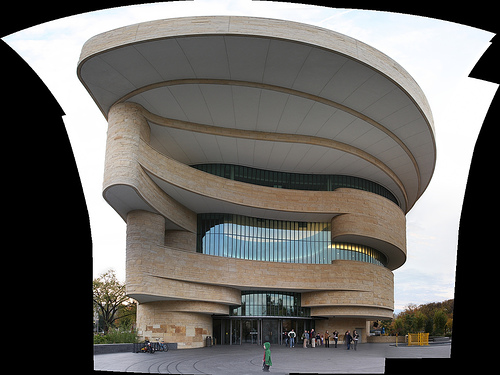
I spent last Saturday morning wondering around downtown Washington DC with a friend waiting for an afternoon flight. The day was bright and pleasant and we took in all the major sights. Including the National Museum of the American Indian, which is a pretty spectacular building on the Mall.
The Museum of the American Indian (photo courtesy of ReverendMungo under Creative Commons license http://www.flickr.com/photos/andynelson/2159713642/)
Apparently, the construction of the museum was partially funded by a large donation from a wealthy Native American tribe in Connecticut, whose casinos are clearly quite lucrative. We didn’t have much time to spend inside, unfortunately, but the outside was interesting enough. And not just for the architecture of the building.
A Native American food garden has been planted along the pavement by the side of the building. You can see maize and squash here on the left.
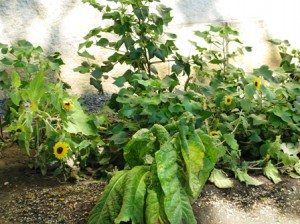
And also tobacco, sunflower and cotton (below).
Further along the pavement there is a nice bit of prairie, with some particularly important medicinal and other useful plants highlighted. All with very informative labels. A really nice idea.
Unfortunately, I couldn’t find anything about this on the museum’s website, so I don’t know whether it is a temporary exhibit or a permanent feature. Anyway, I wonder if the next donation by that Connecticut tribe might be to some of the genebanks which maintain Native American crop germplasm.
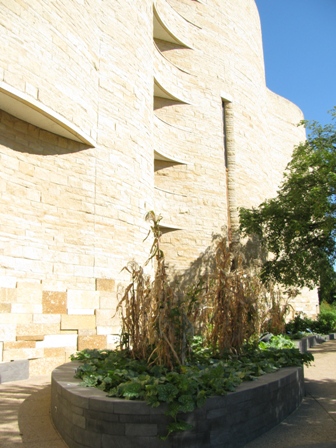 A Native American food garden has been planted along the pavement by the side of the building. You can see maize and squash here on the left.
 Unfortunately, I couldn’t find anything about this on the museum’s website, so I don’t know whether it is a temporary exhibit or a permanent feature. Anyway, I wonder if the next donation by that Connecticut tribe might be to some of the