The wires have been humming lately about a new disease cutting a swathe through Cameroon’s taro crop. It has been in the local news and on ProMed, as “undiagnosed disease.” There’s a discussion about it on PestNet, 1 and some experts think it may be taro leaf blight. There’s a lot of experience on TLB — and resistant varieties — in the Pacific now. They were acquired the hard way, through urgent necessity. Will they be called on to help out in Cameroon?
A different kind of pawpaw
WebEcoist has a nice series of slideshows on “70 Extremely Exotic Plants, Flowers, Forests & Trees.” Kinda silly, I know, but I’m a sucker for photos of weird plants, I guess. Anyway, the one on “Deliciously Exotic Plants, Fruits and Vegetables” puzzled me for a minute because the picture labelled “pawpaw” is certainly no Carica papaya. In my ignorance, I thought the term pawpaw was only ever used as a synonym for papaya. Well, it turns out the fruit in the picture is also called Hoosier banana, and is in fact Asimina triloba. Related to the cherimoya (Annona cherimola), “[t]he pawpaw is native to the temperate woodlands of the eastern U.S. The American Indian is credited with spreading the pawpaw across the eastern U.S. to eastern Kansas and Texas, and from the Great Lakes almost to the Gulf.” There’s a festival devoted to the fruit in Ohio in September. Interestingly, if you search Wikipedia for pawpaw, it sends you straight to Asimina. A Google search also returns mainly Asimina stuff, but if you search images you get a mixture of Carica and Asimina. The dangers of using common names.
Featured: Cassava
Matt welcomes the new word on cassava domestication:
Wow, thanks for that post! I never would have guessed bitterness would be important. It’s a good reminder for all of us not to get too ahead of ourselves in “fixing” other peoples ag problems.
And we’re back …
All spiffed up, cleaned out, and ready to roll. We’ve dumped the rotating pictures, cleaned up the sidebar, and generally oiled the bearings. Comments from almost everyone welcome. 2
AVRDC’s treasure trove of diversity
I was recently at AVRDC headquarters in Taiwan and was quite taken with their demonstration garden. (Among other things. The genebank operation is also impressive, and recovering from a recent unfortunate setback.) It’s a wonderful display of both vegetable diversity and cultivation systems. I was going to blog about it, but then life intervened, or at least work did. Anyway, the latest issue of AVRDC’s newsletter has a piece on the garden, and they have kindly agreed for us to reprint it here, as the newsletter itself is not available online. Which kinda gets me off the hook. The photographs are mine. The following text (and this post’s title) are courtesy of AVRDC.
Although there are thousands of plants people can consume, humanity relies on only a relative handful for food. Indigenous vegetables — whether semi-wild or domesticated — can greatly expand the menu. Grown primarily in their centers of origin or introduced in a given area, indigenous or traditional vegetables provide food in times of scarcity for the world’s poorest people, yet these hardy, nutritious species often are underutilized.
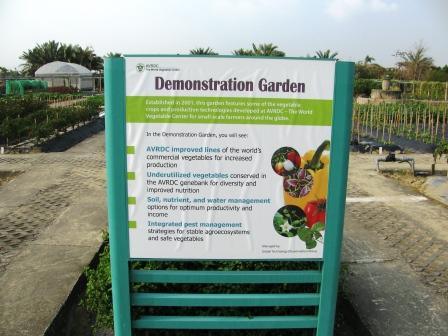
What began in 2001 as an experimental field on the grounds of the AVRDC headquarters campus in Shanhua, Taiwan has blossomed into a 0.63-hectare living example of the mission and work of AVRDC — The World Vegetable Center.
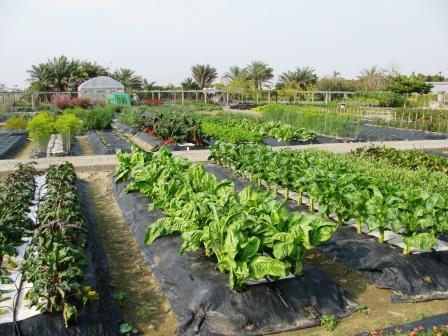
“The Demonstration Garden was designed as an observation plot for indigenous vegetables when we got the project from the Taiwan Council of Agriculture in the beginning,” said Mandy Lin, an assistant specialist in AVRDC Global Technology Dissemination. After 10 years of development, more than 60 different species of indigenous vegetables are cultivated in 200 plots of various sizes and shapes to showcase the special qualities of each species and promote their wider use. The range of species grown also maintains visual interest as the seasons change.
The indigenous vegetables in the garden were selected for three significant characteristics—ease of cultivation (low input), nutritional quality, and resistance to pests and diseases. Visitors touring the Demonstration Garden often are surprised by the number and variety of indigenous vegetables, and the different edible parts, from shoots and leaves to pods and seeds. “We want to convey a simple but principal message to every visitor—that a diverse diet including many different vegetables is beneficial to health,” Mandy said.
In July 2008 the Center’s Global Technology Dissemination group expanded the function of the Demonstration Garden to highlight four major mature technologies: low-cost drip irrigation, starter solution, grafting chambers, and protective shelters. Farmers in developing countries can adopt these technologies to increase yields, improve produce quality, and reduce production costs.
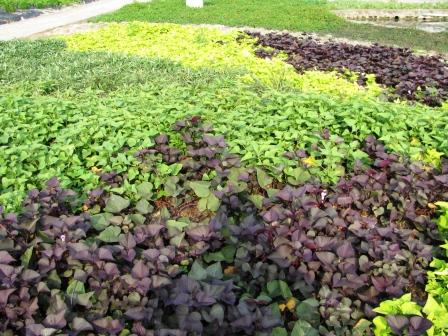
Visitors and AVRDC staff members alike gain new ideas and inspiration as they walk through the garden, enjoy the rich diversity of plants, and see farming technologies in use. As Mandy observed: “You think you are taking care of crops, but in fact they educate you with their beauty and variety.”