It’s probably best not to dig too deeply or dwell too long on the details of fecal transplantation, as Carl Zimmer does in an otherwise fascinating NY Times piece, but it does serve to remind us of the extent to which we depend on the incredible diversity of microbes, and not just for things like nitrogen fixation and fermentation.
Pomological watercolours at the NAL
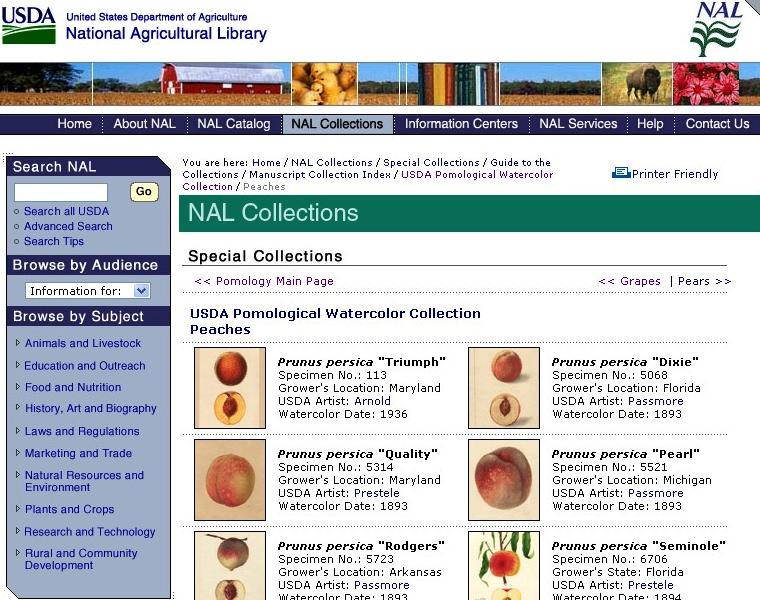 The National Agricultural Library in the US has a Special Collection consisting of watercolours of different fruit varieties. Stunning.
Unbottling the lentil
 It is well known that crops go through a genetic bottleneck at domestication. Due to the founder effect, they typically show a fraction of the genetic diversity found in their wild relatives. Which is bad, but fixable: fixing it is the plant breeder’s job — or part of it anyway. What’s less well known, according to a recent paper on lentils by Willy Erskine and co-authors in GRACE, is that the movement of a crop around the world can also often lead to bottlenecks. 1
Lentil cultivation moved from Afghanistan into the Indo-Gangetic Plain sometime between 7000 and 4000 BC. The authors “reconstructed” this movement by growing random subsets of the ICARDA world lentil collection at two sites, Islamabad and Faisalabad, in Pakistan. Faisalabad is typical of conditions in the Plain, Islamabad is a transitional, mid-altitude environment.
They found that most Afghani accessions did not flower in Islamabad before the local material matured, due to a combination of temperature and photoperiod, the main determinants of flowering in lentils. The few that did were among the most late-flowering in the world. This is probably related to the shift in sowing from winter to spring as lentils moved from their area of origin in lowland SE Turkey and N Syria into the central Asian plateau. The data from Faisalabad in addition showed that every week’s delay in flowering resulted in a 9% loss of yield potential in the lowlands.
So there was strong selection for reduced sensitivity to photoperiod and a return to early flowering as the lentil moved into the Indo-Gangetic Plain, and consequently a genetic bottleneck. 2 But in a way the surprising thing is that there was no cork in the bottle. Where did the genetic variation that allowed adaptation to the Plain come from? The authors note that time to flower in lentils is controlled by both single gene and polygenic systems, and that early flowering is always recessive. Those recessive alleles for early flowering, which may have come from introgression from a wild relative in Afghanistan, must have occasionally come together and been selected for at mid-altitudes, which then “allowed selection for a radically earlier flowering habit as a new adaptive peak for the novel environment of the Indo-Gangetic Plain.”
The challenge is now for breeders to use these insights to broaden the genetic base of the crop in India, where lentil germplasm “is among the least variable among lentil-producing countries for agro-morphological traits … despite its vast area of cultivation there today.”
How many varieties are there in the world, mom?
Back at the day job, we are often asked by journalists and others how many different types, or varieties, of this or that crop there are in a country, or indeed the world. And, with help from our friendly crop experts, we have tried to provide answers. But it is as well to remind ourselves sometimes how slippery the question is. Because, to paraphrase Bill Clinton, it really does depend on what your definitions of “different” and “variety” are. For example, take rice in a particular part of Thailand, as the authors of a recent paper in GRACE did. 3
They looked at 20 accessions of a single landrace, defined as a “geographically and ecologically distinctive population, identifiable by unique morphologies and well-established local name.” That is, these 20 samples, though collected from different farmers and even villages, all basically looked the same, and were recognized as belonging to the same type by farmers, who gave them all the same name — Muey Nawng.
But the authors found significant, non-random, patterned variation within the material, not only in microsatellite markers, which wouldn’t perhaps be so bad, but also in endosperm starch type, days to heading and, interestingly, gall midge resistance. So how many varieties were there among the 20 samples of Muey Nawng? Answers on a postcard, please.
Great Place of Complete Joy, and landraces
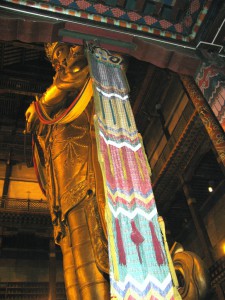 The Gandantegchinlen (meaning Great Place of Complete Joy) Monastery in Ulaan Baatar features a 25 metre tall statue called Migjid Janraisig, “the Lord who looks in every direction.” The original was built in the early 20th century in an effort to restore the sight of Bogd Javzandamba, the eighth Jebtsundamba, spiritual head of Tibetan Buddhism in Mongolia. The statue was dismantled and taken away by the Soviets in 1938, but it was rebuilt in 1996 with donations from the Mongolian people. The statue is gilded solid copper. Well, almost solid. Precious cultural materials are encased within it. Including seeds of dozens of the country’s wheat landraces, according to my friends at the national genebank in Darkhan.