Bruce McF puts that global map of water availability in perspective:
So it might not look like much on the map, but its more than half the Australian population predicted to be faced with high or moderate water stress.
Yikes.
Crops, livestock, microbes, pollinators, wild relatives, agroecosystems, foodways …
Bruce McF puts that global map of water availability in perspective:
So it might not look like much on the map, but its more than half the Australian population predicted to be faced with high or moderate water stress.
Yikes.
James, of the Giant Corn, asks an interesting question:
Do most people who work in the agricultural biodiversity field not like genetic engineering (and even plant breeders)?
This is prompted by his reading of Gary Nabhan’s Where our food comes from, which is about Vavilov and crop diversity and much else besides. James, who is studying for a PhD in plant biology at UC Berkeley, seems to think that the world — or at least Gary Nabhan — has it in for plant breeders and even more so for genetic engineers. I think it is salutary that a plant scientist, someone who has worked on teosinte and it’s more selected form, maize, had barely heard of Vavilov in all his training, and I’m really glad that he has now discovered Nabhan’s book (no matter what he thinks of it) and, more importantly, Vavilov. Here’s part of how I answered his question, in haste:
[T]he greater one’s awareness of agricultural biodiversity, the stronger is the impression that single “breeding” solutions, especially in relation to pest and disease resistance, are inevitably overtaken by the much more rapid evolutionary turnover of pests and diseases. Genetic engineering is even more simple minded than classical plant breeding, transferring just one or a few genes, and is thus even more prone to being overtaken by evolution on the part of the pest or disease. And for nutritional changes, dietary diversity delivers so many additional benefits compared to biofortified staples, that we find it odd that so much money and effort goes into the former and so little into the latter.
In his reply, James talked about stacking resistance genes and high vitA corn (maize) and conceded that both were a lot more work than genetic engineering, especially without molecular markers. My own view, for what it is worth, is that genetic engineering only seems faster. To truly have an impact, the constructs really ought to be put into a wide range of varieties that will thrive in a wide range of conditions. That takes time. So does clearing the regulatory hurdles. And in the end, at least so far, the bottom-line yield gains have hardly been worth sharpening a pencil to write home about.
I am definitely not against plant breeding, nor am I against genetic engineering per se. I do think that genetic engineering has been appallingly managed, has yet to deliver anything of interest to the people who actually have to eat its products (apart from the first ever cleared product, GE tomato paste), and has sucked vast gobs of cash and a few good minds from more interesting and more (intellectually) rewarding science. Other than that, I personally have nothing against it.
In other news: The Scientist Gardener reports that Monsanto’s patent on its first generation herbicide resistant Roundup Ready soybean is about to expire! and suggests that “[w]e’d be even better off (more competition, more disruptive technologies) if we loosened up genetic engineering regulation and let the small guys play”.
Now there’s a thought.
A while ago I was snitty about the pitch for a zero-emission fridge to help farmers in Mozambique to store seeds, because it seemed to be saying that subsistence farmers didn’t know how to save or store their seeds. In the event the proposal did not win one of the World Bank’s Development Marketplace awards. Today’s Development Marketplace blog has good news. The European Commission Food Facility has granted Helvetas US$ 2 million “to establish 90 seed banks benefitting 38,000 families in 300 communities”.
I’m still not sure I fully understand the basis of the proposal, but if the EU gets it, then that’s probably just me. I think than the “fridge” is designed to store next season’s seeds in better condition that whatever techniques the farmers were using before, but there’s also something about helping the farmers “get through the ‘hunger period’,” which is being extended by changing climate. And that’s the bit I don’t get. Were farmers eating their seed stocks before? And how will better storage prevent them eating their seed stocks? Judging from the picture at the DM blog, 90 of those are not going to provide food for 38,000 families, but they might help to provide seed for planting.
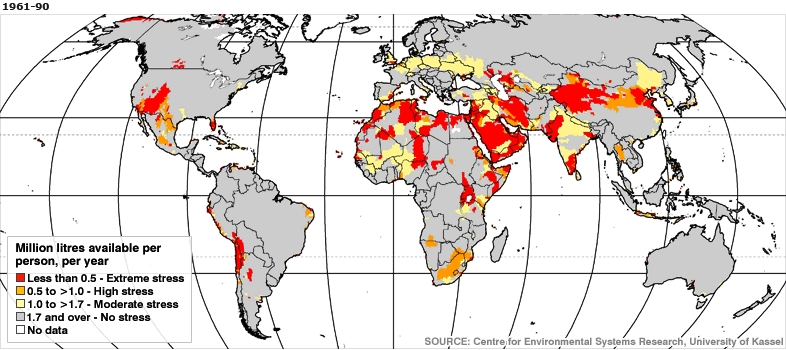
The BBC had an interesting series of maps in December last year on the effects of climate change, economic and population growth on per-capita water availability, based on the work of Martina Floerke and colleagues at the University of Kassel in Germany. Here’s the picture for 1961-90. Red is bad.
And here is the 2070s. Click to enlarge.
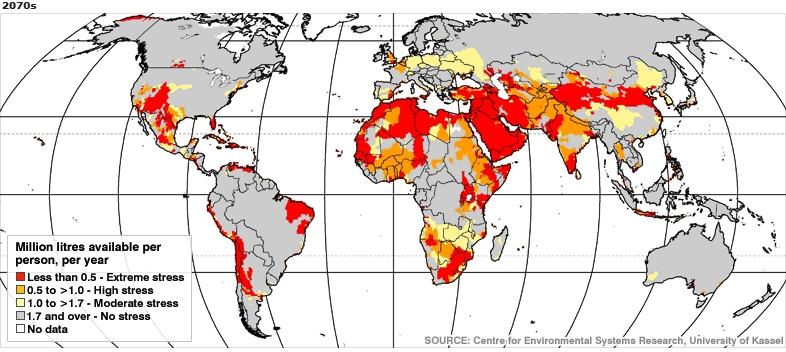
Doesn’t look good, particularly for Central and West Asia, and both southern and North Africa. That’s where your drought tolerant crop varieties are going to come in useful, I guess. And not just that. But I don’t understand how Australia gets away with it so lightly.
6. ACKNOWLEDGES that agrobiodiversity is an important element of biodiversity with significant potential for improving global food security and for climate change mitigation and adaptation, INVITES Member States and the Commission to promote research and capacity development for the sustainable use of agrobiodiversity and ENCOURAGES Member States and the Commission to implement and further strengthen the ITPGRFA;