Do farmers know how to save seeds?

There’s a strange story one hears in various quarters, that small-scale farmers, outside the industrial mainstream, don’t really know how to save their own seeds. We saw it a couple of weeks ago in a comment from Andre, who said that European legislation ensures that “varieties [are] properly maintained and registered and the seed produced according to state-of-the art standards and certified”. The clear implication is that seed produced under any other regime is likely to be defective in some way. I don’t have numbers, of course, but this kind of argument seems to be reasonably common among proponents of high-tech seed breeding. But I was rather surprised to see a somewhat similar argument in a project in the World Bank Development Marketplace, which is busy building to its giddy and exciting conclusion even as I write.

One of the finalists, Helvetas Mozambique, justifies its proposal like this:

“Without access to quality seeds, subsistence farmers practicing rain-fed agriculture continue recycling grain that has been exhausted after generations of cultivation, producing poor yields. …”

To break this cycle, Swiss-based Helvetas proposes what it calls a “zero-emission fridge” consisting of low-cost storage facilities run by community-owned seed banks that “distribute quality seeds of improved crop varieties and serve as a social safety net to benefit 10,000+ rural households”.

What is this notion that grain can become “exhausted after generations of cultivation”? It used to be said of potatoes in Europe, before anyone really understood anything about either sexual reproduction or tuber-borne diseases. And the proof was that if you saved potato fruits and planted true potato seed, the plants were much more vigorous, usually because the seeds did not contain the virus load that plagued seed tubers. Sex reinvigorated the stocks.
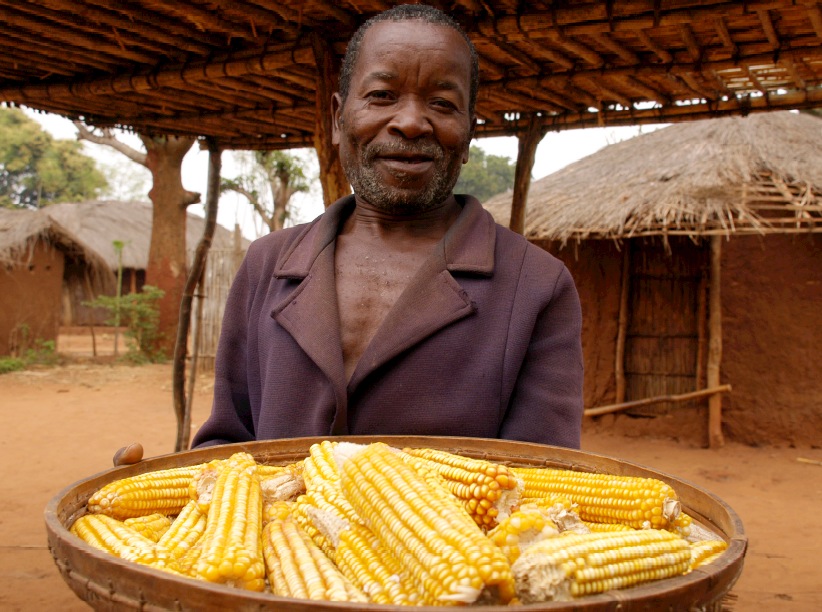
8FC44D73-C968-4BF2-91FB-0EBACA330815.jpg Judging from the picture accompanying the piece on the Helvetas proposal, the grain in question is maize. And maize does indeed suffer from inbreeding depression if seeds from too few individuals are saved, but I’m not aware of any evidence that experienced maize farmers don’t understand this. Does Helvetas have evidence that inbreeding depression is a real problem? Or is it, perhaps inadvertently, promoting a view that one reason subsistence farmers don’t have Swiss bank accounts is that they don’t know what they’re doing?

Looks like we got ourselves a dialectic

Oglio, a third generation farmer eschews modern farming techniques — chemicals, fertilizers, heavy machinery — in favor of a purely natural approach. It is not just ecological, he says, but profitable, and he believes his system can be replicated in starving regions of the globe.

Nearly 5,000 miles (8,000 km) away, in laboratories in St. Louis, Missouri, hundreds of scientists at the world’s biggest seed company, Monsanto, also want to feed the world, only their tools of choice are laser beams and petri dishes.

Reuters anticipates the World Summit on Food Security with the standard oppositional fare.

Featured: Apples

Kanin the Apple Guy speaks:

I guess for me, the old cultivars hold historical significance but also have meaning beyond seedling trees because they were found to be valuable in the past. Rediscovering cultivars in abandoned orchards, experiencing their unique flavors, and speculating on their past utility contribute to the allure to these fruits…

Kanin is the lead author on that “Lost Apples Found” paper, and he has other good reasons too for conserving apple diversity as apples not genes.

Diversity, nutrition and health

If you eat a variety of foods within and among groups – meat, dairy, fruit, vegetables, and grains – you don’t have to worry about nutritional details.

That’s the word from a self-styled “nutrition academic” and you might think, as I do, that that’s all you need to know. But if you’re interested in some of the details, Marion Nestle’s post Are vegetarian diets OK? is well worth spending time on. Far too sensible.

It’s been a good week for the genomes

Cucumber. Tomato. Pig. Horse. A veritable cornucopia of crops and livestock. And from it will doubtless emerge fascinating scientific insights.

  • “[H]orses have a newly forming part in their genetic make-up which shows the evolutionary process in action in a way that has not been seen before.”
  • “[N]ew research applications and innovations at many points in the pork chain.”
  • “[F]ar more is going on in the phloem than anybody … had previously expected.”

(The tomato is just an advanced map; no giant claims there, yet.)

This is really important science, no doubt about it. But I’d like to see a moratorium on claims that any of this is going to improve anybody’s food security. It hasn’t, yet. And personally I doubt that it ever will, but maybe that’s just me. I bought into the dream along with everyone else. Back in 1982 I agreed that cereals would fix their own nitrogen, that photosynthesis would be rejigged to become more efficient, that seed storage proteins would be made more completely nutritious.

The thing is, cereals don’t need to be engineered. It might help, but it hasn’t happened yet and in the meantime legumes are there to take up the slack. Changing C3 plants into C4 plants hasn’t happened yet either, and one has to wonder how much it will help poor farmers in the hot environments that make C4 more efficient. Seed storage proteins have been rejigged; Monsanto built a high-lysine maize, but it vanished more or less without trace because conventionally-bred high-lysine maizes are far cheaper and more attractive to the small-scale farmers who really need better nutrition. Nobody back then was too worried about drought or flooding; tolerance to submersion has now been engineered into rice and could be useful.

Overall, though, I wonder how much more progress might have been made had “ordinary” plant breeding been as easy and attractive as messing about with DNA directly. I also wonder how many surprises like this one are in store:

Indirect costs of a nontarget pathogen mitigate the direct benefits of a virus-resistant transgene in wild Cucurbita

Translation: Transgenic squashes — and almost all of them being grown commercially in the US and Mexico are transgenic — are protected from zucchini yellow mosaic virus. Plants that carry the resistance genes suffer considerably more wilt disease as a result. Hey ho, let’s see if we can add wilt resistance to the mix, shall we?