Lost apples found

It is an incontestable fact that of 7100 named varieties of apples grown in the United States in the 1800s, 6800 are extinct, “no longer to be seen again” according to Cary Fowler.

Or, maybe not.

A press release gives an insight into a study on the Identification of Historic Apple Trees in the Southwestern United States and Implications for Conservation. 1 The bad news is that 11 varieties now account for 90% of all apple sales in the US, with 41% down to a single variety. The good news is that apple trees can live to a good old age, and if the land they’re on isn’t needed for anything else, old trees can still be found.

Kanin J. Routson of the University of Arizona and Ann A. Reilley, Adam D. Henk and Gayle M. Volk at the USDA’s National Center for Genetic Resources Preservation looked at 280 apple trees growing in 43 historic farmstead and orchard sites in Arizona, Utah, and New Mexico. They compared DNA from those trees to 109 known apple varieties that were introduced to the American southwest around the end of the 19th century. The 280 samples harboured 144 different genotypes, 34 of which could be identified with known varieties introduced by commercial nurseries and the USDA. Those 34 covered 120 of the trees. That left 160 trees, and 110 genotypes, with “unique fingerprints that did not match any of the fingerprinted cultivars”.

Of course, some of the unidentified varieties might still be traceable to varieties held in the USDA Apple Collection, not all of which have been DNA fingerprinted. Others could well be seedlings, kept because people valued their fruits. A close look at their fingerprints might reveal parentage. But some, surely, are bound to be lost varieties that once had names. As DNA sequencing becomes cheaper and cheaper, one could hope that even herbarium specimens would be put into the line-up to see whether any of the lost varieties are actually alive and well and holed up somewhere in the American southwest.

Stop Press: Yesterday’s New York Times editorialised on the same subject.
Tracking down rice genetic erosion numbers

So, Olivier de Schutter, the UN Special Rapporteur on the right to food, who teaches at the University of Louvain in Belgium and Columbia University in the United States, has been talking to reporters about the dangers of genetic erosion:

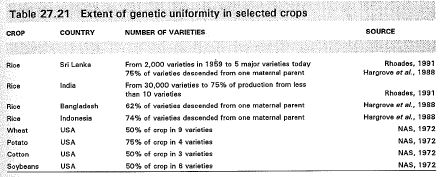
He noted that in Sri Lanka in 1959, for example, some 2,000 varieties of rice were cultivated, whereas today, there are fewer than 100, and some 75 per cent of agro-biodiversity has been lost as a result of the pressure towards to the adoption of uniform improved seed varieties.

We know where the 75% figures comes from, and that it is, frankly, rubbish. What about the other two?

Two thousand Sri Lankan landraces is not implausible. There are 2028 rice landrace accessions in the IRRI genebank, 25 of which have georeferences. So, with various caveats, if I didn’t have any other information, I wouldn’t feel too uncomfortable about using that number for the pre-Green Revolution diversity of rice in that country.

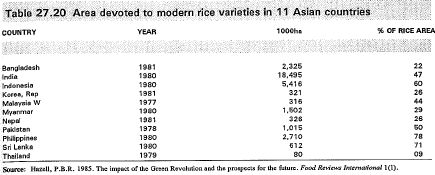
But actually there is other information. The full version of de Schutter’s report, which he kindly sent us, had a reference for the number 2, and thanks to our friend Maria Garruccio at the Bioversity International library we tracked it down. It in turn gives the number as coming from Part 2 of the book “Uses and Values of Biodiversity,” under the section “Biodiversity and Economics,” pages 426-427. The information can be found in a couple of tables.

table2

table1

So that sent us to R.E. Rhoades‘ 1991 article in National Geographic “The world’s food supply at risk” 3 This is a new one on me. Here’s the relevant bit:

In Sri Lanka, where farmers grew some 2 ,000 traditional varieties of rice as recently as 1959, only five principal varieties are grown today. In India, which once had 30,000 varieties of rice, more than 75 percent of total production comes from fewer than ten varieties.

Alas, there’s no reference given for those numbers, but I’m pursuing this further. Prof. Rhoades is not listed as a rice donor to IRRI, though he did work at CIP for some years. But his companion during his trip to Sri Lanka for National Geographic, Balendira Soma Sundaram 4 is, according to IRRI’s databases, a collector of 257 accessions from 3 IRRI collecting missions to that country (1979, 1984, 1988). So he should know.

Incidentally, some 60 improved rice varieties have been released in Sri Lanka since 1964 again according to IRRI’s database. INGER monitors such things.

Not just hungry, sick

While not strictly about agricultural biodiversity (although much more could be made of agrobiodiversity in this realm) Scidev.net draws attention to an editorial in The Lancet. 5 In the run up to (yet another) High Level Summit — this time on Food Security — next week, Scidev.net reports The Lancet’s view that:

Poor terminology adds to the problem — calling undernourished people ‘hungry’ is belittling. Even the term ‘undernourished’ can be confusing to policymakers, says the editorial.

Really? How easily confused those policymakers must be.

It adds that medicalising food — where undernutrition is the disease and food the treatment — could make ensuring food supplies a bigger priority for the global health sector.

Again, because the world has such a good record of delivering global health care to those who need it most?

Climate change gets a namecheck too, natch. And if I sound just a teeny bit cynical, maybe that’s a sickness too.

Oxfam goes to town on the Other Green Revolution

We’ve blogged briefly about how vast areas of the Sahel, far from degenerating, are actually experiencing something of an agricultural rebirth, thanks in some small measure to tree-planting. 6 A post from Oxfam America summarizes some of those efforts, and explains that Oxfam brought some of the people responsible — elevated to eco-hero status — to Washington DC “for discussions with US legislators about local solutions to food insecurity and climate change.” We haven’t noticed any reports of those discussions, but are happy to draw attention to the high impact of local solutions to local problems, especially when they make use of agricultural biodiversity. Thanks to CAS-IP, which has an expanded gloss on Oxfam’s efforts.

CWR at Kew celebrations

Nigel Maxted has just sent a brief personal take on the recent Kew 250th anniversary celebrations to the Crop Wild Relatives discussion group. Here’s a snippet:

Personally I felt the audience was very receptive to the use and need for CWR conservation, but in my view far too many talks outside of the Plant conservation and agriculture session still failed to make the link between conservation and use. I would judge the gulf between the biodiversity and PGR sectors is still a problem that we need to address if we are to have ‘joined-up’ conservation of all biodiversity.

You can download Nigel’s presentation, “A global approach to crop wild relative conservation: Securing our food and agriculture gene pool.” But watch out, it’s a big PowerPoint file.