Mind boggling potato breeding

Tom Wagner explains how he does what he does, kinda, sorta.

Anyway, I had some extra pollen of Nordic October (one of my best reds) and went to a potato seedling growing in a raised bed. I emasculated several buds of the yet un-named seedling and proceeded to tell my neighbor of the pedigree. I said that the original line was CT8406-33, a chacoense/tuuberosum hybrid with slightly blue rings in a purple skinned white flesh potato that was but one of some seedling tubers lines bred for high glycoalkoloids in the foliage to repel Colorado Potato Beetles. This line was either selfed or OP’ed and the result was Red Cat, a red skinned, red fleshed line that had lots of berries. I crossed Red Cat to a male parent called Lenape, a white skinned, white flesh line with high glycoalcoloids. The cross led to the Negro y Azul, a very black/blue skin and fleshed line that saw it’s origin on some certified organic ground off I-5 near Buttonwillow, California. Negro y Azul was crossed to Kern Toro, one of my best reds at that time, a combination of NorDonna and Fontenot. The cross of Negro y Azul and Kern Toro led to Azul Toro, an excellent early blue flesh variety. I crossed the female Azul Toro with pollen from Blue Blood Russet, a cross of Blue Cat and an unknown russet seedling. The resulting cross was named Paint Jar, an inky black/blue with occasional white patches in the flesh. I crossed the Paint Jar with pollen from Dark Red Norland and this created Paint Nor. Paint Nor was crossed with pollen from October Blue, a cross of Nordic October, a red similar to Kern Toro with the exception of additional germplasm from Red October that had ND2912-2R in it….to Azul Toro, previously mentioned. The two seedlings in the raised bed has one I named last week as Mule Skinner Blues. The other had to be named and I thought of Mostly Purple and I serendipitously named it MOSTLY PURPLE as I crossed it with pollen from Nordic October…knowing fully that I had permission to do so.

Federal audit of scientific collections remembers agrobiodiversity

President Bust Bush apparently ordered a review and audit of Federally held scientific collections back in 2005. The report is just out. The article in the Washington Post about this dismisses genebanks in a few words (“rare seeds stockpiled by the Agriculture Department”), but the actual report has a bit more, including a box highlighting the National Center for Genetic Resources Preservation at Ft Collins and making a reference to Svalbard (p 23), and a paragraph on GRIN (p 31). I think that’s pretty good going. The recommendations (starting on p 29) are a fun read. They’re directed at scientific collections of all types in the US — of seeds, herbarium specimens, stuffed animals, rock samples etc. But basically, if you applied them to genebanks globally, you wouldn’t go far wrong.

Mapping our blogging

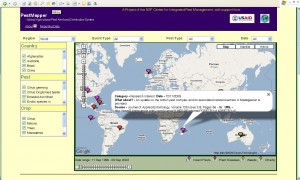
On slow news days my mind turns to things meta. So here’s a map of our agrobiodiversity blogging. You can get a better, interactive one by clicking “Map” up on the menu bar at the top of the page.

blog

Considering we haven’t been geo-referencing from the beginning, I think that’s not too bad a geographic coverage of the world’s agriculture. A few gaps, though. We’ll see what we can do about that.

Is there a natural diet?

A few days ago I wrote a brief post about natural selection and breeding. In essence, can human breeders achieve what natural selection has not, like turn rice into a species that uses the C4 photosynthesis pathway. Ford Denison, whose blog post I was quoting, weighed in not only to agree about C4, but also to point to another recent post of his, The bitter fountain of youth. In this, Denison expands on a paper in which he and colleagues showed that if food is scarce, it may pay 1 to swap early reproduction for a longer life. What has all this to do with agricultural biodiversity?

Because, as Denison pointed out, many components of a diverse diet have tastes and odours that could be associated with times of famine, times when it would be a good evolutionary strategy to delay reproduction and increase longevity.

Past population declines were often caused by shortages of food, which can affect both the amount and types of food eaten. For example, natural insecticides in plants often have an unpleasant taste. Over most of our evolutionary history, therefore, these plants may have been eaten only when preferred foods, like meat or fruit, were not available. Consumption of these “famine foods” would therefore have been a reasonably good predictor of population decline, so they may trigger physiological changes (lower testosterone, etc.) that increase longevity while tending to delay reproduction.

A remarkable result, seen in both nematode worms and fruit flies, is that food odors can reverse the beneficial effects of dietary restriction on longevity (Libert, et al. 2007). If an individual smells food, others may be eating that food, so population size may be increasing. In that case, delaying reproduction would be a losing strategy, even if reproducing now increases the chance of an early death.

What about humans? Our models assumed that individuals reproduce only once, then die, like salmon or soybeans. However, we expect that some of our results will apply to species, like humans, with more complex life histories. One result for humans that is consistent with our hypothesis is that artificially sweetened soft drinks are just as likely to cause metabolic syndrome (related to diabetes) as sugared soft drinks are (Lutsey, et al. 2008). Like food odors, sweet foods may have been correlated, over much of our evolutionary history, with abundance, and therefore with impending increases in population size. If we want to live longer, maybe we should instead eat foods whose chemical composition or flavor remind our bodies of past famines. The health benefits we get from eating vegetables like kale may be due, in part, to the chemicals that give them their slightly bitter taste.

The idea that our preferences and appetites were shaped some time ago is a common one, and in diet gives rise to ideas like the Pleistocene Diet. As Ford commented, his theory suggests a new explanation, for humans, of chemicals plants make to defend themselves against insects, the very chemicals that breeders are trying to increase in some varieties.

Penny, however, was not convinced.

Indigenous diets are often far more diverse in the range of flavors they seek out. They recognize flavors that in the western context, we would interpret purely as smells and include foods that are intentionally bitter, sour, astringent (ie. under ripe bananas), spicey, hot (as in creating heat), rich (oily or high in protein), bland, sweet, salty, pungent (like durian), what we might call foetid or just plain stinky (a sour green sort of smell-taste), and “off” (ie. turned the freshness corner or moulded) along with a few others.

She thinks that the westerners’ preferences are the result of reduced dietary diversity and “corporate food producers and plant breeders making ‘sweet’ junkies out of the city masses”.

Things then get a little out of hand, but I think they’re both correct. It was easy to turn us into “sweet” (and salty, and fatty) junkies precisely because those food elements were rare in our evolutionary history, and so there was no evolutionary advantage to be gained by turning them down, when available. Hence, we don’t know when to stop.

For me, some of the proof of that lies in the fact that indigenous cultures, confronted with a superabundance of sweet, salty and fatty foods are no better than the rest of us at resisting their appeal.

While I’m about it, I wonder how Denison’s idea of bitter tastes being a famine signal relates to the science behind Seth Roberts’ Shangri La diet? Both notions depend on associations being formed between the availability of calories and specific flavours and tastes. Are they even aware of one another? Maybe this post will make them so.

Anyway, my own lunch (bitter, fatty, spicy) calls, so with a quiet “ramen,” I’ll leave the last word to Ford Denison, a genuine, working scientist who is not afraid to blog:

On the other hand, evolution is an ongoing process, so I don’t exclude the possibility that different human groups might respond differently.

Featured: Genetic erosion

After some kind words of encouragement for your faithful bloggers, as they plow their lonely furrow, Pablo unleashes hell on the genetic erosion meta-narrative:

I hope we can finally move beyond the unsubstantiated pseudostats on worldwide erosion of crop genetic diversity, more important and easier to quantify would be how much is being used in production systems where and by whom. Also there is the question of whether it is forever lost or can be recovered or expressed in new cultivars and crosses or in new environments.

As we’ve seen, that quantification of diversity in production systems could be done by looking at landrace names. Or could it?