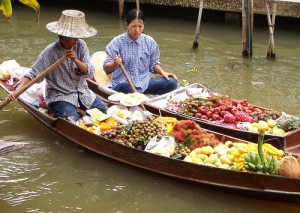
Obligatory photos of agricultural biodiversity in Thai floating market go online to stifled yawns

I’m very ignorant about SE Asia, so I assumed that the famous (or infamous) “floating market of Bangkok” would be in Bangkok, rather than over 100km away. I also didn’t really expect it to be quite the tourist trap it is. Oh well. But they do sell a remarkable variety of fruits, vegetables and other assorted agrobiodiversity there. Go to my Flickr page and leave as many identifications as you can.

3700260331_8d7e5709bb

“Barley-wheat” explained

There’s a National Agricultural Science Museum on ICAR’s the Indian Agricultural Research Institute’s Pusa Campus 1 and I spent an enjoyable hour or so wandering around it during my recent visit to Delhi. One floor takes the visitor on a whirlwind tour of agriculture on the subcontinent from the Neolithic to the Green Revolution. Then you go down some stairs for exhibits on the current state of Indian agriculture. The displays and eye-catching, informative and well-arranged. My only complaint would be about the lack of explicit references to the importance of agrobiodiversity, its conservation and use, for sustainable agriculture, apart from a poster on the Green Revolution. But then the National Bureau of Plant Genetic Resources has its own museum.

Taking photographs was not allowed, so I can’t show you the wonderful diorama of a Mughal garden, and other great exhibits. I do hope the museum goes online sometime. Best I can do at the moment is this scan of the brochure that is handed out as you leave (click to enlarge).
Continue reading ““Barley-wheat” explained”

The debunking of the genetic erosion meta-narrative continues

ResearchBlogging.orgRegular readers will be familiar with our skepticism here at the Agricultural Biodiversity Weblog about the genetic erosion meta-narrative. Not with the fact that genetic erosion has in fact occurred, and is continuing to occur, of course. Just with the notion that it has occurred everywhere, for every crop, to the overall tune of “75% over the past century.” There’s now news of a further nail in the coffin of that hoary myth.

Continue reading “The debunking of the genetic erosion meta-narrative continues”

PBR dedicated to Tony Brown

Volume 31 of Plant Breeding Reviews is dedicated to Anthony H.D. Brown, the distinguished Australian conservation geneticist. Tony has been making fundamental contributions to the theory of crop genetic resources conservation through his work on sampling strategies, core collections and on farm conservation for forty years. But he has also worked tirelessly in the field, as the following little snippet makes clear:

If you happened to be one of the few vehicles driving the remote dirt Peninsula ‘‘highway’’ in Cape York, north Queensland, in July of 1983, you may have seen three collectors (Ted Hymowitz from Illinois and Jim Grace and Tony from CSIRO) sprawled on the lawn outside the Lakeland pub below the billboard saying ‘‘Ice Cold Beer.’’ This was no early knock off; they actually were sampling rare, tiny Glycine tomentella plants. The billboard had nothing to do with site selection; a collector must check all habitats. The roadside pub, a lone building in the rural landscape, was a haven for the thirsty traveler, and it surrounds a haven for wild plants that grazing animals would otherwise decimate. Thus, sampling strategies for germplasm collection adapt to reality.

You can read the full dedication courtesy of Google Preview. Well worth it. You get to know one of the giants of the field, and there’s a refresher course in the history of crop genetic resources and agrobiodiversity conservation thrown in for good measure.
Collecting seeds in Botswana

The Guardian had the nice idea to embed a reporter in a seed collecting trip by the Millennium Seed Bank’s leadership and local partners in Botswana, but the end result is a bit disappointing. Despite Tim Adams’ valiant attempts to bring out the fascination, romance and thrill of plant hunting, along with the logistical challenges and politics of it all, I was just not engaged, I’m sorry to say. Maybe it was the glib, slightly sarcastic, slightly condescending tone. Or maybe I’m just misreading the thing. Maybe I’m just over-reacting to the now ritual comparison of Kew’s operation with the totally different Svalbard Global Seed Vault. Maybe I should just shut up and let you read the piece and decide for yourself.