Frank and the giant peach

While Luigi was getting excited about giant parsley, frequent tipster Dirk Enneking sent word of giant peaches, a much tastier quarry. The great plant explorer Frank Nicholas Meyer traveled widely in the east and sent many collections back to the USDA, his employer. 1 He wrote a wonderful account of his Agricultural Explorations in the Fruit and Nut Orchards of China, published in March 1911 (and, gloriously, available thanks to Google.) Meyer describes the diversity of Chinese peaches, singling one out for special praise.

The best of them all is the “Fei Tau,” or Fei peach, Feitcheng being the name of the village where the orchards are located. These peaches grow to a large size, often weighing over 1 lb apiece, and are of a soft, pale-yellowish colour externally, with a slight blush on one side. The meat is white except near the stone, where it is slightly red. The fruit is a clingstone, with a very large, pointed stone. The skin is very downy. The fruit ripens in the early and middle part of October and has an excellent flavor, being sweet and aromatic. It possesses extraordinary keeping and shipping qualities, keeping until February if wrapped in soft tissue paper. Its shipping qualities are such that it is carried in baskets, slung on poles across the shoulders of coolies, from Feitcheng to Peking, a journey of eight days on foot. So famous is this peach, that it is sent every year as a tribute or present to the imperial court at Peking; and even right on the spot where this fruit grows the most perfect specimens retail at from 10 to 15 cents in Mexican money, a price which is about two-thirds of the average daily wages of the Chinese field laborer.

I want to try one of those! How many of the varieties Meyer mentioned are still available in China?
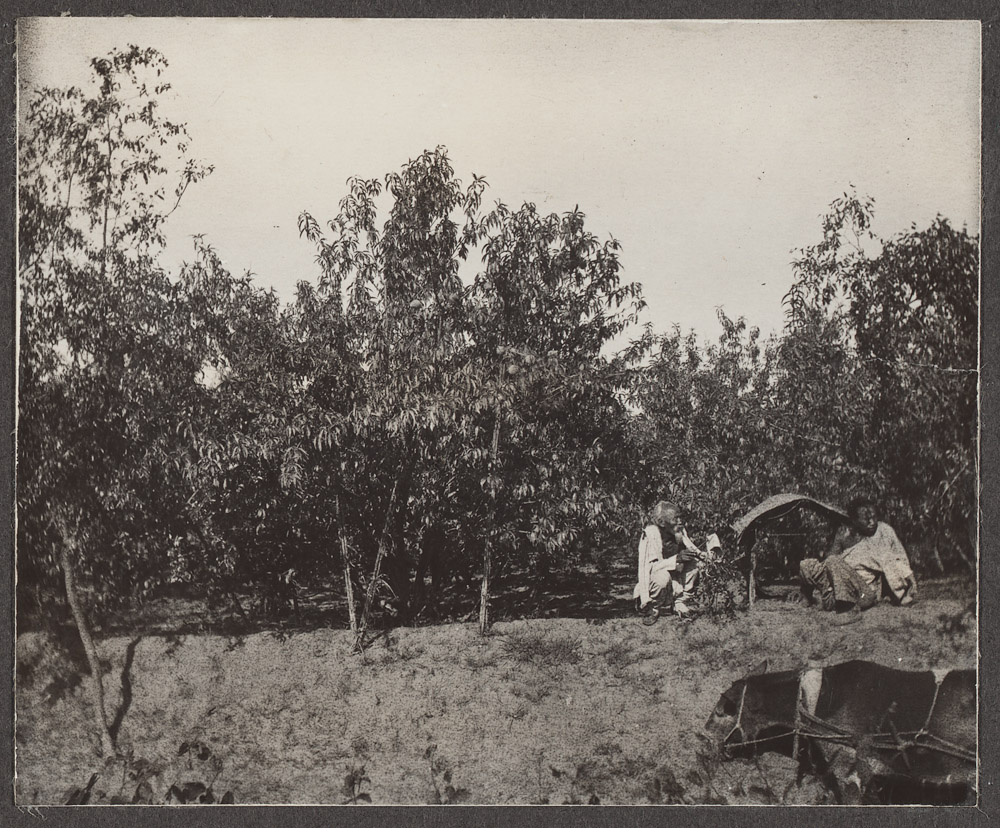
Two men seated in an orchard of Fei Tau peaches (you can see some of the huge fruits in the branches; click to enlarge). Copyright 2004 by the President and Fellows of Harvard College.

Whether you think Meyer’s comment says more about low wages than high prices, the fact impressed Meyer enough to note it. But why were they using “Mexican money”? Meyer describes lots more peach diversity.

Some of these peaches are blood red and when cut through look more like a beet root than anything else. One variety in Shansi is even called the “Rho Tau,” or beef peach, so much does it resemble meat.

He also mentions flat peaches, red and white, which by the sound of it resemble the ephemeral “Saturn” peaches that briefly show up in the fruit-shops of Rome and can perfume a large room with their scent.

Meyer points out that the Chinese genetic diversity had, and in 1911 still has, a lot to offer growers in the US, and that, after all, was his job, to plunder the resources of another sovereign state and bring them back to improve US agriculture. But has anyone calculated the contribution of Chinese peaches like the ones Meyer noted to peaches in the US and elsewhere? It would be a fascinating and tasty case study.

Lewis, Clark, Jefferson and Pawnee corn

Our friend and colleague David Williams remembered a reference to the maize of the Pawnee on reading a recent post and eventually tracked it down.

I found this tidbit about Pawnee corn in the book Undaunted Courage: Meriwether Lewis, Thomas Jefferson, and the Opening of the American West by Stephen E. Ambrose (1996). The author reports on page 418 that, after the intrepid explorers returned from their trip:

Out in St. Louis, the leading citizens were almost exclusively interested in what Lewis had found with regard to Indians and furs. Back east, his botanical and zoological discoveries excited the members of the American Philosophical Society. They wanted seeds, specimens, descriptions. Jefferson promised Benjamin Smith Barton that Lewis would hurry onto Philadelphia after visiting Washington, bringing with him “much in the lines of botany, & Nat. history.” Jefferson kept for himself, to plant at Monticello, seeds of “Missouri hominy corn,” of Pawnee corn, nine “nuts from Missouri,” and two boxes of unidentified seeds. Over the following years, Jefferson faithfully reported on the Indian corn, which he pronounced excellent.

Although the passages in quotation marks were not specifically attributed to their source by Ambrose, footnoted citations for quoted passages immediately preceding and following this paragraph refer to information reprinted in Letters of the Lewis and Clark Expedition, with Related Documents: 1783-1854, 2nd edition, by Donald Jackson (ed.) (1978).

It’d be interesting to delve into those “Letters” to learn more about Jefferson’s “faithful reporting on the Indian corn” that he grew from those seeds, perhaps providing some more specific information about the nature and attributes of that Pawnee corn.

It certainly would. I did some googling and came across this teaser in an article on Jefferson and the plants brought back by Lewis and Clark by Peter Hatch, Director of the Monticello Gardens and Grounds:

“Pani” or Pawnee corn, named for the southern neighbors of the Mandan and Arikara, was planted eight times among the fruit trees in the South Orchard and was Jefferson’s favorite of the Indian corn varieties collected on the journey. A dwarf corn, only 24-inches high, bred for the severity of the short northern Plains growing season, Pani ripened as quickly as six weeks from planting. Jefferson compared it favorably to the short season Quarantine (or “40 day”) corn he received from André Thoüin of the Jardin des Plantes in Paris. The controversial German botanist, Frederick Pursh, who first published the botanical results of the expedition in his Flora Americae Septentrionalis of 1814, wrote that, “it produced as excellent ears as any sort I know.” A similarly dwarf variety, perhaps identical, Mandan corn, was sold by McMahon in 1815.

Do the Pawnee still have this short, precocious variety? Stay tuned…

India clones the buffalo, solves the milk problem

There was a wonderfully informative article on buffalo cloning in Northern Voices Online — tag line: “Connecting Indians Globally” — a few days back. Here’s a few of the interesting tidbits that it serves up (though I haven’t yet verified the information, I should add). A buffalo has been cloned in India for the second time, this one by the name of Garima. The first survived only a few days. India is the world’s largest milk producer (15% of total global production); 55% of that is contributed by buffalo. India’s first cross-bred cow, named Jill, was produced in 1909 at the Imperial Institute of Animal Husbandry Bangalore, by crossing an Ayrshire with the local Haryana breed. And so on.

Now, in such a well-informed and data-laden article, it is surprising not to hear the other side of the story as well. Why not say something about the importance of conserving, continuing to use, and improving local breeds, while all this cross-breeding and cloning is going on? Why not mention the work of the National Bureau of Animal Genetic Resources? After all, it will be a long time before cloned elite buffaloes are contributing to that 55%.

Featured: Genetic erosion

Jacob again, this time on genetic erosion:

Interesting! I have done some digging in this direction. I found that farmers were actually quite conscious about losses, knew the characteristics of the older varieties, but were not regretful about their loss, as these varieties were not resistant to certain diseases…

Read more.

Attack of the Giant Parsley

David Brenner, a curator at the USDA genebank at Ames, Iowa, has just grown what may be the world’s tallest parsley plant.

Brenner says the seeds for the record-breaking parsley plant were first collected from Hungary in 1983. Even though it resembles a large bushy weed, he says it’s a perfect example of parsley. “It also had big tubers,” Brenner says. “The roots are almost four inches across and in Europe, the roots of parsley are another food crop, almost like a potato, so it has a double-barreled purpose.”

The Guinness people have been summoned. The existing record is six feet and this plant is almost eight.

GRIN knows about six Petroselinum accessions collected in Hungary in 1983, from five different villages, and donated in 1987. However, they’re listed as “inactive.” Not for long, I guess. But with the news making it to the media and Guinness on the way, I hope Dr Brenner manages to regenerate a lot of seed. To find out which one of the six the giant is, we’ll have to wait for the characterization data to go online. Look for that “plant height” descriptor…