A different way to conserve coconut

Good news from Roland Bourdeix of CIRAD. His idea for a new approach to the conservation of coconut genetic resources has taken a first important step. Roland wants to find uninhabited, isolated islets around the world and plant each one with a single coconut variety. Think of it: no maintenance costs, no expensive controlled pollinations to preserve the genetic integrity of each population, seednuts whenever you want them. Ok, of course there are drawbacks, but given the costs and difficulties of maintaining conventional coconut field genebanks, it’s worth a try. Roland calls it the Polymotu Project.

Well, Roland now tells us that he has his first islets. Marlon Brando’s family and their company Pacific Beachcomber SC has made available 5 islets from its Tetiaroa atoll. A different Tahitian variety will be conserved on each. As Roland says: “il nous reste encore 45 îlots et vallées à trouver…” Good luck!

Agribusiness at the trough

I’m not fully up-to-date with the latest wiles of industrial agriculture in the US, but I do have the feeling that they are spoiling things for everyone with their subsidies and special exemptions. Fortunately, I can read Susan Schneider’s latest post at Agricultural Law: Agriculture’s embarrassment. She refers to a column by Steven Pearlstein in the Washington Post that lays bare the self-serving antics of the farm lobby, and I’m pretty sure that what happens in the US happens in most other developed countries (but maybe not New Zealand).

Two things seem to be at work here. One is the public view — fostered by all those little-red-barn-and-mixed-livestock-in-the-kindly-farmer’s-yard books for children — that just about everything is fine on Old MacDonald’s farm, and that to thank Old MacDonald for the loving care he takes over our food supply we better give him what he asks for. The other is the reality of industrial food production, which nobody — least of all the food industry — wants anyone to know about.

The eating public — and what does consumer mean, after all? — really needs to open its eyes to what is being done in its name.

Meantime, Susan Schneider has the last word:

The agricultural community should stop to consider not only its own long range interest in climate protection, but to consider the public good that we all need keep in mind in order to address the issue of climate change. And, if it really wants to be selfish, it can also consider the backlash that may well be coming. Pearlman concludes his article with the following:

“The next time the world’s most selfish lobby comes to Washington demanding drought relief, someone ought to have the good sense to tell them to go pound sand.”

An industry so wedded to government support and special treatment should pick its battles wisely.

It is time for the agricultural industry to grow up and acknowledge that there are environmental problems that EVERYONE needs to work together to address.

Some Swiss resisting EU seed juggernaut

We’ve written before about how EU regulations and directives threaten the survival of agricultural biodiversity (and this is as good a place as any to start). Now, alas, the Swiss, in an effort to “simplify trade with EU neighbours,” are planning to emulate their neighbours’ one-size-fits-all approach to regulation and install a certification catalogue of their own.

Can we just remind the Swiss authorities of that old chestnut about those who don’t understand history being condemned to repeat it?

Personally, I have absolutely nothing against seed certification systems, as long as they aren’t monolithic. Customers should be free to purchase whatever varieties they want, certified or otherwise, at their own risk. Anything else is indefensible.

Fortunately, Pro Specie Rara is on hand to campaign against this silliness. We can but hope that the eminently reasonable Swiss will listen to reason, and gain lasting fame among diversity enthusiasts everywhere for more than the cuckoo clock.

Pawnee corn pix

Our friend Karen Williams at the USDA writes:

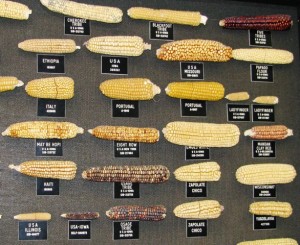
The story of the Pawnee maize is fascinating! You have probably seen the display cases in Beltsville of the collection of maize varieties. Years ago, David and I were involved in getting all the samples photographed. Attached are photos of the 3 samples identified as Pawnee varieties. You are welcome to post these to your blog, if you think they are of interest.

[nggallery id=3]

Unfortunately, the display cases are so old (1930s or earlier) that no documentation on their history exists. We don’t even know who collected them. They predate the NPGS so there are no corresponding germplasm samples.

So lets really push our luck here, and ask whether anyone out there has any information about the USDA’s display case collections?