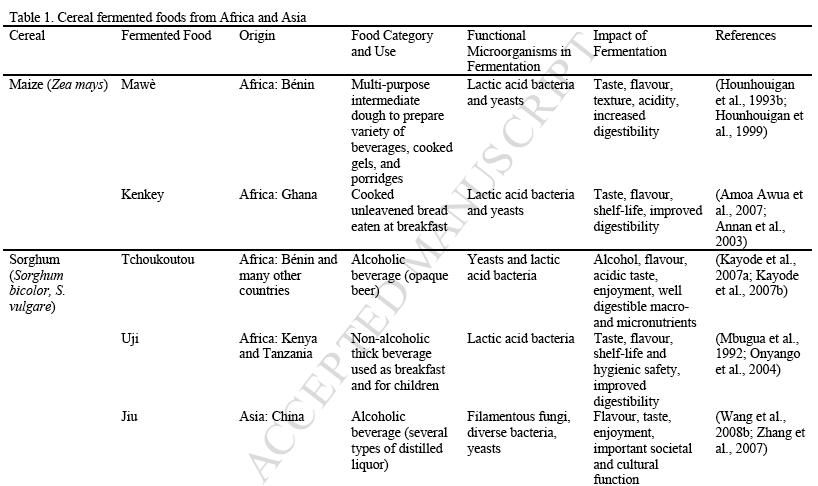
There’s a couple of interesting articles about cereal fermentation in the latest Food Microbiology. Both basically say that fermentation is a useful way of getting more nutrition out of your staples. Rob Nout describes how various traditional fermented dishes are made in Africa and Asia, ranging from kenkey in Ghana to idli in Sri Lanka. The former is made from maize, the latter from rice. Here’s the part of the paper’s Table 1 which lists fermented foods made from maize and sorghum (pearl millet, finger millet and rice are also considered):
It can get complicated. Here’s how they make jnard in India (I’ve removed the references to ease the flow), for example:
Jnard is an opaque beer made from finger millet (Eleusine coracana). Although – judging by its description – it would seem similar to Tchoukoutou, its mode of processing is fundamentally different. Whereas Tchoukoutou is brewed from sorghum malt, Jnard is saccharified by the action of an indigenous amylolytic starter (Murcha) on previously soaked and cooked fingermillet paste. Murcha is a rice-based dried tablet containing a mixed microflora of filamentous fungi, yeasts and lactic acid bacteria, and differs from koji which is a concentrate of fungal conidia of e.g. Aspergillus oryzae, used in the preparation of soya sauce and similar products. The process of preparing Jnard includes an overnight soak of finger millet seeds to soften them, grinding to obtain a crushed mass which is cooked and cooled to about 30ºC. Then, pulverized Murcha is sprinkled in the cooked mass and during a 1-3 day incubation, saccharification, lactic fermentation and alcoholic fermentation take place simultaneously. Functional microorganisms of Murcha and similar Asian amylolytic starters are filamentous fungi (Amylomyces rouxii, Rhizopus oryzae, etc.) which produce a range of enzymes including glucoamylase that degrades starch directly into glucose; yeasts (Endomycopsis fibuligera, Saccharomyces cerevisiae, etc.) which ferment part of the glucose produced; and lactic acid bacteria (Enterococcus faecalis, Pediococcus pentosaceus and others) growing together with the yeasts. LAB are able to co-exist with yeasts in a protocooperative manner.
Continue reading “Forays in fermentation”