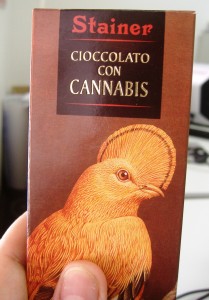
And thanks to Charlotte for a present which brings together two pretty cool bits of agrobiodiversity.
The pedigree of tolerance to submergence in rice
You may remember a post a few days ago about submergence-tolerant rice. Our friends at IRRI have been kind enough to explain to me where the gene in question — sub1 — came from.
I hope I get this right. It seems the immediate parent for IR64-sub1 was from the cross IR49830, which in turn came from the cross IR22385, made in 1978. The source of the gene at the time was a line called FR13A, which was derived from a germplasm accession called IRGC 8887. That was acquired by IRRI in 1963 from India, but with no further passport data.
If you want to get an impression of the complexity of the pedigrees of modern varieties, below is the one for IR64-sub1, with IRGC 8887 highlighted in yellow, thanks to the pedigree visualization tool that IRRI has been developing (click to enlarge).
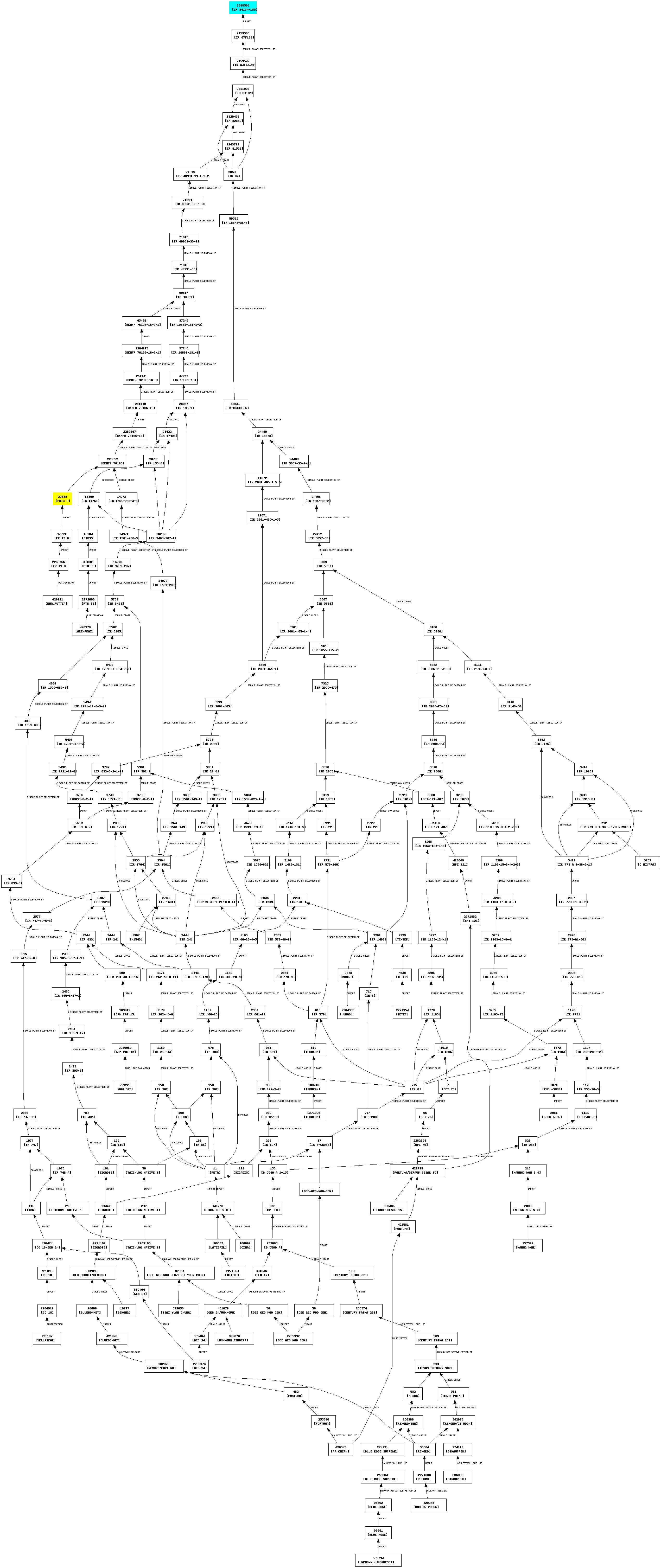
It’s a great illustration of the reason for the Multilateral System of access and benefit sharing being put in place by the International Treaty for Plant Genetic Resources for Food and Agriculture. In a bilateral system, such as the one envisaged by the Convention on Biological Diversity, how would you work out the contribution of IRGC 8887 — or indeed any of the other germplasm involved in the pedigree — to the overall success or otherwise of the final product?
Featured: Wheat domestication
J. Giles Waines clarifies wheat domestication:
“World wide wheat species” do not descend from einkorn wheat Triticum monococcum (AmAm), first cultivated close by Gobekli. The source of the AuAu genome in BBAuAu tetraploid and BBAuAuDD hexaploid wheats is a wild diploid species, Triticum urartu, that was never cultivated as far as we know, nor domesticated. It does grow in the vicinity of Urfa, Turkey, and is more drought tolerant than einkorn. The source of the BB genome that provided the egg of the initial hybrid, and hence the extra genes for mitochondria and chloroplasts is thought to be an ancestor of present day Aegilops speltoides, which also grows near Urfa and Harran.
Plant Conservation Day reminder
Actually, I didn’t even know there was a Plant Conservation Day. BCGI put me on to it. And it does seem to be a celebration very much focused on botanic gardens. But why shouldn’t genebanks and heirloom gardeners and others interested in agrobiodiversity get in on the act too? We’ve got a couple of months to think up things to do…
Iron-tolerant rice
SciDev.net reports on a fascinating trial set to begin in May. Researchers in West Africa have selected about 80 different rice varieties from genebanks around the world. These will be planted in iron-rich soils in four countries: Burkina Faso, Ghana, Guinea and Nigeria to see how they survive. Iron at the levels found in the trial plots would normally kill high-yielding rice varieties. The researchers will be looking for the five best varieties in each plot, and will be assisted in their search by local farmers who have agreed to participate in the variety selection. The best-performing varieties will then be given to the farmers to grow using their normal methods, to see whether they outperform traditional varieties.
An interesting aspect of the trial seems to be that the researchers are not looking for high-iron rice, which might help to address chronic anaemia. They want varieties that will yield well on high-iron soils, even if the rice itself remains iron poor. Increasing the mineral content (notably iron and zinc) of cereal crops remains an important breeding goal, complicated by the arcane relationships between soil levels, genotype, other soil chemistry and, probably, phases of the moon. There is impressive variation among accessions of wheat wild relatives and several methods have already been tried to make high-iron rice, which does actually reduce anemia. There are also traditional rice varieties that are high in iron.